
It looks like you're new here. If you want to get involved, click one of these buttons!
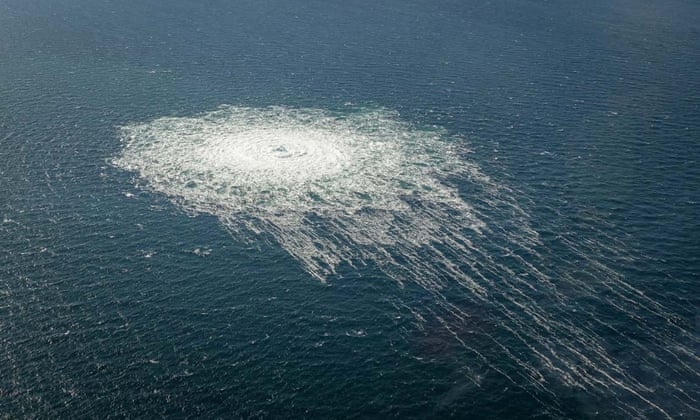
Note: I'm also going to post this as a new topic for those who may not be following this particular thread.Gas is pouring into the Baltic Sea from three separate leaks on the Nord Stream 1 and 2 pipelines amid claims by seismologists in Sweden and Denmark of two sharp spikes in undersea activity, possibly indicating explosions, and speculation about sabotage.
A seismograph on the Danish island of Bornholm, near where the leaks occurred, twice recorded spikes on Monday, the day on which the Nord Stream 1 and 2 gas pipelines underwent dramatic falls in pressure, the German geological research centre GFZ said.
A Danish military flight over the leaks brought back striking images from the ruptures, including one showing an area of bubbling gas a kilometre wide on the sea’s surface.
The seismograph recorded near-silence until just after midnight GMT (2am local time), when there was a spike representing a tremor in the earth followed by a continuous hissing wave form. The pattern was repeated at 5pm GMT.
Amid the speculation over sabotage, suspicion immediately turned to potential culprits – with fingers pointed at Russia, whose pipelines were hit, suggesting a further weaponisation of energy supplies to Europe in the midst of the conflict in Ukraine. Not least it was seen as a possible message about the vulnerability of other marine gas infrastructure.
“There are some indications that it is deliberate damage. You have to ask: Who would profit?” one European security source told Reuters. The Danish prime minister said sabotage could not be excluded. Poland’s foreign minister was more forthright, suggesting that the damage could be an act of provocation on behalf of the Kremlin.
Meanwhile the Kremlin spokesperson, Dmitry Peskov, called the news “very concerning” and said that “no option can be ruled out right now”, including sabotage.
The steel pipe itself has a wall of 4.1 cm (1.6 inches) and is coated with steel-reinforced concrete up to 11cm thick. Each section of the pipe weighs 11 tonnes, which goes to 24-25 tonnes after the concrete is applied.
British sources said they believed it may not be possible to determine what occurred with certainty.
One UK insider speculated that any explosions were unlikely to have been caused by a submarine or underwater vehicle, because their presence would have been detected in the relatively shallow Baltic waters. Sections of the pipelines are between 80 metres and 110 metres deep.
The day of drama began when the Danish energy agency said it had found the leaks on the Nord Stream 1 pipeline north-east of the island of Bornholm, and a third in the Nord Stream 2 pipeline in Swedish waters south-east of the island. “This is not a small crack. It’s a really big hole,” the energy agency said.
Underlining the significance of the event, Javier Blas, an energy and commodities commentator for Bloomberg, described the undersea gas pipelines in the region as one of Europe’s most important strategic assets. “The subsea pipelines linking the North Sea gas fields, and then Norway with the rest of the continent and the UK are among the most strategic assets right now for Europe. High time for maximum protection. Cyber-attacks against energy assets are, too, a key risk for Europe,” Blas tweeted.
A five-mile exclusion zone for shipping has been set up around Bornholm, and flights below 1,000 metres have been banned in the area. Methane, the primary component of natural gas, partially dissolves in water, is not toxic and creates no hazard when inhaled in limited quantities.
“Breakage of gas pipelines is extremely rare”, Danish authorities said in a statement. “Therefore we see reason to raise the preparedness level as a result of the incidents we have seen over the past 24 hours.”
Nord Stream AG, the pipeline operator, had on Monday morning reported an unexpected overnight drop of pressure from 105 to 7 bar in Nord Stream 2, which is filled with gas but was cancelled by Olaf Scholz, the German chancellor, shortly before Russia’s invasion of Ukraine.
A further drop of pressure was reported on Monday afternoon in Nord Stream 1, which Russia shut down indefinitely at the start of September, initially saying it needed repairs.
Since no gas has flowed through either of the pipelines since the start of the month, German authorities have been quick to reassure people that the leaks will not affect its plan to fill gas storage tanks in time for winter.
Environmental NGOs said the leaks were likely to cause large-scale damage to the environment. “As soon as methane in gas form raises from the surface of the sea into the atmosphere, it will massively contribute to the greenhouse effect,” said Sascha Müller-Kraenner of the pressure group Environmental Action Germany.
Russia’s invasion of Ukraine will cost the global economy $2.8 trillion in lost output by the end of next year—and even more if a severe winter leads to energy rationing in Europe—the Organization for Economic Cooperation and Development said Monday.
The estimate by the Paris-based club of advanced economies lays bare the magnitude of the economic fallout from the biggest military conflict on the continent since World War II. Russia’s attack has sparked a surge in energy prices that has weakened household spending and undermined business confidence, particularly in Europe.
Western governments fear that Russia’s order of a partial mobilization and its preparations to annex swaths of Ukraine could prolong the conflict for many months, perhaps years, further fueling the uncertainty now weighing on the global economy.
The OECD expects the eurozone economy to grow by just 0.3% in 2023, with Germany’s economy set to contract by 0.7%. When it last released forecasts in June, the research body expected to see growth of 1.6% in the eurozone and 1.7% in Germany.
The OECD warned that Europe’s economy could suffer an even sharper downturn if energy prices were to rise again. Should natural-gas prices rise by 50% over the remainder of the year, European economic growth could be 1.3 percentage points lower in 2023, while the global economy would grow by just 1.7%.
Such a surge in prices could arise if Europe faces energy shortages over the coming winter, driven by particularly low temperatures. To reduce that risk, the OECD estimates that energy consumption will need to fall by between 10% and 15% compared with recent years.
The cost of supporting households and businesses is pushing government debts higher, and that has led to an increase in borrowing costs that may further weaken growth. To avoid further big rises in debt, the OECD said that help should be targeted at the most vulnerable households.
It estimates that the 35 governments whose policies it tracks have committed to spending roughly $150 billion on broad-based measures to keep prices down through December of this year, compared with around $15 billion on more targeted price measures.
The OECD lowered its forecast for U.S. economic growth in 2023 to 0.5% from 1.2% previously, but said a steeper slowdown is possible if inflation doesn’t fall as rapidly as the Federal Reserve hopes.
The organization expects China’s economy to rebound modestly in 2023 from sluggish growth in 2022 that reflects lockdowns to contain the Covid-19 pandemic. In June, the OECD forecast growth of 4.4% in 2022, but now expects to see an expansion of just 3.2%. For 2023, it projects growth of 4.7%.
“The forecast for this year is for the lowest growth since the 1970s, with the exception of the pandemic,” said the OECD. “Next year, we expect growth that is still significantly lower than has been registered in China for a long time.”
That's a repeat of something that I speculated on a few days ago. In this morning's Wall Street Journal there's a report that suggests that that's actually the case:I'm wondering if the employment/unemployment picture is becoming fragmented. There are many reports of large layoffs in businesses and financial operations which are large-scale operations. But, as Crash mentions, not so much in smaller local businesses, largely retail, restaurant, and other "service" type jobs.
I'm guessing that the overall employment picture may be more complex than is generally being reported. It may be that the reporting mechanisms were not designed to accurately reflect the situation that we have right now, and therefore don't give us sufficient granularity.
The economy is weakening, big companies from Ford to Facebook’s parent are cutting jobs or freezing hiring and inflation is eating into household budgets. Yet for many small-business owners, finding workers is as difficult as ever.
More than one-third of small businesses said hiring challenges had worsened in the three months ended Sept. 1, according to a Goldman Sachs survey of nearly 1,500 small-business owners. Forty-seven percent of them said finding and retaining qualified employees was the most significant problem small businesses faced, up from 43% in the survey released in June.
Nearly 60% of small companies report that worker shortages are affecting their ability to operate at full capacity, according to a September survey of more than 725 small-business owners.
Nearly 80% of small-business owners said they have increased wages and compensation in response to hiring challenges, according to the survey, and another 11% plan to do so. In addition, 60% of small businesses have refined their recruiting strategies, while 46% have boosted employee benefits.
Some small-business owners say they see the job market easing at the margins. William Duff Jr., founder and managing principal of William Duff Architects Inc. in San Francisco, said the firm is getting more applications for junior-level jobs that require six to seven years of experience or less. Senior architects are harder to find, he said. The 30-person firm, which struggled most of the year to fill job openings, handed out raises at the start of the year and again in the summer.
Boudreau Pipeline Corp., based in Corona, Calif., says it has turned down more than $13 million in work this year, roughly 22% of the amount it has been awarded, because it doesn’t have enough staff. The roughly 350-person company installs underground utilities, water, sewer and storm drains.
“It’s frustrating,” said the company’s president, Alan Boudreau, who figures he could easily employ 50 more people. The company has boosted wages by 22% over the past two years and added three in-house recruiters. It offers hiring bonuses of as much as $2,500 and retention bonuses of up to $5,000, provided workers stay at least one year. In early 2021, the company boosted referral bonuses to as much as $1,500, up from $150 four years ago. Referrals are the best source of new hires, Mr. Boudreau said.
In August, Vladimir Gendelman eliminated college-degree requirements from all job positions at his Company Folders Inc., a Pontiac, Mich., maker of custom presentation folders, binders and envelopes. He came up with the idea after promoting his executive-assistant to a job as print project manager, though she didn’t have any skills or training in printing, prepress or graphic design.
“We realized we don’t need an education,” he said. “We need somebody who is learning on their own, somebody who can figure things out.”
*Compare PRHYX and TUHYX. I got into the latter because the former is closed. The ER is .05 cheaper on PRHYX. And it's much more spread-out. Manager tenure is over 3 years now. On TUHYX, Manager tenure is over 9 years.PRWCX PRHYX
Ditto. Caught my attention while scanning a watchlist I keep. VWINX -1.26% / VFINX -1.03%.Bonds were so week today, 9/26/22, that several allocation funds lost MORE than S&P500
© 2015 Mutual Fund Observer. All rights reserved.
© 2015 Mutual Fund Observer. All rights reserved. Powered by Vanilla


