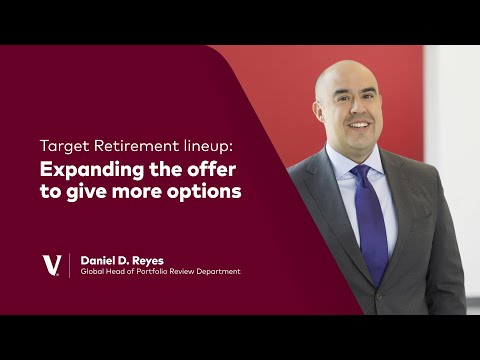
Vanguard Unveils Target-Date Series With Annuity Access "Vanguard, the nation’s leading provider of target date solutions
*,
is deepening its commitment to
retirement innovation through a collaboration with TIAA,
a pioneer and leader in guaranteed lifetime income.
This collaboration brings together two trusted names in the
retirement industry to deliver
a
retirement income solution designed to provide retirees access to a guaranteed income stream for life."
"'
Retirement isn’t one-size-fits-all, and for those who want more predictability,
guaranteed income can provide added peace of mind alongside their savings,'
said Lauren Valente, Managing Director and Head of Vanguard Workplace Solutions.
'In working with TIAA, another mission-driven organization, we’re giving participants
an option to turn a portion of their savings into income they can count on for life.'"
https://corporate.vanguard.com/content/corporatesite/us/en/corp/who-we-are/pressroom/press-release-vanguard-launches-target-retirement-lifetime-income-trusts-120325.html* Source: Based on AUM market share of the TDf industry. Sources: Vanguard and Morningstar, Inc.,
as of September 30, 2025.
Vanguard Unveils Target-Date Series With Annuity Access "The Vanguard Target
Retirement Lifetime Income series follows the same glide path as the flagship funds
until age 55, when it begins allocating to the TIAA Secure Income Account, a savings annuity.
A savings annuity lets you build up money over time and later convert it into an income stream for life
backed by the insurance company. By age 65, the annuity portion will reach 25% of the portfolio,
and investors can decide whether to convert that portion into lifetime income payments.
This series will only be available through defined-contribution plans, such as 401(k)s."
"The TIAA Secure Income Account carries no explicit expense ratio, so total costs are expected to be the same
or lower than Vanguard’s standard Target
Retirement Funds.
Fees start at 0.08% for the mutual fund and can be lower for collective investment trusts,
depending on plan size."
https://www.morningstar.com/funds/vanguard-unveils-first-new-target-date-series-since-2003
Rare Thanksgiving week S@P buy signal So we transition from "Thanksgiving Week Buy Signal" into "Santa Clause Rally"?
S&P is a world of its own as far as I'm concerned. Highly concentrated and buoyed by passive flows into retirement plans. Those flows have been known to slow markedly during down markets adding to the decline. (And if you're out of work during a recession it's unlikely you'll be contributing to the plan.)
I think tech analysis is one good way to understand the markets and may well suggest what will happen a month or even several months out. Longer term? There could be trouble in River City.
Bond Market Retrospective " It is refreshing to have an established bond analyst to discuss the process of exploring various sectors of bonds and their inefficiencies."
But I don't see why we need an "established bond analyst" when we already have FD1000.
Well, if your toilet ain’t working, do you want a
general therapist who claims to know a lot about everything from gutter repair to toasters? Or do you want a dedicated plumber with all the right tools?
"great" post.
Since
retirement I have been in at least 95% bonds. In the last 3.5 years, I have been in 99+%.
The images below, which I copied directly from Schwab, show I made 11.4% since 1-1-2018 and 11. 8% in the last 5 years.
Go ahead and find a bond fund that beat the above performance and never lost more than 1% from any last top.
https://ibb.co/yn39KpsChttps://ibb.co/27w1XV1wMy toilet is flushing pretty well.
Bond Market Retrospective [snip]
If your goal is to earn more with lower volatility, which is where I am since retirement,
then a few principles stand out:
Consider funds from small to medium-sized shops; they often have more flexibility
and can uncover opportunities larger firms can’t.
Newer funds can sometimes perform even better because they’re more nimble.
Don’t obsess over expense ratios; what ultimately matters is performance after fees.
The bond market is unique; certain segments can outperform for only a few months (sometimes longer),
so active trading and tactical skill really matter.
Timing is also critical, especially avoiding major drawdowns like in 2020, 2022, and 2024.
[snip]
For those who haven't listened to the podcast or read the transcript,
I would like to clarify that these "principles" were never mentioned during the extensive conversation.
Bond Market Retrospective Great interview—excellent explanation of why bonds are different and how skilled managers can take advantage of inefficiencies in the bond market.
If your goal is to earn more with lower volatility, which is where I am since retirement, then a few principles stand out:
Consider funds from small to medium-sized shops; they often have more flexibility and can uncover opportunities larger firms can’t.
Newer funds can sometimes perform even better because they’re more nimble.
Don’t obsess over expense ratios; what ultimately matters is performance after fees.
The bond market is unique; certain segments can outperform for only a few months (sometimes longer), so active trading and tactical skill really matter.
Timing is also critical, especially avoiding major drawdowns like in 2020, 2022, and 2024.
I listened to most of the interview, but I didn’t hear much about where to invest now, which is ultimately the guidance most of us are looking for.
CEFs? I only use them when I’m completely out of the market due to very high risk, like in 2022, when they can drop sharply within days. In those situations I trade them for hours. Other than that, I don't touch them.
Stable-Value (SV) Rates, 12/1/25 Stable-Value (SV) Rates, 12/1/25
TIAA Traditional Annuity (Accumulation) Rates
EARLY release! 25 bps increases, except no change for IRA.
Restricted RC 5.00%, RA 4.75%
Flexible RCP 4.25%, SRA 4.00%, IRA-101110+ 3.75%
TSP G Fund pending (previous 4.125%).
Options outside of workplace
retirement plans include m-mkt funds, bank m-mkt accounts (FDIC insured), T-Bills, short-term brokered CDs.
#StableValue #401k #403b #TIAA #TSP
https://ybbpersonalfinance.proboards.com/post/2317/thread
The ‘S&P 493’ reveals a very different U.S. economy Following are edited excerpts from
a current report in The Washington Post:
A few trillion-dollar companies are powering the market’s gains. Here’s what’s happening to most other businesses in the United States.
On its face, 2025 has been a good year for the stock market. The S&P 500 was dragged out of its tariff-induced springtime slump by a small subset of AI-forward power players whose spectacular gains defied an otherwise softening economy. Even now, despite a rocky November, the benchmark index is up more than 12 percent since the start of the year.
A group of trillion-dollar brands known as the “Magnificent Seven” — Alphabet, Amazon, Apple, Meta, Microsoft, Nvidia and Tesla — has been at the forefront of those gains, thanks in large part to corporate spending and intense interest in artificial intelligence. But economists and investors are raising concerns about the companies that aren’t part of the AI investment boom — in other words, most businesses in the United States.
An index that leaves out the seven high-flying tech firms — call it the S&P 493 — reveals a far weaker picture, as smaller and lower-tech companies report lackluster sales and declining investment.
“You have the headwind of de-globalization and tariffs, and the tailwind of AI … those forces are battling to a draw, and in that crosswind you get winners and losers,” said Moody’s Analytics chief economist Mark Zandi. “Anything that is not connected to AI is throttled lower.”
Strip out the Magnificent 7 and the rally looks less impressive
Some experts are worried that the S&P 500, an index of large-company stocks that underpins the fortunes of millions of Americans with 401(k) and other retirement accounts, has become too reliant on the Magnificent Seven; they collectively account for about a third of its value, leaving the broader stock market heavily dependent on the continued success of “the AI trade,” says Torsten Slok, chief economist at the private equity firm Apollo Global Management.
“There is no diversification in the S&P 500 anymore in my view … it is all the AI story now,” Slok said.
Publicly traded small and midsize companies have taken a beating by comparison. The Russell 2000 lost 4.5 percent in the one-month period leading up to Friday, compared with a loss of around 2 percent for the S&P 500. A little more than a third of the companies in the Russell 2000 index either don’t make money or are losing money.
The market’s concentration in Big Tech has also given rise to concerns about what would be left if an AI bubble were to burst. Those fears have been amplified in recent weeks as Big Tech names suffered a modest sell-off, with some analysts raising concerns that the AI industry has overspent on infrastructure at a time when the technology’s actual profit-generating potential is still nascent.
Tech stocks have endured a series of rocky sell-offs since late October, with the tech-heavy Nasdaq index falling around 7 percent from its Oct. 29 peak. Markets rebounded Friday, with the index trimming some of its losses from earlier in the week.
Slok, the Apollo economist, says he is particularly worried about the recent AI losses because so much of the recent economic growth has been shored up by free-spending wealthy households. A deep correction in AI stocks, if it ever arrived, could threaten the “wealth effect” that is doing so much to prop up the economy, Slok warned.
Anyone talk investments with friends? ”our guy says we are doing great "
That raises an interesting question. Assuming this is for someone in retirement, what would ”doing great” mean YTD?
Someone sitting 100% in cash would think 5% YTD is “great.”
Playing in longer dated CDs …. maybe 7%?
With 100% in a balanced fund 10% might appear “great.”
For an actively managed broadly diversified portfolio +15% might be “great “
With an hefty exposure to gold / precious metals, +30% YTD might represent “great”.
Disclosure: My performance has not been “great”, but is OK. I’ve managed to step on my own toes a few times this year.
I think most people would be even hard pressed to answer what they meant by "doing great". and that might be fine. it could be, we set up a plan and we are on track. but IMO its unfathomable to me to leave that to trusting a person who even though is maybe bound by some fiduciary "code", really can have whatever motives they want.
In most of my circles, most people think their advisor is staring at candlestick charts shouting "buy" "sell" into a phone all day long and had their finger on the pulse of the market and is beating the pants off the market. So when they say "great!" they usually think they are beating some benchmark because their guy is uniquely intelligent enough to position them in that way.
Anyone talk investments with friends? ”our guy says we are doing great "
That raises an interesting question. Assuming this is for someone in retirement, what would ”doing great” mean YTD?
Someone sitting 100% in cash would think 5% YTD is “great.”
Playing in longer dated CDs …. maybe 7%?
With 100% in a balanced fund 10% might appear “great.”
For an actively managed broadly diversified portfolio +15% might be “great “
With an hefty exposure to gold / precious metals, +30% YTD might represent “great”.
Disclosure: My performance has not been “great”, but is OK. I’ve managed to step on my own toes a few times this year.
Anyone talk investments with friends? IMO even bogleheads invest very different from each other surprisingly.
Most of my friends don't care or pay attention to anything around investing or retirement.
that said they know i pay attention and have asked me for information here or there. I have a few books that i recommend or lend out. most of the time even if they read them, it doesn't bring about much discussion. or we'll talk about it.
whats funny is that I know pretty well about half a dozen financial advisors and even they don't like talking shop. The one friend who is largely a insurance salesperson moreso an advisor and I have pretty great conversations because he is genuinely curious and feels like he's been led astray somewhat by the industry he's in.
The guys that taught me were older gentlemen. they loved talking this and its what got me to start paying attention.
people want conversations around 10X'ing on some stock, nobody wants to talk about what trowe price, vanguard, or capital group is doing in the world of mutual funds and ETF's.
Lazard Global Equity Select Portfolio will be liquidated https://www.sec.gov/Archives/edgar/data/874964/000093041325003441/c114414_497.htm497 1 c114414_497.htm
THE LAZARD FUNDS, INC.
Lazard Global Equity Select Portfolio
Supplement to Current Summary Prospectus and Prospectus
The Board of Directors of The Lazard Funds, Inc. (the “Fund”) has approved the liquidation of Lazard Global Equity Select Portfolio (the “Portfolio”).
No further investments are being accepted into the Portfolio, except for investments by certain brokers or other financial intermediaries or employee benefit or
retirement plans (acting on behalf of their clients or participants) with pre-existing investments in the Portfolio pursuant to an agreement or other arrangement with the Fund, the Distributor or another agent of the Fund regarding Portfolio investments. Promptly upon completion of liquidation of the Portfolio’s investments, the Portfolio will redeem all its outstanding shares by distribution of its assets to shareholders in amounts equal to the net asset value of each shareholder’s Portfolio investment. It is anticipated that the Portfolio’s assets will be distributed to shareholders on or about December 30, 2025.
Prior to the liquidation of the Portfolio, depending on the arrangements of any broker or other financial intermediary associated with your account through which Portfolio shares are held, the Fund’s exchange privilege may allow you to exchange shares of the Portfolio for shares of the same Class of another series of the Fund in an identically registered account. Please see the section of the Prospectus entitled “Shareholder Information—Investor Services—Exchange Privilege” for more information.
Dated: November 13, 2025
Please retain this supplement for future reference.