
Howdy, Stranger!

It looks like you're new here. If you want to get involved, click one of these buttons!

Here's a statement of the obvious: The opinions expressed here are those of the participants, not those of the Mutual Fund Observer. We cannot vouch for the accuracy or appropriateness of any of it, though we do encourage civility and good humor.
  • A Look At The Current State of the Economy ( & Markets) and Where They May Be Headed -- Heisenberg
    This article provides a useful look at the current situation and possible future trends. (Some may find it useful to glide around the more dystopian/dramatic references in the article.) Here are a few excerpts:
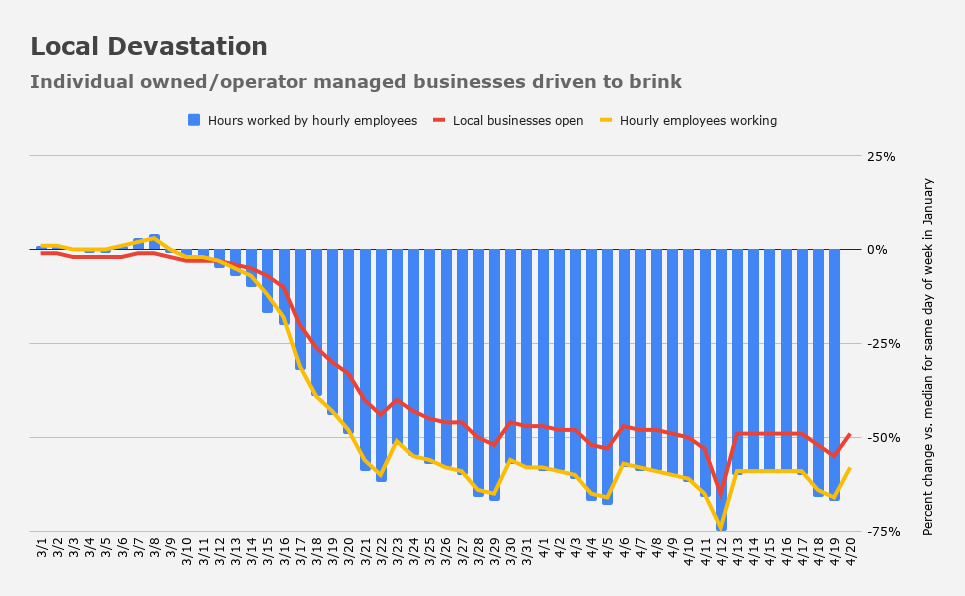
    The manufacturing sector hasn't completely rolled over yet, but the services sector simply ceased to exist starting late last month.....The message is clear: Main Street isn't just hurting, it is disappearing in a very literal sense. As Atlanta Fed boss Raphael Bostic warned earlier this month, "May is going to loom large, in terms of the transition of concern from this being a liquidity issue… to this perhaps translating and transferring into a solvency issue, and whether companies can exist at all."
    image
    (...from Homebase, a scheduling and time tracking tool used by more than 100,000 local businesses covering 1 million hourly employees.)
    .
    .
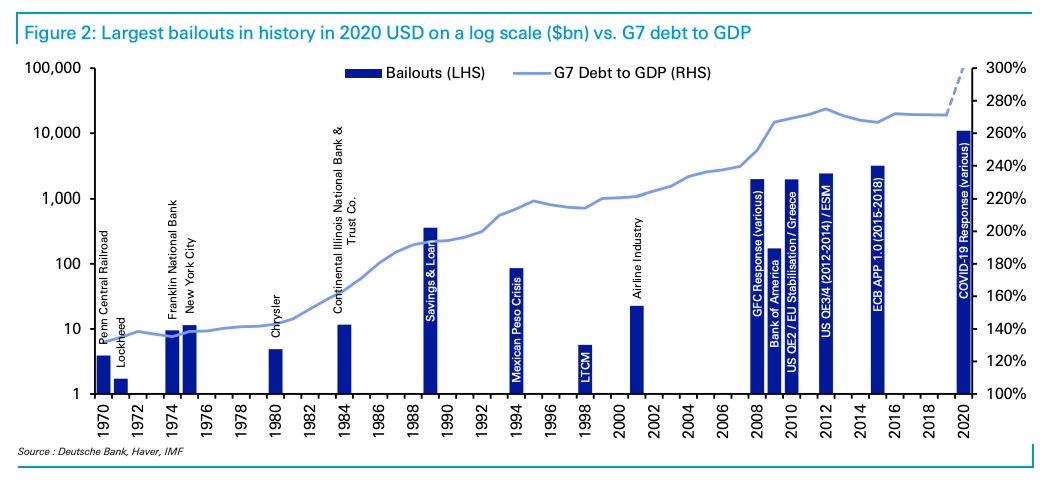
    Deutsche Bank rolled up the fiscal and monetary support programs announced and implemented in the US and Europe into a single "bailout" figure. The sheer size of the COVID-19 response necessitated a log scale (on the left axis) in order to help "better identify the earlier bailouts and get a rough feel visually for the numbers," as the bank put it. ....."Obviously we won’t know how much will be used until much further down the road," the bank cautioned, in the course of presenting the numbers and accompanying visuals.
    image

    ....policymakers have been deliberately suppressing volatility, compressing risk premia, tamping down credit spreads and keeping the market wide-open for borrowers for the better part of a decade....
    Deutsche Bank's George Saravelos.....At the extreme, central banks could become permanent command economy agents administering equity and credit prices, aggressively subduing financial shocks. With unlimited capacity to print money, central banks have unlimited capacity to intervene in asset markets too. Put simply, a central bank that pegs bond, credit and equity markets is highly likely to stabilize portfolio flows as well.
    https://seekingalpha.com/article/4340027-dystopia-now
  • Updated Trinity Study for 2020 – More Withdrawal Rates!
    Using tools like Portfolio Visualizer (click on
    metrics tab) an investor can review historical data on the safe withdrawal rate of their portfolio. For example a portfolio of 100% PRWCX would have a "Safe Withdrawal Rate" of 10% and a "Safe Perpetual Withdrawal Rate" of 5.6%. The rule of thumb for a Safe Perpetual Withdrawal Rate is 4% according to the Trinity Study (linked below).
    Understanding these concepts is an important element of "safely" deriving a portion of one's income in retirement over a time frame of 30 - 50 years.
    From the Article:
    First, I wanted to see how this was working with recent stock market returns. The original study was only covering years up to 1995. I wanted to have more recent data. I wanted to make sure that the results were holding with more recent stock market behavior. So this simulation will cover returns until the end of 2019!
    Secondly, the original study was only covering up to thirty years of retirement. I wanted to be sure that the portfolio can sustain withdrawals for much more extended periods. For people retiring early, I think that 50 years is not unreasonable.
    The Trinity Study:
    https://thepoorswiss.com/trinity-study/
    The Update to the Trinity Study for 2020:
    https://thepoorswiss.com/updated-trinity-study/
    Here's a 4 Part Series on the Topic.
    Part 1:
    safe-withdrawal-rates-guide-part-1-background.html
    Part 2:
    https://fiprofessor.com/2019/07/14/safe-withdrawal-rates-guide-part-2-enough-data.html
    Part 3:
    https://fiprofessor.com/2019/07/21/safe-withdrawal-rates-guide-part-3-more-bootstrapping.html
    Part 4:
    https://fiprofessor.com/2019/07/27/safe-withdrawal-rates-guide-part-4-perpetual-rates.html
  • When it comes to alloaction funds___
    Hi guys. Another asset allocation fund that I like ... but, do not own is SFAAX. They use to be more transparent with posting their positioning but now they just list their baseline asset allocation as a 40/60 (bond/stock) portfolio. However, I know it gets jockeyed from time to time based upon the manager's read on the makret. I have learned that its stock allocation can range from a low of 45% upwards to a high of 75% while its bond allocation can range from a low of 25% to a high of 55%. It is another fund that has performed well in this recent stock market downdraft. In checking it's performance I'm finding that it is down year to date by -2.65% with a ten year average total return of +9.39% as of 4/24/2020. And, as I write, it is off it's 52 week high by 6.68%. In comparison, the S&P 500 Index is off its 52 week high by 16.2% with a ten year average return of around 11.0%. With this, the fund does employ and offer some downside risk measures while providing excellent returns for an asset allocation fund.
    MFO list this as a moderate asset allocation fund with a risk level rating of 3 and with a performance rating of 5. And, yes it made MFO's Honor Roll.
    Anybody on the board own this fund? If so ... perhaps, you would be willing to report its positioning from its latest shareholder report? And, make some additional comments. I'd be most interested in learning of your comments and thoughts.
  • Get Ready for the Return of Inflation Fed actions have increased...money...at a blistering rate
    Although outside of the topic of this thread, but in reply to the block quote:
    @Crash
    You noted:
    "And we should not have to invest in JUNK in order to get a decent income stream, each month..."
    You don't have to invest in a high yield bond fund for your mission.
    Keep in mind with what I write, that I am a total return investor. Be it equity, bonds or a combination. Total return, is what really matters to compound one's money over time.
    You are desiring to chase higher yield to have a decent income stream; I look towards chasing bond yield when it is headed down, which equals "price performance and profit" for the total return view.
    Depends on how one views income stream and from where it arrives, yes?
    You view that income stream comes from a monthly distribution of "yield"; likely from a bond fund investment.
    I view income stream (when needed) to arrive from which ever fund holding I choose.
    I'll use FBALX as an example, and presume all of the money we have actively invested, is in this fund. So, at this date; one has about a 70% equity and 30% bond portfolio. Perhaps a bit hot to the equity side, but any other balanced fund may be substituted, as with VWINX. The main point being, that long term performance of either fund is decent.
    FBALX doesn't have a monthly distribution, only quarterly for the bond portion and semi annual for cap. gains; and the yield is only 1.7%. These don't matter; as the focus is long term total performance of the asset.
    If one wants or needs a monthly distribution from this fund; the desired amount of FBALX is sold, which automatically moves to the Fidelity MM account and then transferred to the existing, linked credit union account. Magi-co within a few days time.
    Well, just another view of the process of not really needing a bond fund that provides a monthly distribution to obtain the monthly cash flow result.
    NOTE: I recall your monthly monies are coming from within an IRA, if so; you're already meeting part of the annual RMD.
    My 2 cents worth.
    Catch
  • 7 Twelve portfolios using NTF network mutual funds and ETF's
    Hi Everyone here,
    Recently I came across Online 7 twelve portfolios &
    got interested due to its Brokers specific Fidelity 7Twelve Portfolio with NTF network funds & Etf's.
    They also have Vanguard or Schwab network portfolios.
    Have you heard or Used The 7Twelve Portfolio before?
    How's Performance & tracking with Fidelity in 2019 to April 2020?
    http://www.7twelveportfolio.com/Downloads/7Twelve-Model-Intro.pdf
    It's by Craig L. Israelsen www.7TwelvePortfolio.com
    and with12 NTF mutual funds, utilized in the 7Twelve design can be index funds or actively managed funds.
    You can build the 7Twelve model in an IRA account, 401(k) account, regular investment account.
    All 12 funds are equally weighted in the “core” 7Twelve model (each with an allocation of 8.33%).
    The equal- weighting is maintained by periodic yearly rebalancing.
    'There are also three “Age Based” versions of the 7Twelve model that progressively reduces the risk of the portfolio.
    Anyone familiar here or have implemented it using Fidelity's NTF funds?
    What Do you think
    Thanks.
    Majick
  • When it comes to alloaction funds___
    @linter. Thanks for your question. I hold a good slug of CTFAX in my taxable account. Overall about 65 percent of my investments are held in taxable accounts since I have been an investor for the past sixty plus years from the age of twelve. And, simply stated ... I feel I'd be buying the distribution if purchased now. Yesterday, CTFAX sold down equities from an allocation of 70% to 40%. This sell activity will no doubt result in a sizeable capital gain payout in the upcoming June distribution.
  • When it comes to alloaction funds___
    Hi guys, I keyed all of the ticker symbols that Catch22 used in his graph into my fund analysis & review sleeve with fund performance numbers through 04/23/2020. I looked at each fund for its 1 month return period, a year to date period, a one year period, a three year period, a five year period, and a ten year period. For each period the best performing fund was awarded three points, the second best two points and the third best one point. For this study the best performing fund was PRWCX with a total of nine points. The second best was VLAAX with a total of eight points. And, the third best was CTFAX with a total of seven points. Interesting, there was only one fund that had positive returns for all periods and that fund was CTFAX.
  • QCD Rollover?
    Hard to find anything on point since, as the quote below suggests, nothing explicit exists. Still, FWIW:
    Furthermore, although qualified charitable distributions (QCDs) can be used to satisfy your RMD, I believe that you cannot make a rollover contribution using those funds. To be a qualified charitable distribution, the assets need to be paid directly to the charity. However, in order to begin a rollover contribution, the funds must be paid directly to you so they are under your control. Thus, even though I cannot find an explicit ruling on the matter, I believe any QCD already taken in 2020 will also be final.
    https://www.marottaonmoney.com/if-you-act-fast-you-can-undo-your-2020-rmd-thanks-to-the-cares-act/
    That's from the COO of a fee-only wealth management firm. Hardly authoritative, though it is coherent. If I found anything to the contrary containing more than a bald assertion, i.e. with some rationale, I would post that as well. This is all I've found to date.
    Let us know if your rollover passes muster.
  • M* switches their risk rating on Canadian banks to HIGH. (Additional post, now)
    Steve Eisman. One of the "Big Short" guys from '08-'09: "...Eisman did not specify which U.S. banks he was long. He also said “some” European banks would make for good short positions along with Canadian banks..." (Shorts???)
    Eisman reckons the biggest US banks would be a good play..... Here's the link: (CNBC.) https://www.cnbc.com/2020/04/23/big-short-steve-eisman-likes-the-big-us-banks-after-coronavirus-sell-off.html
    ______________________________________________________
    In addition: “The Canadian banks, I think, have not had a credit cycle in literally 30 years. They are not prepared for it and they’re going to have real problems,” he said, without specifying which banks he was betting against..."
    *** Please, can someone translate that for me? Thanks.***
  • Investing in an inflationary environment
    Inflation? My starting point, from decent definition: Inflation is a measure of the rate of rising prices of goods and services in an economy. Inflation can occur when prices rise due to increases in production costs, such as raw materials and wages. A surge in demand for products and services can cause inflation as consumers are willing to pay more for the product.
    Obviously, there are several common areas that may cause broad inflation. Broad inflation, however; may be impacted more from some select sectors and how these sectors affect an individual household, IMHO. Example: While both personal healthcare needs (insurance, meds, etc.) and technology (computers, smart phones) are of great benefit for a household; their inflation paths likely have a bigger bang for the buck, over time. We have supplemental health insurance through United Health....it's expensive, well; until you need it. So, the offset, to pay for the insurance could be to buy United stock or a healthcare fund that has United stock as part of the portfolio. We may think the insurance cost is way out of line, but if this is the case; then holding the stock/fund should be of benefit and effectively the profit will pay for the premiums over time. As for technology and the consumer side, is that one has been able to upgrade, if desired; the ability of the product.......computers, smart phones, flat screen televisions, etc. If one has been investing in technology over the years, the likely profits have more than paid for the tech. upgrades one desires.
    Investing in growth should provide, over time; enough to overcome broad inflation. Though a S&P 500 investment product should provide for growth too, as a reflection of the economy; for us, there remain sectors in the S&P 500 which we do not choose to invest, although this investment offers diversification. There are numerous quality growth funds, etf's or sectors within the growth area, to choose. Healthcare and tech. are ,of course; subject to their own problems with performance over time periods.......as in legislation that may affect profits, etc.; or too expensive and the big money takes profits and runs to another sector. Such, is the nature of all investing, eh?
    OPPS, ADD: CPI (gov't. only data) 1971- April 10, 2020 = 537.3% AND Jan., 1999 - April 10, 2020 = 54.5%
    NOTE: Our investment portfolio is fully tax deferred (IRA's), so we do not have to be concerned with buys/sells or capital gains when moving our investments. Taxable accounts will have other considerations; although long term investing in growth should not be set aside for this reason, IMHO.
    My 2 cents worth.
    The below chart is a line graph, for an easier view of returns; click the lime green/red icon at the bottom left of the chart screen for a bar graph. You may return to the line graph when clicking the icon adjacent.
    This CHART starts at Jan. 4, 1999 comparing FSPHX, FSPTX and the S&P500.
    Take care of you and yours,
    Catch
  • Fed Trying To Contain Zombie Apocalypse It Created -- Ed Yardeni
    This is an interesting look at what the Fed has been doing in recent weeks.
    Creating the Zombie Apocalypse. Fed Chair Jerome Powell is doing an admirable job of playing the action hero in “2012 Zombie Apocalypse,” a 2011 film about a fictional virus, VM2, that causes a global pandemic. He is doing whatever it takes to stop the zombies from killing us by ruining our economy and way of life.
    blog.yardeni.com/2020/04/fed-trying-to-contain-zombie-apocalypse.html
  • QCD Rollover?
    YOU have 60 days to return it from date of distribution, I believe I read. Although that may be from CARES implementation.
    (Already taken out your 2020 RMD but wish you hadn’t? You might be able to roll over distributions you’ve already taken for 2020, says Slott. If you've already received a distribution from your own IRA or one inherited from a spouse for 2020, you can roll it back into your IRA within 60 days of receipt. ]
    A couple of tweaks.
    The "classic" 60 day rule is that the clock starts from the date you receive the distribution, not from the date the distribution is made. It can take a few days to receive the check in the mail.
    https://www.irahelp.com/slottreport/6-facts-every-ira-owner-should-know-about-60-day-rollover-rule
    CARES extended the time from 60 days to three years, and allowed the money to be deposited back into an IRA in pieces. But these modifications apply only to the first $100K withdrawn, and then only if it was withdrawn because of a COVID-19 created need.
    The inherited IRA rule is not that you are rolling it back into the inherited IRA. It must be rolled over into an IRA owned by the beneficiary (spouse). As Kitces writes:
    (Nerd Note: The lone exception for beneficiaries would be for a spouse who chose to remain a beneficiary of the deceased spouse’s retirement account. In such an instance, they may be eligible to put the RMD back into their own retirement account, as a spousal rollover, using one of the methods described above.)

  • QCD Rollover?
    YOU have 60 days to return it from date of distribution, I believe I read. Although that may be from CARES implementation.
    (Already taken out your 2020 RMD but wish you hadn’t? You might be able to roll over distributions you’ve already taken for 2020, says Slott. If you've already received a distribution from your own IRA or one inherited from a spouse for 2020, you can roll it back into your IRA within 60 days of receipt. ]
    Derf
  • QCD Rollover?
    My thought was that a QCD is an RMD distribution without tax consequences. Since CARES made RMD's unnecessary in 2020 (after the fact), those who took an early distribution should be able to put it back. We'll see...
  • Bill Miller: This is one of the 5 greatest buying opportunities of my life
    By March of 2009, Miller's flagship had drawn down about 80 percent. He only drew down half that 11 years later. How does he get the new capital to take advantage?
    Oh, but this, gotta love: He cited economist John Maynard Keynes who once said it was “the duty of every serious investor to suffer grievous losses with great equanimity.”
  • Bill Miller: This is one of the 5 greatest buying opportunities of my life
    A couple of big name fund guys are bullish on stock market opportunities...
    Miller said only four other times have stocks have been as attractive: In 1973-1974 when the Vietnam War was going on and Richard Nixon had resigned as president; in 1982 after Mexico defaulted on its debt; in 1987 following Black Monday; and in 2008-09 during the last financial crisis. "If you missed the other four great buying opportunities, the fifth one is now front and center," wrote Miller, who is now the chief investment officer and founder of Miller Value Partners in Baltimore.
    Justin Thomson, a chief investment officer for T. Rowe Price Group Inc. (NASDAQ: TROW) who oversees international equities, also offered some guidance to help investors thrive.....he sees a buying opportunity...."I should emphasize that truly great companies are rare," Thomson wrote in a white paper. "Opportunities to buy great companies at great prices are even rarer. We are currently at one of those moments."
    https://bizjournals.com/baltimore/news/2020/04/21/bill-miller-this-is-one-of-the-5-greatest-buying.html?ana=yahoo&yptr=yahoo
  • QCD Rollover?
    I normally take my RMD in the form of QCD's. A month ago, before the CARES Act suspended RMD's for 2020, I sent a QCD to a charity that was in desperate need. The funds came out of a traditional IRA, which of course was greatly devalued since last year. If I'm reading the IRS rules correctly, I have 60 days to rollover an RMD back into the IRA, but it doesn't mention how it treats a QCD. I'd like to replenish the IRA from cash if possible. Any advice?
  • Mutual Fund Company Rant
    USAA recently "sold" their Investment division to Charles Schwab for $1.8 Billion. That's $1,800,000,000 in cash. USAA will transfer $90 Billion in assets to Schwab sometime in May 2020. I asked how individual investors (there are 1 million) will benefit from this sale. I am still waiting for that answer. This latest move may not mean anything for the orphan investors who are leaving USAA for Schwab. Doesn't look like individual account holders will receive any of this $1.8B as a "bonus" for this asset transfer.
    The 1 million investors seem due some it not all of this windfall.
  • FMIJX = OUCHX
    "...I can say that if you are not a buy and hold forever (Bogle style) then you are not an investor...."
    I come here to learn. Reading many of the interchanges between others here and FD1000, it's clear that he/she has an unreasonable need to win all the time. Reminds me of conversations with my nephew. Reminds me of the Orange Abortion in the White House.
    ....... When I was a younger man and doing comunity organizing, our leader reminded us very early about a Cardinal Rule: if you control the terminology and definitions and can get the ones on the other side of the issue to start believing and using your definitions and terminology, then you've all but WON the issue.
    ********************************************
    I'm not interested in embroidery nor competition in here. You've got info worth sharing? Share it, by all means.
    My main point is that you can't make your assumption on others. If an investor meets their goals then it's that simple. I know a guy that sold his company for millions of dollars years ago and wants low volatility and invested over 90% in Munis and it worked great for him over 20 years. Another one retired with a pension + his SS covers his expenses and all his money is in stocks. Another guy uses only CEFs and trade them with good results. They all met their needs, there is no right or wrong answer, the problem is trying to put someone in a box that you don't like.
    Over the years I shared my thoughts and actually helped hundreds who contacted me privately. I never tell them to use my style, never, I helped them using their style. This is what many can't grasp.
    Example: An older relative retired around 2001-2 and told me he saw several financial advisors and thinks that 1% is too high and he really doesn't trust them while markets got volatile and he wants a stable LT simple portfolio and all his money is at Vanguard. Based on his portfolio, he needed about 3-3.5% yearly withdrawal. I told him he can be in just 35-40% stocks and the rest bonds and to invest in just 2 funds VWIAX+VSCGX. Every 2-3 years this guy calls me and thank me how I saved him so much money and how it works.
    I knew VWIAX would be better but I wanted to diversify a bit more. Below are the results(link)
  • Fed’s High-Yield ETF Buying Defies Explanation
    More socialism for the rich without concern for the "moral hazard" of supporting junk bond investors:
    https://bloomberg.com/opinion/articles/2020-04-14/federal-reserve-s-high-yield-etf-buying-defies-explanation
    Moral hazards apparently only apply to poor folk getting government benefits or homeowners and students seeking forgiveness for their debt. But hey, junk bond ETF investors and their debt issuers need a lift after issuing credits during the longest bull market in history. If your debt is still rated junk after the longest bull market--not a fallen angel but junk at issuance--what does that say about the quality of the business and why should a government agency be bailing you out? And poor Fed, can only leverage Treasury coverage of these purchases 7 to 1 instead of 10 to 1 for ordinary investment grade corporates.