
Howdy, Stranger!

It looks like you're new here. If you want to get involved, click one of these buttons!

Here's a statement of the obvious: The opinions expressed here are those of the participants, not those of the Mutual Fund Observer. We cannot vouch for the accuracy or appropriateness of any of it, though we do encourage civility and good humor.
  • Stimulus checks
    It's slightly more complicated than OJ described, but that's the general idea.
    The checks (or deposits or debit cards) are based on your 2019 AGI. If your 2020 AGI is higher, you won't get any more but you get to keep the extra amount. So if you qualified for a check based on 2019 AGI while your 2020 AGI disqualified you, consider yourself lucky.
    Conversely, if your 2020 AGI is lower than your 2019 AGI and so you are eligible to receive a greater amount, you'll get that extra amount in the form of a rebate on your 2020 tax return.
  • Stimulus checks
    @OJ - did you read the FAQ's?
    LINK
    Despite getting a direct deposit payment last time it looks like I have to file my tax return for 2020 to get this one.
  • Emerging Markets Small Cap
    @JonGaltill: BCSVX is not an EM fund, but it is a small-mid cap international fund that follows the Brown Capital process for selecting stocks of companies that "will make a difference." The domestic version, BCSIX, and BCSVX are heavily weighted in technology and healthcare. I own both of these, as well as the aforementioned ARTYX, an EM fund that holds some US companies.
  • Jim Cramer: We Keep Aiming Higher ... and Higher
    Agree. Bucket approach works well to ensure living expense for near term, 3-5 years. Shifting the gains from equity funds to the balanced funds make a solid approach in this low yield environment.
  • Jim Cramer: We Keep Aiming Higher ... and Higher
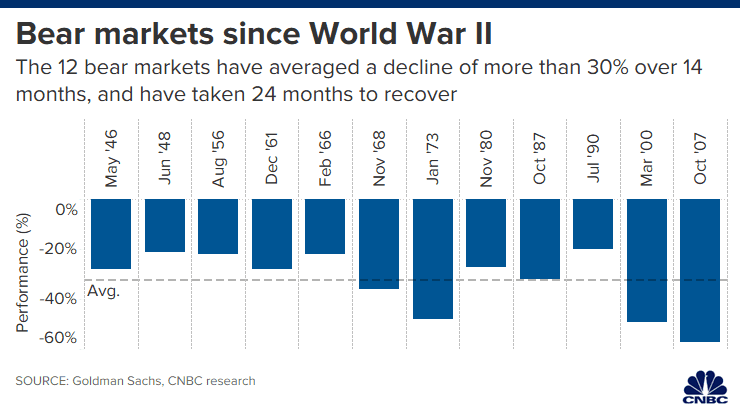
    One gut check for investing in up markets is to reference your present portfolio value with different draw downs scenarios (in percentages) and the potential recovery time (in months/years)
    S&P 500 data since WWII:
    Here are a few charts to help illustrate my point (averaged 14% drop over 8 months)...frequency (33% of the time):
    Corrections:
    image
    Bear Markets (averaged over a 32% drop over 3 years 2months)...frequency (20% of the time):
    image
    Another view of drops from S&P 500 Highs and the subsequent time to reach new highs:
    image
    Since WWII the market has either corrected (14%) or fell into a bear market (over 30%) 38 times over the last 75 years or about half the time.
    Also, a 14% loss (correction) requires a 16.25% gain to break even from that correction. A 33% loss (bear market loss) requires a 49.25% gain to break even.
    At these market levels ask yourself a few questions:
    Short term:
    - Do I have debt that I could pay off with some of these gains (prior to a correction)?
    - Do I have large one time payments (weddings, tuition, house projects, vacations, etc) that could be funded by reallocating some of your market gains to cash with some of these gains.
    Long term:
    - For young, long term investors, prepare yourself emotionally for sell offs of 14% - 35% at least every other year. Continue adding to your retirement (investment) by dollar cost averaging in both up and down markets.
    For me...and
    - For retirees using their portfolio for income, try to position 3-5 years of your income needs in less volatile investments.
    I am using VFISX and VWINX for this propose in retirement. In years where the market returns are better than VWINX, I reallocate some of these gains into VFISX & VWINX. I also may take yearly income from these funds in years when they far outperform.
    When the market sells off I first draw from VFISX, then VWINX. These two funds help me navigate yearly income withdrawals during market downturns while the rest of my portfolio waits for a recovery.
    Reference:
    heres-how-long-stock-market-corrections-last-and-how-bad-they-can-get
  • Third Avenue International Real Estate Value Fund in registration
    Not a new fund, just an acquisition by Third Ave Value of REMS International Real Estate Value-Opportunity Fund (REIFX - founders shares, REIZX - Z class). Though it appears from the prospectus that TAV will be adding Investor class shares with a 0.25% 12b-1 fee.
    https://thirdave.com/third-avenue-expand-re-platform/
    Here's the prospectus supplement (Oct 29, 2020) from the other (acquired fund) side.
    https://www.sec.gov/Archives/edgar/data/1396092/000138713120009434/rems-497_102920.htm
    Presumably the new shares will be sold NTF; the existing REIFX shares are sold with a TF and no reduction in the $50K min at Fidelity and Schwab.
  • James Kieffer no longer associated with Artisan Mid Cap Value and Value Funds
    They'll probably be forming their own shop.
    Perhaps ultimately, but "Jim Kieffer ... will remain part of the investment team for the time being, working as an analyst, advisor, and mentor."
    (M* Analyst Note for ARTQX.)
    This contrasts with the simultaneous announcement at ARTGX that Justin Bandy is leaving immediately. Perhaps the difference is that Kieffer is a lead manager while Bandy had recently been added to ARTGX and this was his first managing assignment.
    The new M* quote page for funds presents the inflows and outflows graphically. ARTQX had major outflows in 2013-2015 but since then flows have been pretty quiescent, especially in 2020. ARTLX shows a similar pattern, though its major outflows were in 2015-2016.
    It is reasonable to suggest that ARTGX has not fared well against its world fund peers because that category includes blend and growth as well as value funds. But ARTQX has been lagging its domestic value peers (2* over the past three years). ARTLX has been running hot and cold (four bottom decile years and three top decile years over the past decade).
  • Roth IRA for my grandson
    Congratulations to them. They're in good company, especially starting out.
    Warren Buffett called an S&P 500 index fund “the best thing” for most people who want to invest.
    As part of his remarks offering some broader advice about investing at his company’s first-ever virtual annual meeting on May 2 [2020], Buffett said, “In my view, for most people, the best thing to do is to own the S&P 500 index fund,” which would track the S&P 500.
  • Emerging Markets Small Cap
    FSEAX looks amazing. Yes. Helluva 2020. As if all the shit happening around the world wasn't even going on.
  • VLAAX vs FPURX vs PRWCX
    Stillers, have you had occasion to look at the variants of AIGPX (available at Wells with low minimum)?
    Yes, used to own it and it sits just below VWIAX and FMSDX on my 30%-50% list. Its 2020 blowout year jumped it to the top TR performer of the three. It is however largely a LC/MC Growth fund on the stock side. I prefer to get that exposure through the higher stock allocation AA funds and dedicated Growth funds. That said, if I added another 30%-50% AA fund, this would likely be it.
  • Emerald Small Cap Value Fund change in liquidation date
    https://www.sec.gov/Archives/edgar/data/915802/000139834421000510/fp0061082_497.htm
    497 1 fp0061082_497.htm
    FINANCIAL INVESTORS TRUST
    Emerald Small Cap Value Fund
    (the “Fund”)
    Supplement dated January 11, 2021
    to the Fund’s
    Prospectus and Statement of Additional Information
    dated August 31, 2020, as supplemented
    As previously disclosed, on December 8, 2020, the Board of Trustees (the “Board”) of Financial Investors Trust (the “Trust”), based upon the recommendation of Emerald Mutual Fund Advisers Trust (the “Adviser”), the investment adviser to the Fund, a series of the Trust, determined to close and liquidate the Fund on or about January 11, 2021. The date for such liquidation is now expected to be on or about January 29, 2021 (the “Liquidation Date”).
    If the Fund has not received your redemption request or other instruction prior to the close of business on the Liquidation Date, your shares will be redeemed, and you will receive proceeds representing your proportionate interest in the net assets of the Fund as of the Liquidation Date, subject to any required withholdings. As is the case with any redemption of fund shares, these liquidation proceeds will generally be subject to federal and, as applicable, state and local income taxes if the redeemed shares are held in a taxable account and the liquidation proceeds exceed your adjusted basis in the shares redeemed. If the redeemed shares are held in a qualified retirement account such as an IRA, the liquidation proceeds may not be subject to current income taxation under certain conditions. You should consult with your tax adviser for further information regarding the federal, state and/or local income tax consequences of this liquidation that are relevant to your specific situation.
    PLEASE RETAIN THIS SUPPLEMENT FOR FUTURE REFERENCE
  • VLAAX vs FPURX vs PRWCX
    It is interesting to observe balanced funds during this phase in the business cycle. Within the M* 50-70% equity category the risk level an investor assumes can vary widely. It tips the hand of the fund's perception of risk vs reward. M* produces data showing 2016-2020 Historical Equity trends. Some Balanced funds have assumed more equity exposure at stock market highs after a decade + long bull market. These funds sit at 66% up to 70%+ equities. Others funds have reduced equities from 2016-2020 protecting investors from a possible downturn (less than 60% equity). Totally opposite viewpoints of the same market. Extreme examples of two within 50-70 are BRUFX and BALFX. This wide descrepancy is obviously going to produce much different CAGR, SD and MDraw going forward. To each his own.
  • 2020 Asset Performance
    @JonGaltIII,
    Drawdown has considerable impact on future returns. Let me try to explain this with some calculation.
    Let say you lost 10% in fund A in 2020. An amount of $100 investment is reduced to $90.
    100 X (1-0.1) = 90
    In order to regain the $10 lost, you must gain 11% in 2021 (not merely 10%).
    100 = (1+X)*90 (original 2020 value) and solve for X. X is the percentage gain required for 2021.
    X = 0.11 or 11%
    Therefore the deeper the "hole" or drawdown is, the larger % gain is required and often longer duration to fully recover the loss. Case in point, S&P 500 index lost 40+% in 2008, and it took 53 months to fully recover and many investors can't handle the pain or patience to wait it out. Many cut their loss and sell near the bottom which is the worst outcome as the investors now lock-in the loss permanently. Therefore the magnitude of drawdown has a significant psychological effect that often lead to panic selling. The key here is minimize the drawdown while balancing a reasonable return. Thus a well balanced portfolio with the right asset allocation will likely to have a much smaller drawdown in a down market. This would allow the investors to sleep well.
    There are many very useful tools in MFO Premium site that allow one to compare fund candidates with respective to their drawdown %, recovery period, and annual return for various market cycles. And I am barely scratching the surface of Premium capabilities.
  • Waiting for the Last Dance -- Jeremy Grantham
    Thank you for sharing your thoughts on this very productive tread. Yes, 2020 was a rough one as many of us survived while earned a few bucks. 2021 will be different again. Stay safe.
  • Perpetual Buy/Sell/Why Thread
    Year-end portfolio tinkering.
    Me thinks perhaps the market forces the Fed unleashed in March 2020 will continue to play out in 2021 as vaccines get distributed. With that in mind, a couple of "exotic" funds were added to the fund portfolio.
    Bond Pot: Added SVARX. Sold PFOAX. Pot includes PTIAX, PONAX, RCTIX, SVARX, IOFIX. IOFIX will probably be eliminated as it continues to recover in 2021 (replace with GIBLX or ?).
    Mixed I Pot: Added GBLMX. Sold HBLAX. Pot includes VWINX, GBLMX, DHHIX, PFANX, TRECX.
    I've got some PONAX but expenses keep rising and the fund seems to be struggling since the management changes. I have LBNDX on my radard to replace my PONAX. That said, both LBNDX anda GIBLX (better longer term) have really high turnover rates.
  • Waiting for the Last Dance -- Jeremy Grantham
    ... can understand where you are coming from. If I panicked in March 2020, I would have missed out on a huge finish to 2020. I know we can't time the market ...
    I did not panic, I trust, and was not trying to time, in the usual sense. By May 11 all of our equity fund holdings were back to breakeven or abovewater (except for FRIFX, not a huge portion). I projected that this plague was going to be much worse and longer-lived than most were saying, which has turned out to be the case. (I'd lost to covid at end March my oldest college friend, of 55y nonstop acquaintance, healthy etc. --- a jarring, sudden-enough death.) I believed the economic impact was going to be much worse than predicted, including crippled consumer spending. Turned out to be only partly the case; certainly the latter did not occur. All this thinking of mine was informed by extensive reading and some crude numbercrunching. I thought if we could avoid a >20% monthslong / yearslong drop in this early stage of our retirement we would be better off. So as with so much in life I regret it only in hindsight.
    I can however guarantee that right after I get back in the really big broad market drops will occur, without fail.
  • 2020 Asset Performance
    Ok... I somehow can't take my eyes off the drawdown on those sectors. So, given that, what is the takeaway? Because from various articles, energy and financials and small and mid caps along with emerging markets are supposed to be the 2021 winners. Is that because the drawdowns were so large in 2020? Still learning about drawdowns and why they are so important.
    I'm not a professional, but I can understand your question. It seems to me that current (magnificent!) Market returns are due to the fact that stocks and bonds are utterly disconnected from "fundamentals." Governments everywhere have been busy "juicing" their economies due to the pandemic. Prior to the Covid thing, there was the "stimulus" to grease the gears again, following the Real Estate bubble and Crash back in 2008-09. I don't think all of that stimulus had ever been removed, since then. So, paraphrasing from something I read here a while ago: "The Markets are on a Methamphetamine bender." And when "ordinary," established big names do very well, they normally drag the small-caps and EM along with them. This is when those other sectors outperform.
  • Waiting for the Last Dance -- Jeremy Grantham
    @JonGatIII, Be mindful of the risk going forward. I survived both the tech bubble in 2000 and financial crisis in 2008 through my risk-adverse asset allocation. Even then it took years to fully recover the loss. It was a humbling experience and the black swan events will come again. It is a simple question of when and not if.
    2020 was an aberration event with the Fed being part of the market as @davfor pointeded out by buying stocks and bonds while reducing interest rates to near zero. Without the Fed the stock market would be still in red as the country is in deep recession. There are consequence to these Fed's action such as higher inflation, devaluation of USD, lower bond yields and etc. While you have the luxury of time, it is helpful to learn to become better informed investors.
  • 2020 Asset Performance
    Ok... I somehow can't take my eyes off the drawdown on those sectors. So, given that, what is the takeaway? Because from various articles, energy and financials and small and mid caps along with emerging markets are supposed to be the 2021 winners. Is that because the drawdowns were so large in 2020? Still learning about drawdowns and why they are so important.
  • Waiting for the Last Dance -- Jeremy Grantham
    That was very helpful and I can understand where you are coming from. If I panicked in March 2020, I would have missed out on a huge finish to 2020. I know we can't time the market and I'm nervous after having a great 2020 year but I'm not retired or close. So, I don't want to be foolish (although I'm equity heavy) and ignore what's in front of us.
    @davfor and @sven thanks for sharing. Enjoyed Reading Charles Lynn link as well. Really interesting.