
Howdy, Stranger!

It looks like you're new here. If you want to get involved, click one of these buttons!

Here's a statement of the obvious: The opinions expressed here are those of the participants, not those of the Mutual Fund Observer. We cannot vouch for the accuracy or appropriateness of any of it, though we do encourage civility and good humor.
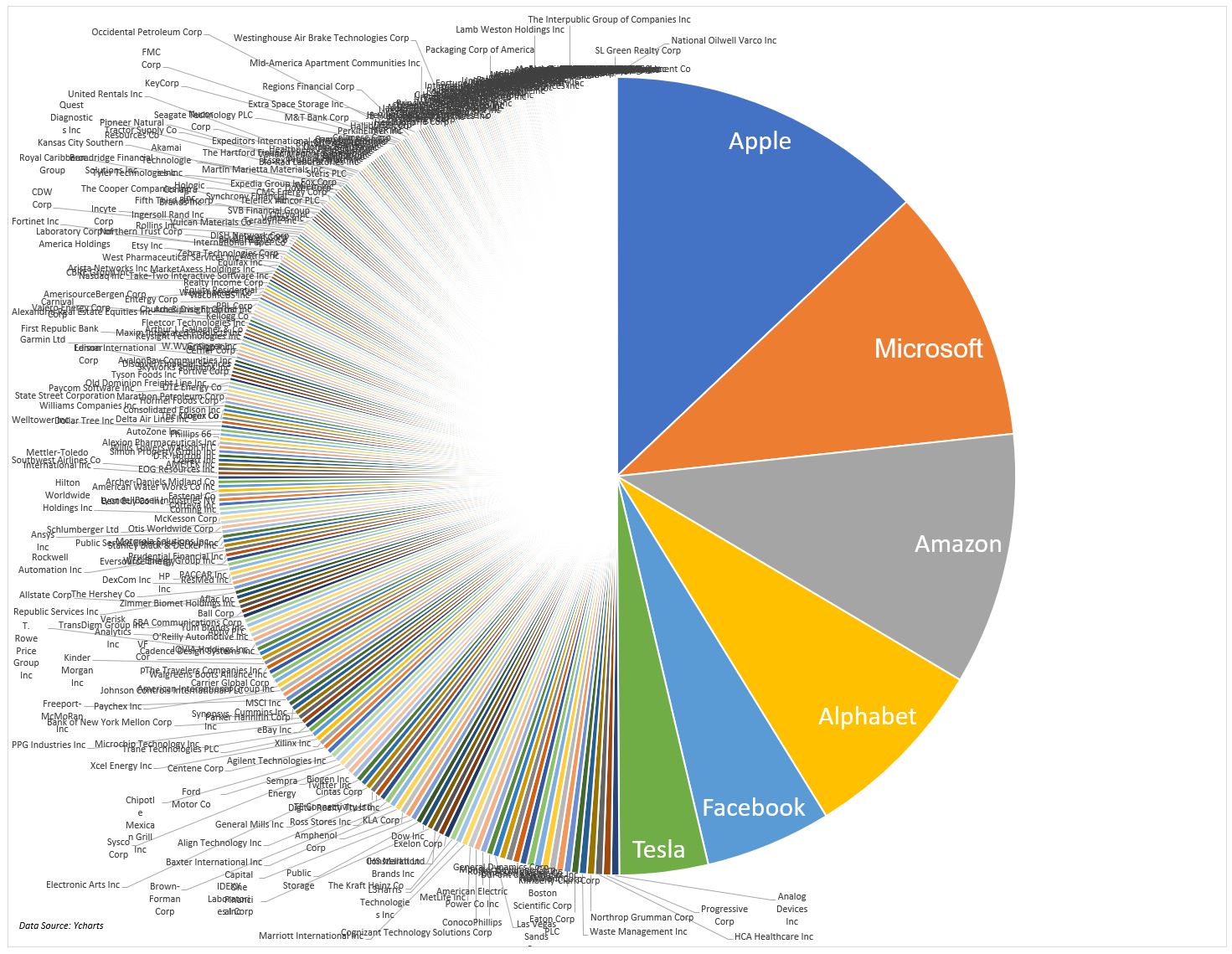
  • S&P 500 and it's new Addition -Tesla
    Top 3 Mutual Fund Holders of Tesla (TSLA)
    4-mutual-funds-hold-tesla-stock
    S&P 500 Forecast: How Will the Addition of Tesla Impact the Index?
    SP-500-Forecast-How-Will-the-Addition-of-Tesla-Impact-the-Index
    @MikeM2,
    ETFs prepare for balancing act as Elon Musk’s Tesla joins S&P 500:
    S&P still hasn’t announced what stock Tesla will be replacing, saying it will release that decision after the market closes Dec. 11.
    The S&P 500 isn’t the only index affected. Several other benchmarks will be rejiggered to accommodate the car maker, as well as any deletions from the S&P 500.
    Tesla, for example, is the largest weighted stock in S&P’s completion index, a benchmark tracking all U.S. stocks except those in S&P 500, and will have to be removed. Any stock taken out of the S&P 500 will trigger its addition back into the completion index, as well as step downs into S&P’s mid and small-cap benchmarks.
    State Street’s Mr. Bartolini said at least five of its exchange-traded funds will have to be rebalanced as a result of Tesla’s addition, including the biggest ETF in the world, the SPDR S&P 500 Trust ETF, and its growth-focused ETF, the SPDR Portfolio S&P 500 Growth ETF.
    Tesla’s inclusion “will require a fairly numerous amount of trades,” said Mr. Bartolini.
    global-investing/2020/12/01/tesla-sp-500-2
  • Bond mutual funds analysis act 2 !!
    wxman123,
    PIMIX is still a good fund but when I owned it I like the way it was. Since PIMIX is so huge the managers had to compromise and own more HY + EM + lower the distributions and still behind. PIMIX ranked at 78 in category in 2019 and 52 in 2020. The best risk/reward in bond land was in securitized. I'm never concerned about outperformance, it's what I do.
    JAVSX is a small fund where the managers can be flexible and use their best ideas.
    The question as is always what investor you are, goals and style. You need to do your own due diligence to suit your needs
    ==================
    dtconroe,
    I am willing to revisit usage of funds like VCFIX/VCFAX as a fund that was considered one of the safer, less riisky funds, prior to the crash, especially when you look at its relatively smooth performance track since the crash. When a reputable brokerage, like Schwab, is willing to put it on its Select fund list, I tend to give that fund more "benefit of the doubt" than funds like IOFIX, DHEAX, and SEMPX, which had terrible crash performance
    If you look at 3 years prior to the crash and compare VCFIX,IOFIX,SEMMX,PIMIX (link) you see the following:
    1) SEMMX+IOFIX had the best risk/reward with Sharpe+Sortino.
    2) SEMMX had good performance annually over 5% with very low SD=0.9.
    3) IOFIX had double the performance with reasonable SD=2.6
    4) VCFIX had good risk/reward and beat PIMIX
    March 2020 changed is all.
    I don't invest based on crashes just as I didn't after 2008. There are investors who see danger while I see an opportunity (chart).
    But I understand what you do and it suits your style.
    HOBIX is another fund with good risk/reward since March 2020 see (chart).
  • Bond mutual funds analysis act 2 !!
    10 years is too long. PIMIX was great until 01/2018 but its AUM got much bigger than 5-6 years ago, the managers had to look outside their best ideas in securitized and now more HY and EM and the yield is now at 4%.
    For mostly special securitized and still lower SD you can use JASVX. 2 of the managers are from SEMMX but this fund performance was much better in March 2020 than SEMMX,PIMIX,VCFIX and good YTD. I know it's new but the managers aren't. YTD (chart)
    I like and own JASVX but it is not exactly the same type of fund as PIMIX at this point. Also not sure I see PIMIX doing so bad outside of this year (still up 4.6%) and last. Agree that the bloat won't allow "secret sauce" outperformance going forward, but still can be a good fund. Definitely watching closely. My concern with JASVX is it's outsized performance this year. I have a rule that when you see a fund outperform that much you need to expect that it could underperform just as badly, like IOFIX. Put differently, I'd tell my elderly mom it's fine to park a good chunk of her savings in PIMIX, not so sure about JASVX. But being the bond master I'm interested in your take on this.
  • Bond mutual funds analysis act 2 !!
    10 years is too long. PIMIX was great until 01/2018 but its AUM got much bigger than 5-6 years ago, the managers had to look outside their best ideas in securitized and now more HY and EM and the yield is now at 4%.
    For mostly special securitized and still lower SD you can use JASVX. 2 of the managers are from SEMMX but this fund performance was much better in March 2020 than SEMMX,PIMIX,VCFIX and good YTD. I know it's new but the managers aren't. YTD (chart)
  • Bond mutual funds analysis act 2 !!
    image
    I agree that BASIX is pretty good, MNCPX looks better when you look at performance + SD.
    Schwab have 2 recommended Multi funds JMSIX,VCFIX and I think they are not as good the others on my list. TSIIX is clearly better as a generic fund. PTIAX is another good one specializing in securitized and Munis. If I wanted to use riskier fund I would go with HSNYX over these two. It has much better performance for 1-3 years and lower SD
  • Bond mutual funds analysis act 2 !!
    For What It is Worth, BASIX is a very good NonTraditional Bond fund, that has a very favorable M* Fund Analyst Report, and has held up pretty well in 2020, and has a nice longer term performance record. Its portfolio has a very diversified mix of Government, Securitized, and Corporate holdings. At Schwab, it is a NTF offering that has very low requirements to invest in the fund.
    Another fund worth looking at is VCFIX, an institutional class fund at Schwab, that is now available with very low initial investment requirements. It got clobbered in the March crash, but has had a very smooth performance trend since then. Schwab now has it as one of 2 funds in its "Select list" of recommendations for the Multisector bond oef category.
  • VGENX Vanguard Energy
    As the one of the few places not part of the market's current irrational exuberance, and where there is "blood in the streets" it is time to buy oil and nat gas.
    Unless you believe ( incorrectly ) that no one will ever again fly in an airplane, drive an internal combustion engine automobile, or heat their house with anything other than solar or geothermal
    It is unclear if XOM will preserve the dividend as their strategy of increased capital investments hit the Covid Wall, but their are lots of other companies whose share price will rise as the cost of oil goes up when the economy gets back to more nearly normal.
    I would not bet on AMC surviving, and the future of the shopping mall is very uncertain, but PXD, EOG and CVX will survive until "alternative energy" takes over. This is at least ten years away, and probably longer.
  • Social Security Benefits to Increase by 1.3% in 2021 / Plus - Budgeting for Next Year
    Dug this Full Story up this morning while working on my 2021 budget numbers.
    Reconciling the end-of-year numbers (cash on hand vs remaining liabilities) is always a nightmare. But after doing all the number crunching, I’m ending 2020 with a $6 (six-dollar) surplus. Yikes! Pretty darn lucky. It’s usually off by more. :)
    25 or more years ago I learned how to budget-out for a year in advance. Began keeping written records on 8 X 11” sheets of loose-leaf paper and have been true to the methodology. A cover-page tabulates the year’s projected income from various sources along with the year’s budgeted expenses.. These need to balance. Much is on auto-pilot. But about a dozen separate pages are used for tracking the major anticipated outlays (travel, home repair, new computers, etc.). A contingency fund is also built-in for unanticipated expenses. Without getting too specific, the approach builds in a generous sum of “pocket money” every month so that there’s no need to record smaller purchases like motor fuel, groceries, incidentals.
    A written approach like this has to be considered a dianosaur by today’s standards. But “If it ain’t broke, don’t fix it”. Curious what approaches others use (including the “Hail Mary” plan) in budgeting expenses?
  • VGENX Vanguard Energy
    Related News...time to invest? I'm thinking not just yet, though if Exxon maintain it's dividend payment these energy stocks may become the place investors "reach for yield" (9%-ish right now).
    Exxon Faces Historic Write down After Energy Markets Implode
  • 2020 Challenge - participants
    As of 11/30/2020, my "Retirement Portfolio" has total value of $1,113,533, and a YTD total return of 11.35%:
    ARBIX----- $215,747----- 19.4%
    FGDFX------ 122,431----- 11.0
    PIMIX------- 217,673----- 19.5
    TSIIX------- 222,628----- 20.0
    VLAIX------ 335,054------ 30.1
    TOTAL-- $1,113,533---- 100.0%
    Fred
  • Fidelity merges three funds into other funds
    FEXPX started out in 1994 as Fidelity Export Fund, focused on companies deriving at least 10% of their revenue from exported goods and services. Aside from driving the fund toward larger companies, I'm not sure what effect this constraint had. Apparently too much, as in 1997, Fidelity broadened its charter to include multinationals.
    I haven't followed the fund for a long time, but it seems to have evolved into another me-too LCV. In 2018, its top 10 holdings (31%) were all value (9 companies) or blend (one company), in 2019 its top 10 holdings (47%) were all value (9 companies) or blend (one company). Same for its top 10 holdings (51%) in early 2020.
    Pay no attention to the fact that its current portfolio looks like a conventional LCG fund. The fund changed managers on July 1, likely to serve as a caretaker and migrate the portfolio into growth. The merger into FFIDX, a large cap growth fund, doesn't seem fair to FEXPX's investors. Fidelity still lists FEXPX as a Fidelity Pick, LCV.
    FDFFX was originally marketed in 1983 as Fidelity Freedom Fund, a go-anywhere fund (like Magellan) designed specifically for tax-sheltered investments. Upon checking, I see that for a couple of months in late 1982 it was even called Fidelity Tax-Qualified Equity Fund before it was offered to the public. In this tax sense it was somewhat like MQIFX. It seems to have come full circle, now being merged into FMAGX.
  • Fidelity merges three funds into other funds
    https://www.thinkadvisor.com/2020/11/30/fidelity-moves-to-merge-3-funds-as-assets-hit-3-5t/
    Funds affected:
    Fidelity Independence Fund
    Fidelity Export and Multinational Fund
    Fidelity Emerging Europe, Middle East, Africa (EMEA) Fund
  • Portfolio Construction Going Forward
    Notes from the interview:
    On the equity side... trading the gains in QQQ (Thank Q, Thank Q, Thank Q) into under valued allocations of Small Caps, Emerging Markets, and commodities.
    On the Bond side... no longer a hedge for equity risk. 10 year treasury is at 0.7% . A 60/40 portfolio may successfully return 1- 3% over the next 10 years (Grantham has felt this way for the last 10 years). Retirees don't want a potential 50% equity side draw down.
    Gold and commodities have upside potential of 10-12 % increase due to inflation pressure as a result of a secular weak dollar and price increases in resources (industrial output).
    Be Bullish
    - China Stocks & Asia Satellite Countries
    - US Small Cap
    - Commodities
    - A weak dollar makes the rest of the world's markets strong with more stimulus on the way which may also be good for silver and gold.
    - A Global approach to equities exposure might look like (25% US / 75% Foreign)
  • Fidelity Disruptors Fund - FGDFX
    I'd at least hold off awhile with this new fund. It's not clear how it is managed and ISTM you are comparing its performance with the wrong benchmark.
    Fidelity's prospectuses are typically vague, but this one more than usual. This is a fund of funds, but the prospectus doesn't make clear who is responsible for the asset allocations or even say anything about how they're done. I'll contrast it with the prospectus for FMRHX, another Fidelity fund of actively managed funds.
    Investment strategies.
    FMRHX: "The Adviser, under normal market conditions, will use an active asset allocation strategy to increase or decrease asset class exposures relative to the neutral asset allocations [previously specified] by up to 10%..."
    FGDFX: silent. The only info I could find was in the SAI, where it says that "The fund may not purchase the securities of any issuer if, as a result, more than 25% of the fund's total assets would be invested in the securities of companies whose principal business activities are in the same industry." This doesn't really help understand the allocation among the underlying funds.
    Investment Risks. Similar verbiage for both funds: "The fund is subject to risks resulting from the Adviser's asset allocation decisions." What decisions? By whom?
    That gets us to the managers who are supposedly responsible for the asset allocation. It looks like Fidelity just threw the same eight managers at all the disruptor funds. Completely opaque as to who is steering which ship.
    Is the ship being steered at all, or is it on autopilot? I looked at the latest monthly holding filing. That's a legal document, so it has to tell you what the fund is holding directly. That's different from Fidelity's sheet listing the securities it holds indirectly via the underlying funds.
    The number of shares of the underlying funds are very similar. Given that the fund with the lowest value has the highest number of shares and so on down, the figures suggest that Fidelity is simply shooting for an even allocation (20%/fund) and periodically rebalancing. No asset allocation management, at least so far. This is a reason to wait - to see whether the fund really is on autopilot, or if it will change once it has more AUM.
    As to the underlying holdings... Aside from the finance fund which is off in its own world, there's significant overlap among the underlying funds. Disregarding MasterCard (MA) and Capital One (COF) (which are in the finance fund), all of the other holdings in the top 15 are held by 2-3 of the underlying funds. Not unexpected, but it does call into question how much diversification you're getting.
    Which brings us to the classification of this fund. I suspect M* classified it as LC Blend because it has to put new funds somewhere, and Fidelity didn't give any indication of how it would do asset allocation.
    The underlying technology fund is 75% LCG. Communications is 53% LCG. Automation is 46% LCG. Medicine is slightly more LC blend (33%) than LCG (26%), but when you add in its MCG (23%) and SCG (4%), it's still a majority growth fund. Only Finance isn't a growth fund. But it's not the value fund one might expect, with only 22% invested in value, less than the 30% it has in growth stocks.
    The fund as a whole is 45% LCG. Remember this is with a fairly neutral mix (finance currently constitutes 19.6% of the portfolio). So it seems fair to consider this a LCG fund, and those are the funds one might compare this with. Alternatively, one might compare it with some LCG global funds. This fund is 70/30 domestic/foreign. About 40% of the funds I could find with roughly this mix are world large stock (per M*).
  • Fidelity Disruptors Fund - FGDFX
    FGDFX is a new fund that M* places in the large blend category. I have been "test driving" the fund in my 2020 Challenge Portfolio over at the M* Discussion Forum with very encouraging results. Comparing it to SPY over its short history shows an excellent risk/reward profile, however the mangers are unknown to me:
    Total Return Max DD Sharpe Std Dev
    FGDFX 25.8% -3.1% 3.0 16.0
    SPY 13.4 -6.1 1.7 15.5
    According to Fidelity, the fund's "disruptive strategies seek to identify innovative developments that could signal new directions for delivering products and services to customers. Generally, these companies have or are developing new or unconventional ways of doing business that could disrupt and displace incumbents over time. This may include creating, providing, or contributing to new or expanded business models, value networks, pricing, and delivery of products and services."
    Normally, FGDFX invests in assets of five Fidelity funds that concentrate in the following areas, respectively:
    - automation
    - communication
    - finance
    - medicine
    - technology
    I am considering using this rather intriguing new fund in my personal portfolio, perhaps up to a max. of 10%. Would appreciate comments or suggestions from investors in the fund, or others who may have followed or have knowledge of the fund.
    Thanks,
    Fred
  • Janet Yellen supposedly Biden's pick for Treasury Secretary
    Can you imagine what the unemployment rate would be if most of the on-line merchants were not hiring emergency staff to handle the pandemic business increase? Amazon alone has hired 427,300 new employees in the past ten months: that's 1400 people PER DAY, each and every day since January.
    Source: NY Times
  • Janet Yellen supposedly Biden's pick for Treasury Secretary
    @wxman123,
    My comments were generic and not directed towards any particular political party or president.
    You may be conflating the economy with the stock market.
    They are not one and the same.
    Values for some important economic indicators are listed below.
    The U.S. unemployment rate was 6.9% for October which is nearly double the 3.5% rate in February.
    Wage growth for 2020:
    Jan: +4.27%
    Feb: +4.67%
    Mar: +0.75%
    Apr: -6.64%
    May: -3.66%
    Jun: -1.54%
    Jul: +0.07%
    Aug: +1.08%
    Sep: +1.89%
    Oct: +2.11%
    Quarterly GDP estimates for 2020:
    Q1: -5.0%
    Q2: -31.4%
    Q3: +33.1%
  • Value investing is struggling to remain relevant. What is VALUE
    This (article) is pretty good explaining VALUE

    It is now more than 20 years since the Nasdaq, an index of technology shares, crashed after a spectacular rise during the late 1990s. The peak in March 2000 marked the end of the internet bubble. The bust that followed was a vindication of the stringent valuation methods pioneered in the 1930s by Benjamin Graham, the father of “value” investing, and popularised by Warren Buffett. For this school, value means a low price relative to recent profits or the accounting (“book”) value of assets. Sober method and rigour were not features of the dotcom era. Analysts used vaguer measures, such as “eyeballs” or “engagement”. If that was too much effort, they simply talked up “the opportunity”.
    ....
    This would be comforting. It would validate a particular approach to valuing companies that has been relied upon for the best part of a century by some of the most successful investors. But the uncomfortable truth is that some features of value investing are ill-suited to today’s economy. As the industrial age gives way to the digital age, the intrinsic worth of businesses is not well captured by old-style valuation methods, according to a recent essay by Michael Mauboussin and Dan Callahan of Morgan Stanley Investment Management.
    The job of stock picking remains to take advantage of the gap between expectations and fundamentals, between a stock’s price and its true worth. But the job has been complicated by a shift from tangible to intangible capital—from an economy where factories, office buildings and machinery were key to one where software, ideas, brands and general know-how matter most. The way intangible capital is accounted for (or rather, not accounted for) distorts measures of earnings and book value, which makes them less reliable metrics on which to base a company’s worth. A different approach is required—not the flaky practice of the dotcom era but a serious method, grounded in logic and financial theory. However, the vaunted heritage of old-school value investing has made it hard for a fresher approach to gain traction.
    ...
    In Graham’s day the backbone of the economy was tangible capital. But things have changed. What makes companies distinctive, and therefore valuable, is not primarily their ownership of physical assets. The spread of manufacturing technology beyond the rich world has taken care of that. Any new design for a gadget, or garment, can be assembled to order by contract manufacturers from components made by any number of third-party factories. The value in a smartphone or a pair of fancy athletic shoes is mostly in the design, not the production.
    In service-led economies the value of a business is increasingly in intangibles—assets you cannot touch, see or count easily. It might be software; think of Google’s search algorithm or Microsoft’s Windows operating system. It might be a consumer brand like Coca-Cola. It might be a drug patent or a publishing copyright. A lot of intangible wealth is even more nebulous than that. Complex supply chains or a set of distribution channels, neither of which is easily replicable, are intangible assets. So are the skills of a company’s workforce. In some cases the most valuable asset of all is a company’s culture: a set of routines, priorities and commitments that have been internalised by the workforce. It can’t always be written down. You cannot easily enter a number for it into a spreadsheet. But it can be of huge value all the same.
    A beancounter’s nightmare
    There are three important aspects to consider with respect to intangibles, says Mr Mauboussin: their measurement, their characteristics, and their implications for the way companies are valued. Start with measurement. Accounting for intangibles is notoriously tricky. The national accounts in America and elsewhere have made a certain amount of progress in grappling with the challenge. Some kinds of expenditure that used to be treated as a cost of production, such as r&d and software development, are now treated as capital spending in gdp figures. The effect on measured investment rates is quite marked (see chart 2). But intangibles’ treatment in company accounts is a bit of a mess. By their nature, they have unclear boundaries. They make accountants queasy. The more leeway a company has to turn day-to-day costs into capital assets, the more scope there is to fiddle with reported earnings. And not every dollar of r&d or advertising spending can be ascribed to a patent or a brand. This is why, with a few exceptions, such spending is treated in company accounts as a running cost, like rent or electricity.
    The treatment of intangibles in mergers makes a mockery of this. If, say, one firm pays $2bn for another that has $1bn of tangible assets, the residual $1bn is counted as an intangible asset—either as brand value, if that can be appraised, or as “goodwill”. That distorts comparisons. A firm that has acquired brands by merger will have those reflected in its book value. A firm that has developed its own brands will not.
    The second important aspect of intangibles is their unique characteristics. A business whose assets are mostly intangible will behave differently from one whose assets are mostly tangible. Intangible assets are “non-rival” goods: they can be used by lots of people simultaneously. Think of the recipe for a generic drug or the design of a semiconductor. That makes them unlike physical assets, whose use by one person or for one kind of manufacture precludes their use by or for another.
    In their book “Capitalism Without Capital” Jonathan Haskel and Stian Westlake provided a useful taxonomy, which they call the four Ss: scalability, sunkenness, spillovers and synergies. Of these, scalability is the most salient. Intangibles can be used again and again without decay or constraint. Scalability becomes turbo-charged with network effects. The more people use a firm’s services, the more useful they are to other customers. They enjoy increasing returns to scale; the bigger they get, the cheaper it is to serve another customer. The big business successes of the past decade—Google, Amazon and Facebook in America; and Alibaba and Tencent in China—have grown to a size that was not widely predicted. But there are plenty of older asset-light businesses that were built on such network effects—think of Visa and Mastercard. The result is that industries become dominated by one or a few big players. The same goes for capital spending. A small number of leading firms now account for a large share of overall investment (see chart 3).
    ....
    The third aspect of intangibles to consider is their implications for investors. A big one is that earnings and accounting book value have become less useful in gauging the value of a company. Profits are revenues minus costs. If a chunk of those costs are not running expenses but are instead spending on intangible assets that will generate future cashflows, then earnings are understated. And so, of course, is book value. The more a firm spends on advertising, r&d, workforce training, software development and so on, the more distorted the picture is.
    The above is a much better explanation why Apple IS NOT another "blend—a blue chip stock ".
    image image