Howdy, Stranger!

It looks like you're new here. If you want to get involved, click one of these buttons!

Here's a statement of the obvious: The opinions expressed here are those of the participants, not those of the Mutual Fund Observer. We cannot vouch for the accuracy or appropriateness of any of it, though we do encourage civility and good humor.
  • Infinity Q Diversified Alpha Fund to close to new investors
    https://www.sec.gov/Archives/edgar/data/1261788/000089418920010078/infinityq497etempclosure.htm
    497 1 infinityq497etempclosure.htm 497
    Infinity Q Diversified Alpha Fund
    Investor Class - IQDAX
    Institutional Class IQDNX
    A series of Trust for Advised Portfolios
    Supplement dated December 30, 2020, to the
    Prospectus and Statement of Additional Information (“SAI”)
    each dated December 31, 2019
    IMPORTANT NOTICE ON PURCHASE OF FUND SHARES
    Effective as of the close of business on December 31, 2020, the Infinity Q Diversified Alpha Fund (the “Infinity Q Fund”) is closed to all new investment, including through dividend reinvestment, and the Infinity Q Fund’s transfer agent will not accept orders for purchases of shares of the Infinity Q Fund from either current Infinity Q Fund shareholders or new investors. Current shareholders, however, may continue to redeem Infinity Q Fund shares. If all shares of the Infinity Q Fund held in an existing account are redeemed, the shareholder’s account will be closed.
    Shareholders will be notified when the Infinity Q Fund is re-opened for all investment.
    Please retain this Supplement with the Prospectus and SAI.
  • Investing at the All Time Highs In VFINX
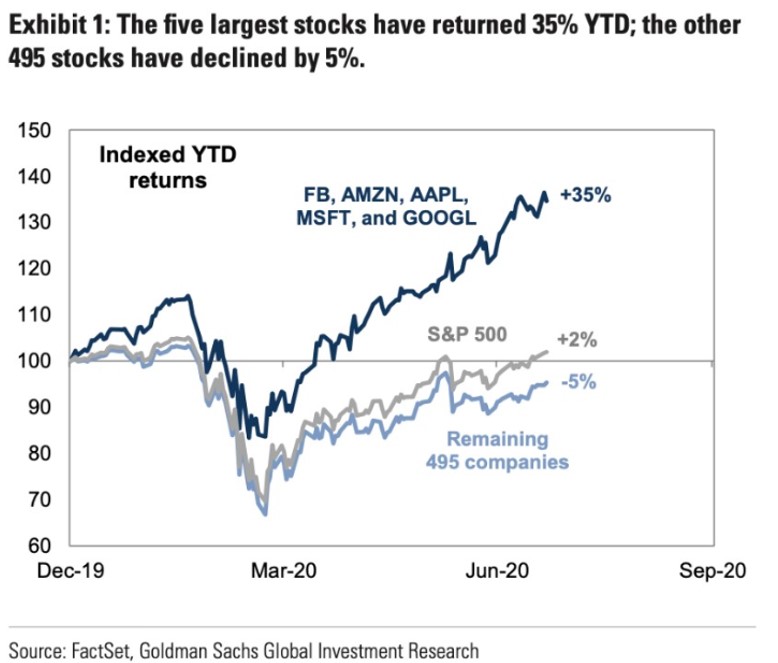
    This year 5 stocks in the S&P 500 accounted for a 35% gain. The other 495 stock together accounted for a collective 5% loss. That's changing...see article linked below:
    the-biggest-market-comeback-of-the-year
    image
  • Am I reading this right ... ?
    DODBX was shorting the S&P500 as of September 2020 ?
    Or, was that a pure hedge...
    D.S.
  • The Making of Biden's Superfast Push for Clean Electricity
    The Gospel of Hydrogen Power (NYT Article):
    You can make (hydrogen) fuel using water and solar power, as he does. The byproduct of making hydrogen is oxygen, and the byproduct of burning it is water. Hydrogen is among the most plentiful elements on earth, so you don’t have to go to adversarial countries or engage in environmentally destructive extraction to get it. The car is as quiet to drive as any other electric, it requires little maintenance, and because it doesn’t carry 1,200 pounds of batteries, it has a performance edge.
    hydrogen-power-cars
    The comments at the end of the article are more informative than the article.
  • The Making of Biden's Superfast Push for Clean Electricity
    I always liked this flow chart. It shows the magnitude of the task to change the country’s energy sources. According to this, solar supplies a tiny amount of electrical generation and a minuscule (1%) of the total consumption. I’m not saying don’t change, just pointing out what a heavy lift it will be.
    image
    https://www.visualcapitalist.com/visualizing-americas-energy-use-in-one-giant-chart/
    Original source: https://flowcharts.llnl.gov
  • Alternatives to Low Yielding Bond Funds
    I'm assuming that @Crash means that PTIAX's R² calculated relative to Bloomberg Barclays U.S. Aggregate Bond Index is substantially higher than the category's R² calculated relative to that same index.
    While 39% is certainly higher than 16%, the numbers are so low as to provide little insight. At best (i.e. assuming that the linear regressions are even meaningful), it says that 2/5 of PTIAX's gains/losses can be explained by movements in the "bond market".
    Multisector bond funds don't resemble the bond market and so comparing performance with the broad market doesn't offer much insight. M* doesn't even benchmark the category against this index. Instead it uses Bloomberg Barclays U.S. Universal Bond Index. (See the footnotes under the Risk and Volatility Measures table cited.)
    https://www.morningstar.com/articles/864498/a-more-complete-bond-index-fund
    FWIW, the index that M* finds to be the best fit to the fund is a 65/35 blend of Barclays High Grade and Barclays High Yield indexes. Which isn't all that surprising given that the fund has about 10% BB or below and another 8% unrated. That's less junk than the category average (40% BB or below and 5% unrated), which also explains its higher but still small correlation with the (investment grade) aggregate bond index.
    http://performance.morningstar.com/fund/ratings-risk.action?t=PTIAX
    Compare this with a multisector fund like TSIIX which comes close to category average allocations: 36% BB or below and 4% unrated). With more junk, its R² relative to the investment grade aggregate bond index of 15.30% is nearly the same as the category average 16%.
    http://performance.morningstar.com/fund/ratings-risk.action?t=TSIIX
  • Alternatives to Low Yielding Bond Funds
    rickrmf If I'm not mistaken, the new mandate took effect in June or July 2020. During the March swoon, the fund followed the old mandate, so its stock allocation was only 10-20 %, when the decline started.
  • Alternatives to Low Yielding Bond Funds
    Hi Fred,
    You inquired about GAVAX, here is a link to David Snowball's review:
    Link
    FYI: here is the performance of the funds I mentioned, along with FIKFX and VASIX, during the March swoon. See this chart:
    "https://stockcharts.com/freecharts/perf.php?GAVAX,CTFAX,TMSRX,SWAN,VSCGX,VASIX,fikfx"
    CTFAX and GAVAX are tactical allocation funds, so I'm looking/hoping for the managers to help with defense.
    Re: CTFAX, I believe its strong performance during the March swoon reflects its new mandate, so that's encouraging.
    Best of luck, happy new year!
    Rick
  • Investing at the All Time Highs In VFINX
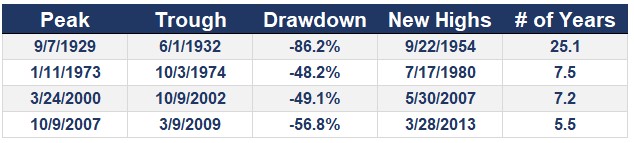
    It's funny how most studies on market performance ignore the Great Depression as if it never happened, yet the first article does reference it:
    image
    The author does mention that this price performance ignores dividends so the recovery rate would've been sooner than 25 years with that, but I wonder how many people during the Great Depression would have had the stomach or the financial wherewithal with 25% unemployment to hold on and reinvest their dividends as the market went into free-fall.
  • Investing at the All Time Highs In VFINX
    For SP500 w full reinvestment:
    This is even true for the peak starting 9/2k --- it took ~6y, though, following the ensuing dip --- and for the peak starting 11/07 --- and that one took, following the ensuing dip, just under ~5y. To break even.
    Sobering, but if one stays optimistic ....
    Worse, as everyone knows, if you 'ignore' (somehow) the second peak (and had gone all in Labor Day 2k), it was not until xmas 2010, over a decade later, that you were breakeven on paper --- and that while suffering ~27% inflation.
    Such a scenario certainly seems more likely now going forward than anything else, with the market 'foaming at the mouth':
    https://www.nytimes.com/2020/12/26/business/investors-bull-market-pandemic.html
  • Alternatives to Low Yielding Bond Funds
    If you're interested in multisector bond funds, you may want to consider RCTIX.
    Fact Sheet

    Thanks for the suggestion, Observant.
    RCTIX is already on my watch list and I am currently monitoring its risk/reward performance. So far, so good.
    Thanks, again.
    Fred
  • Alternatives to Low Yielding Bond Funds
    If you're interested in multisector bond funds, you may want to consider RCTIX.
    Fact Sheet
  • Bond fund Yield Comparison? Are 30 day SEC yields really the method?
    It is confusing and very messy when dealing with portfolios of all different maturities, coupons and ratings (different yield curves). That's why it's easier thinking about these questions with a single bond or a homogeneous portfolio of bonds all the same.
    If you own a bond and sell it before maturity, even assuming that rates remain the same, you'll get a bit more than YTM. This is because longer term bonds pay higher rates. Since SEC yield reflects YTM, I don't believe this return is reflected in that yield.
    Think of a two year bond paying interest annually. Let's say that market rate for a two year bond is 2% and market rate on a one year bond is 1%. (This time I'll ignore pennies for simplicity). If the two year bond pays 2% each year, it will cost you $100 (par).
    A year after buying, you get a 2% interest payment. You're now holding a 1 year bond with a 2% coupon (that's above the 1% market rate for a one year bond). So you're able to sell that bond for $101 (1% premium). Your net return: 2% market rate interest plus 1% in capital gain.
    [A buyer of your bond, if holding to maturity would net 1% on that bond (2% coupon less 1% loss in value). There's your 4% total return over two years.]
    There's no difference between you doing this with your own bonds and a fund manager doing this with the fund's portfolio. You get more total return by turning over bonds because you're taking on more risk.
    When holding a two year bond to maturity the average maturity over that time is one year. If instead you sell a two year bond after a year (and replace it with another two year bond), your average maturity over time is 1.5 years. You're always holding a bond that matures between one and two years from now.
    We didn't assume rates were changing here - just that we didn't have an inverted yield curve where shorter bonds pay higher yields than longer bonds.
    Rates changing complicates this. If you swap one bond for another of the same maturity, nothing's going to change. It's as if you sold your bond and then simply repurchased it. Your sale price and your purchase price will be equally affected by the rate change.
    But if you're selling shorter maturity bonds and replacing them with longer maturity ones, then a change in the yield curve is going to affect how much you get for extending that average maturity. In ways I honestly don't want to work through right now :-)
  • Bond fund Yield Comparison? Are 30 day SEC yields really the method?
    @msf. Thank you for your always great explanations. Since bond funds are buying and selling bonds every day and not holding them to maturation usually, I would imagine that the SEC yield is the cumulative yield of all the bonds in the fund held until maturity only on that day when published. If bonds are sold prior to maturity the yield would be more based on market rate changes. Correct? Would this also be accounted for in the SEC yields? Probably not?? Would it be noted in capital gains or losses and not in the SEC yields? So your true total return may not be accounted for by SEC yields only. Thanks again for your help with this subject which I find quite confusing.
  • Alternatives to Low Yielding Bond Funds
    Take a look at Vanguard's W funds, VWIAX and VWENX. You won't get big dividend %, but they also throw some good cap gains. Works for me.
  • ARK Investing ETFs: Interview with Cathy Wood
    ARK Innovation ETF is discussed in the following blog post.
    Other "hot" funds from the past are also mentioned.
    A Short History of Chasing The Best Performing Funds
  • I am losing my patience with TBGVX ?
    My point with those funds (which do make an interesting list) is that value simply hasn't performed as well as blend, let alone growth. Lewis made this point as well in asking whether you were disappointed with the fund or with value in general.
    KGIRX was not a fund I was familiar with. Something to note about it is that unlike most of the other better performing foreign LCV funds is that it has a large measure of EM. Really large. 43%.
    I ran a few searches, and the closer one hews to low risk, foreign LCV, the more similar the performance becomes. For example, one screen was:
    Category = foreign large value or foreign large blend
    Large Cap Value >= 25%
    Large Cap Growth < 10%
    Bear market percentile < 50%
    YTD return > 0
    For me rapid spikes down or up don't matter. Unless one is planning on selling within a small window of time, ISTM that recovery time is more important than how deep a plunge is. Since the 2020 spike (decline) was between January 17 (when the market hadn't risen much YTD) to March 23, it seemed reasonable to look for funds to "break even" over the current year, hence YTD return > 0. (Between 1/17 and 3/23, many funds seemed to have drawdowns of 34% - 35%.)
    Not too many funds pass this screen. (Variants include increasing the percentages of both LCG and LCV while keeping a significant difference between the two.) One of the few that did was PRCNX, which led me to believe you were looking for very similar funds.
    Another fund that came out of that initial screen (LCV >= 25, LCG < 10) was GSAKX. This sits on the border of value and blend. It wanders along the dividing line; M* called it value in 2019-2020, but blend in the prior three years. It's highly concentrated (34 stocks), and very Eurocentric @ 79% including UK. Its 1/17-3/23 drawdown was 34.5%, just slightly less than VEA's 35.1%.
    Changing the screen slightly (LCV >= 35, LCG < 25) gives a few different funds. One is LZIOX. This is a more wide ranging fund from what is generally a value shop. It's generally been blend, though it had a year as a LCG fund and is now LCV. It has a more conventional 70 equities. It has performed respectably, though it too fell 34.6% between 1/17 and 3/23. Over the past three years it has done significantly better than TBGVX.
    BRXAX is another fund from this screen. It's been LCV for the past four years, but this year its portfolio is blend and M* has placed in in the blend category. 149 stocks, including a bit more than 20% EM. Likewise, it fell 34.5% between 1/17 and 3/23.
    None of these funds is going to set the world on fire. They're lower risk, reasonably performing, relative value funds. In contrast, TBGVX is a "deep-ish value" fund.