
Howdy, Stranger!

It looks like you're new here. If you want to get involved, click one of these buttons!

Here's a statement of the obvious: The opinions expressed here are those of the participants, not those of the Mutual Fund Observer. We cannot vouch for the accuracy or appropriateness of any of it, though we do encourage civility and good humor.
  • At what point will the Fed cry “Uncle”?
    I hear you. The Fed and ECB will be playing catch-up for some time, attempting to tame inflation. But if production and consumption sink too far, you can bet they'll prime the pump again. After all is said and done, we'll end up with currencies that are worth about what the Filipino peso is worth right now: 1.8 cents, in US terms. In my own lifetime, I believe the Inflation Monster can be traced to LBJ. He had good intentions. "War On Poverty." But the Vietnam War buried him. And the US dollar. It was at about that time when families began to NEED two incomes to live decently.
    China is supposed to be a bright investing spot at the moment. I cannot see myself investing in China-land any more than I'd give my money to Rosneft. The Iron Curtain is up again. The world is in the midst of an economic re-shuffling that is rather unusual. De-globalization. You mention commodities. Still $5.59/gallon here. THAT'S not going to be remedied very soon. Production needs to ramp-up. PRNEX is in the doldrums, as is my ET. Bargain buying time. Bloomberg TV says 1st half of 2022 was WORST for Stock and bonds IN HISTORY. In HISTORY.
  • AAII Sentiment Survey, 6/29/22
    I did not expect bearish sentiment to drop nearly 13% from last week's 59% to this week's 46% but again we had a big move up in the equity market late last week.
  • FPA New Income Fund re-opens to new investors
    Thanks for posting.
    As of H1, the fund is down (2.85%). for any other bond fund, that would be a superb return on a relative basis.
    But unless they can pull a rabbit out of their proverbial hat, this may be their first ever losing year.
  • M*: "The report is no longer supported."
    Yes, this situation has been discussed in detail in the "M* screwing everything up again" thread. There's likely no fix for this situation.
    Thanks, OJ. Guess I stopped reading that thread a little too soon.
  • M*: "The report is no longer supported."
    As mentioned previous, the correct M* link requires a rebuild.
    This will take one to the M* page for a ticker.......just a few extra strokes.
    ---As before, click the ticker symbol
    ---right click Google search
    ---select incognito mode.......Google will load choices for the ticker
    ---scroll down 1 or 2 lines for the M* link
  • Oldest mutual funds: name changes
    I don’t think this is what you are looking for - but interesting, none the less.
    https://www.marketwatch.com/story/these-4-funds-launched-before-the-great-depression-still-deliver-for-investors-2017-01-07
    Thanks Rbrt. The oldest closed-end fund is older than the oldest open-end fund, and the closed-end category had far more assets at the end of the 1920s. So in theory, if I want to track the long term 'returns actually received by mutual fund owners' I would include these in my sample. Both the SEC 1939 report and Wiesenberger through at least the 1960s give closed-end expense ratios and performance.
    Unfortunately, almost all the early closed-end funds were leveraged, and most were not diversified common stock funds exclusively. And there was an enormous bust after 1929, on the order of the South Seas bubble, with incredible survivorship bias when examined from a later period. So, regretfully, I have (thus far) decided not to include closed-ended funds.
    But it's a choice I'll have to defend, and its good to be reminded of the Barron's piece.
  • M*: "The report is no longer supported."
    Yes, this situation has been discussed in detail in the "M* screwing everything up again" thread. There's likely no fix for this situation.
  • Money Market Rates - interesting again?
    One can't always believe what one reads. Especially from tertiary sources.
    Investopedia writes:
    Not every security will have the same settlement periods. All stocks are T+2, and mutual funds differ but are T+1 and T+2, depending on the fund. However, bonds and some money market funds will vary between T+1, T+2, and T+3.
    ...
    Correction—May 5, 2022: This article previously contained an error regarding the settlement date timeline for mutual funds.
    Fidelity also has apparent inconsistencies. Contrast the MMF prospectus excerpt Yogi provided with this writing in Fidelity's help section (bold in original): "How long does it take for a mutual fund trade to settle? ... Sells and buys of money market funds settle the same day"
    Investopedia is right on one point - settlement times of MMFs vary. Some MMFs settle T+1 and some settle T+0. Read their SEC filings. Examples of T+0 funds are the institutional shares of Blackrock MMFs.
    In their prospectus, the purchase and sale section of each fund reads in part: "To purchase or sell shares of the Fund, purchase orders and redemption orders must be transmitted to the Fund’s office ... You have until the close of the federal funds wire (normally 6:45 p.m. Eastern time) to get your purchase money in to the Fund."
    They really do settle same day. I've owned at least one of them. You can trade them through Merrill.
    One can infer from the prospectus that it's not up to the brokerage whether to settle the same day or not. If the brokerage carries the fund it must settle the same day.
  • AAII Sentiment Survey, 6/29/22
    For the week ending on 6/29/22, Sentiment improved a bit but was very negative: Bearish remained the top sentiment (46.7%; very high) & bullish remained the bottom sentiment (22.8%; very low); neutral remained the middle sentiment (30.5%; below average); Bull-Bear Spread was -23.9% (very low; interestingly, it has good correlation with the UM Sentiment). Investor concerns included high inflation & supply-chain disruptions; the Fed; market volatility (VIX, VXN, MOVE); Russia-Ukraine war (18+ weeks). For the Survey week (Thursday-Wednesday), stocks were up, bonds up, oil up, gold down, dollar up. #AAII #Sentiment #Markets
    https://ybbpersonalfinance.proboards.com/thread/141/aaii-sentiment-survey-weekly?page=6&scrollTo=689
  • Time to invest in natural gas ?
    @TheShadow : Nice find. Time to check the bill again. Pay-back is a Bitch !
    Thanks, Derf
    Added : After checking bill it shows a PGA Purchased gas adjustment.
    130.3 therms @ $0.36240 Base
    130.3 '' @ $0.23650 PGA 7/28 days
    130.3 '' @ $0.32890 PGA 21/28 days
    FEB . billing
    Wouldn't gas distribution company have contract with their supplier . Maybe their suppler has to buy on the spot market ?
    Also note that PGA is on all bills.
    Is it time to own a piece of the suppliers & pay yourself.
  • Time to invest in natural gas ?
    This was from the local Philadelphia news last night about customer's bills:
    https://6abc.com/pgw-weather-normalization-adjustment-bill-surcharge-philadelphia-gas-works/12004300/
    Also, while not rating or recommending this mutual fund, you can play the natural gas angle through Hennessey's Gas Utility Fund (GASFX /HGASX).
  • How a massive refinery shortage is contributing to high gas prices
    Bloomberg provides a reasonably fair summary of the situation. This paragraph summarizes the story: https://www.bloomberg.com/news/articles/2022-06-29/why-is-fuel-so-expensive-it-s-not-just-the-oil-price-quicktake
    “5. Can’t we just make more fuel?
    Swaths of refinery capacity shut down during the pandemic and it’s not easy to bring it back online. The US lost more than 1 million barrels a day of capacity between 2019 and 2022 and the remaining plants were already running close to flat out. Some facilities will never restart, even with profit margins near records. The big, multiyear investments needed for such facilities have become tougher to secure as everyone from policymakers to consumers and financiers eye greener alternatives.”
    Counterpoint… the lack of investments in refinery’s or drilling is not due to consumer demand or consumer shifts, it’s a current policy issue. It seems to me that the majority of consumers and policy makers are nowhere near consensus on the issue. I’m not certain that policy makers find the high price of gas to be a problem and they likely view it as an excellent opportunity to promote alternatives.
  • Money Market Rates - interesting again?
    I see T+1 settlement for m-mkt funds at Fido & Vanguard, just as at Schwab.
    Fido SPAXX (core/settlement fund) prospectus: "Shares will be sold at the NAV next calculated after an order is received in proper form. Normally, redemptions will be processed by the next business day, but it may take up to seven days to pay the redemption proceeds if making immediate payment would adversely affect a fund." https://fundresearch.fidelity.com/mutual-funds/summary/31617H102
    VG VMFXX (core/settlement fund) prospectus: "If your redemption request is received in good order, we typically expect that redemption proceeds will be paid by a Fund within one business day of the trade date; however, in certain circumstances, investors may experience a longer settlement period at the time of the transaction." https://investor.vanguard.com/investment-products/mutual-funds/profile/vmfxx#fund-literature
    If some brokers offer T+0 m-mkt fund settlement, that would be good to know.
    Edit/Add: I also know that Fido and Schwab update their websites by 8:30-9:00 pm Central on most days but that doesn't affect their official settlements.
  • Time to invest in natural gas ?
    Natural gas in the US recently was $9/MMBtu (about triple from a year ago) but is multiple times more expensive than that in Europe and Asia. In June, Freeport LNG plant in TX had an explosion and suddenly the US prices collapsed to $6+ (still double from a year ago) - on the fear that very profitable US LNG exports would go down. Yes, volatile it is.
    https://www.cnbc.com/2022/06/14/natural-gas-plummets-as-freeport-delays-facility-restart-following-explosion.html
  • How a massive refinery shortage is contributing to high gas prices
    Price gouging !! I just posted about huge increase in monthly, average, natural gas bill.
    Derf
    Well, you call it price-gouging. But that seems to be popular behavior with every industry these days. -- Airline fares. Agriculture/food. its impossible to go through a burger drive-through without paying +$10/person, for crap 'food' (it may be Solyent Green). My landlord raised the rent 12%. Housing prices are up outrageous sums since the helicopter money was dropped by Jay "Top Gun" Powell.
    The employer I happen to work for has raised its prices on all of its product lines +100% since 2019. --- And we keep having more customers showing up at our door asking for more product.. (i.e. no loss of volumes due to the high prices).
    When everyone is "price-gouging", its not price-gouging. its inflation. Inflation is every where and at every time a monetary phenomenon (M. Friedman). Our govt (including Jay "Monopoly Money" Powell) has done this to us.
    Are you better off now than you were 4 years ago?
  • Fund Allocations (Cumulative)
    Fund Allocations (Cumulative), 5/31/22
    While high market volatility continued, there were very minor changes in fund allocations, so fund investors stayed put. The changes from the last month are for a total OEFs & ETFs AUM of about $30.24 trillion, so +/- 1% change is about +/- $302.4 billion. Also note that these changes are from both fund inflows/outflows & price changes.
    OEFs: Stocks 52.65%, Hybrids 7.22%, Bonds 21.03%, M-Mkt 19.10%
    ETFs: Stocks 81.31%, Hybrids 0.55%, Bonds 18.14%, M-Mkt N/A
    OEFs & ETFs: Stocks 58.89%, Hybrids 5.76%, Bonds 20.40%, M-Mkt 14.95%
    https://ybbpersonalfinance.proboards.com/thread/245/fund-allocations-cumulative-monthly?page=1&scrollTo=688
  • jp morgan hedged equity stategy funds
    I agree that seems like one part of the issue. Another perhaps related part may be the way the put spread collar works.
    Because the three month collars have different start and end months in each of the funds, it's possible for one fund to be in the "protected" area, where market declines don't affect the payoff value, while another fund could have already blown through the protection.
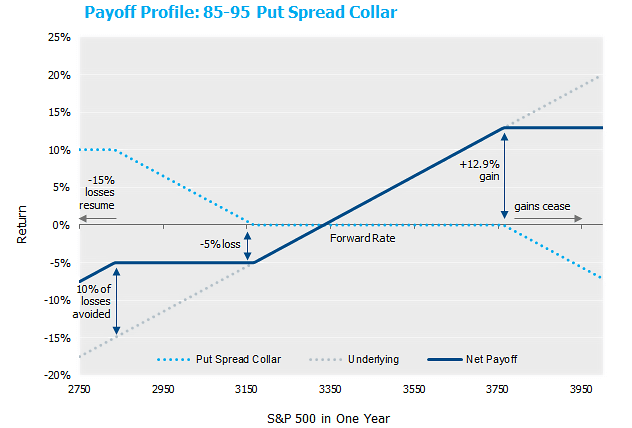
    See diagram below. In this example, where the collar kicks in after a 5% loss at which point it provides 10% loss "insurance". Suppose two months ago the market went up 5%, and in the past month it dropped 10%.
    A collar that started two months ago would be protecting a fund with a net 5% market loss. That is, the collar would just be kicking in now. But a collar that started just one month ago would be half used up. It would be protecting a fund with a net 10% market loss. (5% of that loss would be covered by the higher strike price put option.)
    After another 5% drop in the market, its protection would be used up. At that point, the value of the latter fund would follow the market down, while the former fund would still have some protection.
    image