Howdy, Stranger!

It looks like you're new here. If you want to get involved, click one of these buttons!
Here's a statement of the obvious: The opinions expressed here are those of the participants, not those of the Mutual Fund Observer. We cannot vouch for the accuracy or appropriateness of any of it, though we do encourage civility and good humor.
  • 2% swr
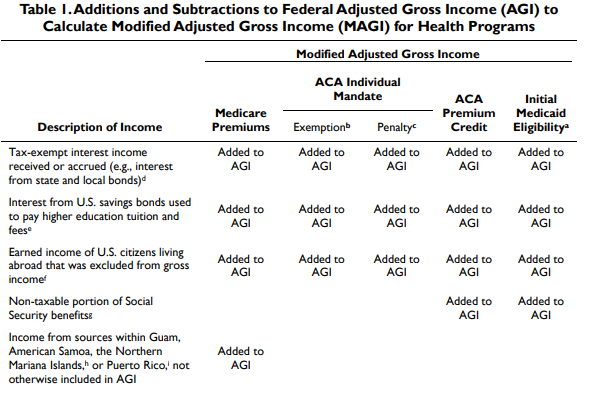
    MAGI calculation for IRMAA includes only the taxable portion of Social Security. The entire amount of SS is included in other MAGI calculations, e.g. for Medicaid. Below is the major part (but not all) of a table from a Congressional Research Report showing MAGI calculations for IRMAA and other health related programs.
    image
    https://sgp.fas.org/crs/misc/R43861.pdf
    Reducing income to just what one needs is letting the tail wag the dog. If I have $1M in cash, which is better:
    - Buying 3 month T-bills generating $30K (annualized) in taxable income and increasing my Medicare Part B premium by less than $1K, or
    - reducing this unneeded income to zero (and saving with lower income taxes and lower Medicare premiums) by keeping that cash in a non-interest-bearing checking account?
    Note that I've taken risk out of the equation by using short term Treasuries.
    Just as one optimizes taxes by smoothing income before retirement (e.g. by shifting deductions such as contributions and property taxes from one year to the subsequent or previous year), the idea in retirement is to smooth income in retirement, rather than reduce it. That's where incremental Roth conversions help.
    Optimal in many circumstances can be putting money, to the extent allowed, into HSAs. Unlike Roth contributions, HSA contributions are not taxable. With the exception of a few states, earnings while in HSA accounts are not taxed.
    SS income is included for IRMMA calc. So, if a surviving spouse claims SS based on higher benefits earned by deceased spouse, that could increase Part B premiums.
    The effect is the same regardless of whether the higher benefits come from the deceased spouse or from the surviving spouse. Pre-death, the taxes don't depend on which spouse had the higher benefits (assuming MFJ - income is combined). Post death, the surviving spouse receives the higher benefit regardless of whether that comes from the deceased spouse or the surviving spouse.
    Moving from a higher State income tax to a no to low State income tax State in retirement is another good way to keep more of what you worked so hard for during your working life.
    Often not. There's much more to the calculation than state income tax rates. An excellent, very long piece on the Kitces site (I've read much but not all of it) discusses several different factors and how the situation depends not only on income tax rates, but on the mix of income sources, on the level of income, etc.
    https://www.kitces.com/blog/state-income-tax-retirees-top-marginal-rates-social-security-pension-income-age-exemptions/
    One example from that page to illustrate this:
    Example 4: James and Dolly Madison anticipate that they will each receive $18,000 of Social Security income and $19,500 of qualified-plan income during retirement, for a combined total income of $75,000 each year.
    With their retirement income mix, the Madisons would have an estimated $0 state tax bill in 24 states! Notably, this list includes Illinois, New Jersey, and New York, states commonly thought of as high-tax states.
  • AAII Sentiment Survey, 10/5/22
    For the week ending on 10/5/22, Bearish remained the top sentiment (54.8%; extremely high) & neutral remained the bottom sentiment (21.3%; extremely low); bullish remained the middle sentiment (23.9%; extremely low); Bull-Bear Spread was -30.9% (extremely low). Investor concerns: Recession; inflation; supply-chain disruptions; the Fed; US elections; market volatility (VIX, VXN, MOVE); Russia-Ukraine war (32+ weeks); European banks; geopolitical. For the Survey week (Thursday-Wednesday), stocks were up (October dollar-relief rally?), bonds flat/down, oil up sharply (ahead of OPEC production cuts), gold up, dollar down. #AAII #Sentiment #Markets
    https://ybbpersonalfinance.proboards.com/thread/141/aaii-sentiment-survey-weekly?page=7&scrollTo=798
  • WTO Sees Sharp Slowdown in Global Trade, Pointing to Possible Recession, Lower Inflation
    Sold oil equities today. These direct investments are now 0.5% of portfolio value.
    wow, man. yours are brass. i just could not do it that way.
  • 2% swr
    There are various factors that affect net Part B premiums. IRMAA is just one of them. It is almost impossible for IRMAA alone to cause the premium to triple when filing status changes from MFJ to single.
    Part B Premium	2022 Coverage (2020 Income)		2023 Coverage (2021 Income)
    Standard Single: <= $91,000 Single: <= $97,000
    Married Filing Jointly: <= $182,000 Married Filing Jointly: <= $194,000
    Married Filing Separately <= $91,000 Married Filing Separately <= $97,000
    Standard * 1.4 Single: <= $114,000 Single: <= $123,000
    Married Filing Jointly: <= $228,000 Married Filing Jointly: <= $246,000
    Standard * 2.0 Single: <= $142,000 Single: <= $153,000
    Married Filing Jointly: <= $284,000 Married Filing Jointly: <= $306,000
    Standard * 2.6 Single: <= $170,000 Single: <= $183,000
    Married Filing Jointly: <= $340,000 Married Filing Jointly: <= $366,000
    Standard * 3.2 Single: < $500,000 Single: < $500,000
    Married Filing Jointly: < $750,000 Married Filing Jointly: < $750,000
    Married Filing Separately < $409,000 Married Filing Separately < $403,000
    Standard * 3.4 Single: >= $500,000 Single: >= $500,000
    Married Filing Jointly: >= $750,000 Married Filing Jointly: >= $750,000
    Married Filing Separately >= $409,000 Married Filing Separately >= $403,000
    https://thefinancebuff.com/medicare-irmaa-income-brackets.html
    If one is in the first bracket (paying just the standard premium), then the premium can triple by moving the one of the top two brackets (3.2 or 3.4 times as much). But if one is in the second or higher bracket, it is impossible for the premium to triple.
    So the initial MAGI (MFJ) must be no more than $182K. Filing as a single next year, the MAGI would have to be greater than $183K to jump into one of the top two brackets.
    That is, even with the change in filing status from married to single, MAGI would have to go up in order for the Part B premium to triple. It would not triple if MAGI remained the same or went down.
    Repeating, there are adjustments aside from IRMAA that affect net Part B premiums. So it is easily conceivable that net Part B premiums could triple with a change in filing status. But not because of IRMAA alone.
  • 2% swr
    @BaluBalu
    Some of the items @Anna has been digging through.
    --- How many years does Irmaa last?
    The Social Security Administration (SSA) determines if you owe an IRMAA based on the income you reported on your IRS tax return two years prior, meaning two years before the year when you pay the IRMAA. For example, Social Security would use tax returns from 2021 to determine your IRMAA in 2023.
    --- How long does the Irmaa surcharge last?
    Unlike late enrollment penalties, which can last as long as you have Medicare coverage, the IRMAA is calculated every year. You may have to pay the adjustment one year, but not the next if your income falls below the threshold.
    IRMAA related search topics, if you're inclined to know more.
  • Are you checking your portfolio too often?
    I feel it’s educational to follow a portfolio. By so doing one comes to understand and appreciate the interplay among many different types of investments. However, to a degree, it’s also counterproductive. Suspect a lot of us could post better returns if we stopped looking for at least 5 years.
    A scatterbrained article citing a half dozen or so knowledgeable investors. But there seems to be a few pertinent take-aways. One relates to the mental stress of checking too often. Another suggests that we are prone to sell too early after a quick gain - diminishing the potential for far greater gains.
    Another Good Link - Study shows nearly half of all investors check their performance at least once a day.
  • Long and Short Cramer (LJIM, SJIM)
    Academic research paper on a related topic
    "Impact of Mad Money Stock Recommendations: Merging Financial and Marketing Perspectives"
    https://journals.sagepub.com/doi/abs/10.1509/jmkg.73.6.244
  • WTO Sees Sharp Slowdown in Global Trade, Pointing to Possible Recession, Lower Inflation
    Sold oil equities today. These direct investments are now 0.5% of portfolio value.
  • 2% swr
    It turns out that deferred accounts are deadly for some widows. The following is an estimate I have made of the federal tax and Medicare B consequences of my husband's death.
    Although my income including RMDs from both accounts goes down 19.12%, my taxable income only goes down 8.79% which makes my taxes go up 33.53% landing me in a higher tax bracket.
    I'm not sure yet what exactly will happen with Medicare B or when it will happen. As far as I can tell I will, at a minimum, triple my Medicare B premium. It may quadruple if I read the latest table correctly.
  • 2% swr
    A bit off topic -
    Are there any exceptions for IRMMA if in one year you have a spike in income from a sale of business or selling your your primary residence? I have to assume many people live in their houses for 20-30 years and downsizing to a new house will trigger a lot of income, notwithstanding the 250K exemption from gain.
  • Are you checking your portfolio too often?
    image
    Warren Buffett doesn't have a computer on his desk ...
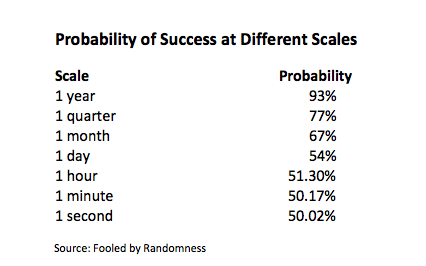
    “Nicholas Taleb, in his profound book, 'Fooled by Randomness', talks about the difference between noise and meaning. He uses the example of the happily retired dentist who builds himself a nice trading desk in his attic, aiming to spend every business day watching the market while sipping decaffeinated coffee. He watches his inventory of stocks via a spreadsheet with live price updates.”
    Chart shows that near-term “gains” or “losses” are relatively insignificant when compared to a portfolio’s longer term probability of success. (Cannot vouch for the accuracy of the statistics - but they appear reasonable.)
    image
    Read full story here
  • 2% swr
    @bee
    Thanks for a re-do of Roth conversions. These have been discussed here for many years; but a good reminder for those who may not be familiar and new to this investment area.
    @davidrmoran
    I presume you're referencing, in part; a non-spousal inheritance of your Roth's, that Secure Act provisions require non-spousal inheritance amounts be withdrawn within a 10 year period, but will not be taxed upon withdrawal. As long as the Roth has been in place for 5 years. Yes?
    @msf
    Good reminders for everyone regarding charity and IRMAA.
    et al Keep in mind that tax rates will become "different" after the Trump era tax changes expire in 2025. Whatever the rates become, could impact some of your taxable income, which would include RMD's. Yup, not that far away for planning purposes.
    Below links do not require a log-in.
    Fidelity Roth conversion Q & A
    Fidelity Roth conversion calculator
    Lastly, relative to the thread topic; everyone's monetary needs and asset base are different.
    Remain curious,
    Catch
  • CGM Funds to liquidate
    It is too bad that funds that liquidate can't just transfer the positions to the sharehoders.
    They can, unless they have promised not to (see below). While redemption in kind works for Authorized Participants who arbitrage huge slugs of equities, do retail investors really want to be handed dribs and drabs of many securities? The CGM funds are very concentrated, but they still hold over a score of securities that investors would have to deal with.
    CGM Mutual Fund (LOMMX): 19 stocks, 5 Treasury bonds
    CGM Focus Fund (CGMFX): 25 stocks
    CGM Realty (CGMRX): 42 stocks
    see also Adoption of (1) Rule18f-1 Under the Investment Company Act of 1940 to Permit Registered Open-End Investment Companies Which Have the Right to Redeem In Kind to Elect to Make Only Cash Redemptions and (2) Form-N-18F-1, Investment Company Act Release No. 6561 (June 14, 1971) [36 FR 11919 (June 23, 1971)] (“Rule 18f-1 and Form N-18F-1 Adopting Release”) (stating that the definition of “redeemable security” in section 2(a)(32) of the Investment Company Act “has traditionally been interpreted as giving the issuer the option of redeeming its securities in cash or in kind.”).
    https://www.regulations.gov/document/SEC-2016-2027-0001
  • Huge bump-up today, but...oct. 3rd, '22.
    @_yogibearbull
    Yes sir
    I read somewhere and posted last wk
    After severe panic selling days /capitulation, VIX massively high, poor sentiments
    Then followed (after 5-7 days sales off) w couple days uptrends ( bulk of Stocks sp500 mid caps low caps) 85% 90% finishing positive for 3 5 days (new consecutive higher highs) despite massive bad news, new baby bull maybe born/formed.
    Will watch market breadth/macd and market trends next 3-6 trading days
    Was watching Bitcoin, did not reach new lower low past 2 3 wks (less than 18.5k) which may mean bottom consolidations
    All bets off if uncle Powell keeping hawkish tones, both feet on the gas pedals/ no backing off (not 0.5%raise followed by 0.25% next yr, and no Qt slows down)...
  • Huge bump-up today, but...oct. 3rd, '22.
    According to Walter Deemer's feed on Twitter (LINK),
    Monday was 89% up-volume day (barely missed being 90% up-volume day)
    Tuesday was 95% up-volume day.
    2 VERY strong successive up-days. Rare.
  • Huge bump-up today, but...oct. 3rd, '22.
    Yes, i'm sitting back, just watching it all with (no doubt) some very temporary glee.
    Glad I found BHB when I did! ...I'm dying to see my PRISX pick itself up out of the ditch. ...It's only a relief-rally, anyhow.
    *bumped into KIT JUCKES last night on Bloomberg TV. He's always interesting, to my mind. He's the FX guy at Societe Generale.
    From a Linked-In profile:
    "I have been busily ignoring Linkedin for years. Linkedin have created another profile of me, as 'bloke what works for Societe Generale'. I am slowly going to start trying to figure this malarky out so if I ignore you or fail to connect with lifelong friends, it's cos I'm rubbish....
    My random thoughts can be found on twitter (@kitjuckes), or by finding my occasional blog on any search engine.
    I was born close enough to Eldoret to be slightly disappointed I can't run a marathon in anything like 2 hours. After that, I spent a lot of time in France, some in boarding school and then some in London, studying economics (though I seem to have spent an awful lot of time playing hockey, tennis and bridge, instead of studying). About a week before my finals I worked out that I really, really like economics, and some time later I worked out that what I am really interested in, is economic history. By then I'd decided to spend six years studying the wrong bits of economics. If I'd worked it all out earlier I'd be an academic, and my wife and children would have deserted me…..so it's all for the best."
    image
  • 2% swr
    @bee : You said , "Starting SWR prior to RMD may actually help lower RMD ." So true !
    When I retired I took what I thought I needed to live thru the year from IRA. Why, because I didn't start SS until 70. Also ran a few "Montys" to see some what ifs. Also the 15 or 20 times income to long term saving came into play.
    For those that can't control their spending in Retirement, will probably see a sharp drop in their accounts. Inheritance would also help the heavy spenders or winning the lottery. No such luck here !
    As said before, different strokes for different folks, Derf
    P.S. Good luck to all with your
    withdrawals, most here won't
    have a problem.