Howdy, Stranger!

It looks like you're new here. If you want to get involved, click one of these buttons!

Here's a statement of the obvious: The opinions expressed here are those of the participants, not those of the Mutual Fund Observer. We cannot vouch for the accuracy or appropriateness of any of it, though we do encourage civility and good humor.
  • Fido first impressions (vs Schwab)
    Ok, I got it.
    MM pays now 5+% but for years it pays under 1%. A couple of year from now it will be much lower. I can always find pretty good risk/reward bond funds but that's my specialty.
    Logins at 4 weeks interval and not interested too much tell me Fidelity is better for you.
    How can $250K sit idle? Suppose I sell 1 million and buy $950K(5% less than a million) it's only $50K. To have $250K sitting idle means you sold $5 million. I'm a stickler in that dept, if I see $100 left, I invest it.
    Taking care of my money and logging in 10 minutes 2-3 times per week is worth it. I always check all my other financial institution sites too. IMO, It's a must in the digital world to protect and verify your assets.
    I only invest in funds/ETFs, very rarely, I trade leveraged CEFs for hours/days when I see a good trade, like 2020, or 2022.
    What does someone pay for RIA services?
  • AlphaCentric Income Opportunities - A Cautionary Tale
    Just like FAIRX,SGIIX,OAKBX during 2000-10, and later 2010-17 mostly in LC tilting growth, I slowly changed to bonds, by selecting PIMIX as my first bond fund in 2010 and increasing it to over 50%, but I sold in 01/2018 and never looked back.
    Then I replaced it with IOFIX for over 50% of my portfolio again. But the world experienced covid and I sold at the end of 02/2020, which is part of my system. I posted about it on the current site (https://www.mutualfundobserver.com/discuss/discussion/55299/bond-mutual-funds-analysis-act-2/p2).
    I started buying again at the end of March 2020 and was fully invested by April. But, IOFIX lost it's mojo in 2021 and I discarded it like I did with many others before.
    The lesson, I make good money with special bond funds, but I'm very careful and sell immediately when the risk is high; in fact, I sell everything anyway.
    I follow this song (https://www.youtube.com/watch?v=7hx4gdlfamo)
  • Fido first impressions (vs Schwab)
    @FD1000
    We're talking past each other because we don't have the same needs from a brokerage or RIA.
    - I'm never 100% in the market so cash earning a competitive rate vs. nothing matters to me.
    - I do not have time to login to my Schwab account daily. Sometimes it might easily be 4 weeks between logins. Terrible waste of my time to login daily to prevent opportunity cost of idle cash.
    - Lost interest being peanuts. Relative to each individual investor as to what is considered peanuts. For example $250K sitting idle for 4 weeks costs $962 at a rate of 5%. Not a princely sum but no reason for me to pad Schwab's pockets.
    - I'm not a fan of layering unnecessary costs(RIA) but in my case I get access to investment instruments that I can't otherwise get without a RIA so cost/benefit to me totally worth it, it isn't even a close call.
    - The flat fee advisory model isn't a substitute for what I need from an RIA + most advisors aren't familiar with Alts. The boilerplate allocation stuff can be spit out by a robo advisor, don't need a human for that. Even an occassional subscription to portfoliovisualizer will be cheaper and better than most advisors.
    Good luck too on your journey.
  • Fintech Apps - Yotta Funds Missing
    Beware of nonbank fintech apps promising good yields.
    What did these people think they were getting from Yotta that they couldn't get from an actual bank?
    It turns out that there's a lot to unpack here. I had not taken a look directly at Yotta. Not surprisingly, it's a "gamified" site designed to attract young customers. But surprising (at least to me) is its banking arrangement.
    Unless I'm missing something, it pays just a 0.10% base rate. Though because it offers chances of winning money, its effective average rate is closer to 2.5% depending on where/when you read figures. So what one gets is the thrill of the chase in addition to (on average) a halfway decent rate of interest.
    Further, it looks like a customer's agreement is directly with Evolve Bank (and perhaps Synapse), not with Yotta. So technically, the customers may in fact be getting their services from an actual bank after all!
    Here's the sample customer agreement. It starts:
    Synapse Financial Technologies, Inc. (“Synapse”) is providing this Agreement to you on behalf of Bank. ...
    This Consumer Interest Checking Account Agreement (this “Agreement”) governs the interest-bearing consumer demand account (the “Account” or “Interest Checking Account”) made available to you by Evolve Bank & Trust (“Bank”), [member FDIC] in partnership with Synapse, as a technology service provider of Bank. ... Access ... is available only through ... Yotta.
    As to watching out for nonbank fintech apps promising good yields - Yotta's promised yield is okay but not great. In contrast, Raisin (formerly SaveBetter) appears to be a well established fintech though which one can get better rates from specific banks than one would get by going directly to those banks. Much as one can sometimes get better CD rates from a bank by going through a broker than going directly to the bank.
    I agree that caution is warranted, as it is for any financial investment. But there doesn't seem to be any substantial additional risk in using Raisin rather than going directly to the banks it works with. While I haven't used it, it looks like a good source of no-penalty CDs.
    Raisin review - Business Insider
    Top savings rates (with several Raisin arrangements) - Deposit Accounts
  • Final SECURE 2.0 & Inherited IRA RMDs
    Final SECURE 2.0 version has been released (260 pages). X/Twitter Jeff Levine
    https://public-inspection.federalregister.gov/2024-14542.pdf
    Edit/Add, 7/19/24. A longer thread is X/Twitter Jeff Levine2. It focuses on the unexpected vs the vague original SECURE 2.0 (re Roth 401k/403b, beneficiary classes, aggregation rule for partially annuitized IRAs, etc).
    One clarification of the 10-Yr Rule for Inherited IRA RMDs is that:
    (i) If the RMDs hadn't started, then the beneficiaries empty the IRA within 10 years in any way,
    (ii) If the RMDs had started, then beneficiaries must continue RMDs at least the same rate for 9 years, and empty the remainder in the 10th year. There have been waivers for these RMDs for 2021-24, and those years will be counted in the 10 years, but resume RMDs as required in 2025 and empty the remainder in the 10th year.
    Edit/Add. The above applies for designated-noneligible beneficiaries, the most common type. But the picture becomes very complicated if all types of beneficiaries are considered.
    https://pbs.twimg.com/media/GSzVXu9XgAApoW0?format=jpg&name=900x900
  • Fido first impressions (vs Schwab)
    stayCalm
    That said Fidelity and Vanguard imo are still better imo because one is not forced to manually enter a 2nd MMF trade for every single buy/sell.
    Most should don't trade, and most shouldn't own MM.
    This is such a small thing, no need to worry about, even if you didn't do the second buy, the yearly difference is meaningless.
    You still need to look at the TOTALs.
    Vanguard? no thank you, bad servicess.
    Fidelity? sure. But, as I said, waving commissions is probably about $2K for me. The ability to invest 99% on day one when I switch funds at Schwab can generate another $K
    These are all peanuts.
    Regards your Catch 22 comment
    I made a generic comment not related to you. All I can tell you is that I met probably at least with 30-40 financial advisors, and I wasn't impressed. Most are just salespeople who repeat what is fed to them.
    Most are not real fiduciaries, even if their title says so. A good one should assess your goals in a couple of hours, set a plan for years to come, and only make changes at pivotal points.
    They also should put you in up to 5-7 funds, at least half indexes, it's not a brain surgery.
    That means charging you maybe $1000-1500 first time and nothing for years, hardly any of them will do it. Fiduciaries should look at their clients interests, not charge them every year, and never by the size of their portfolios.
    Good luck.
  • AlphaCentric Income Opportunities - A Cautionary Tale
    Here's latest on this saga ...
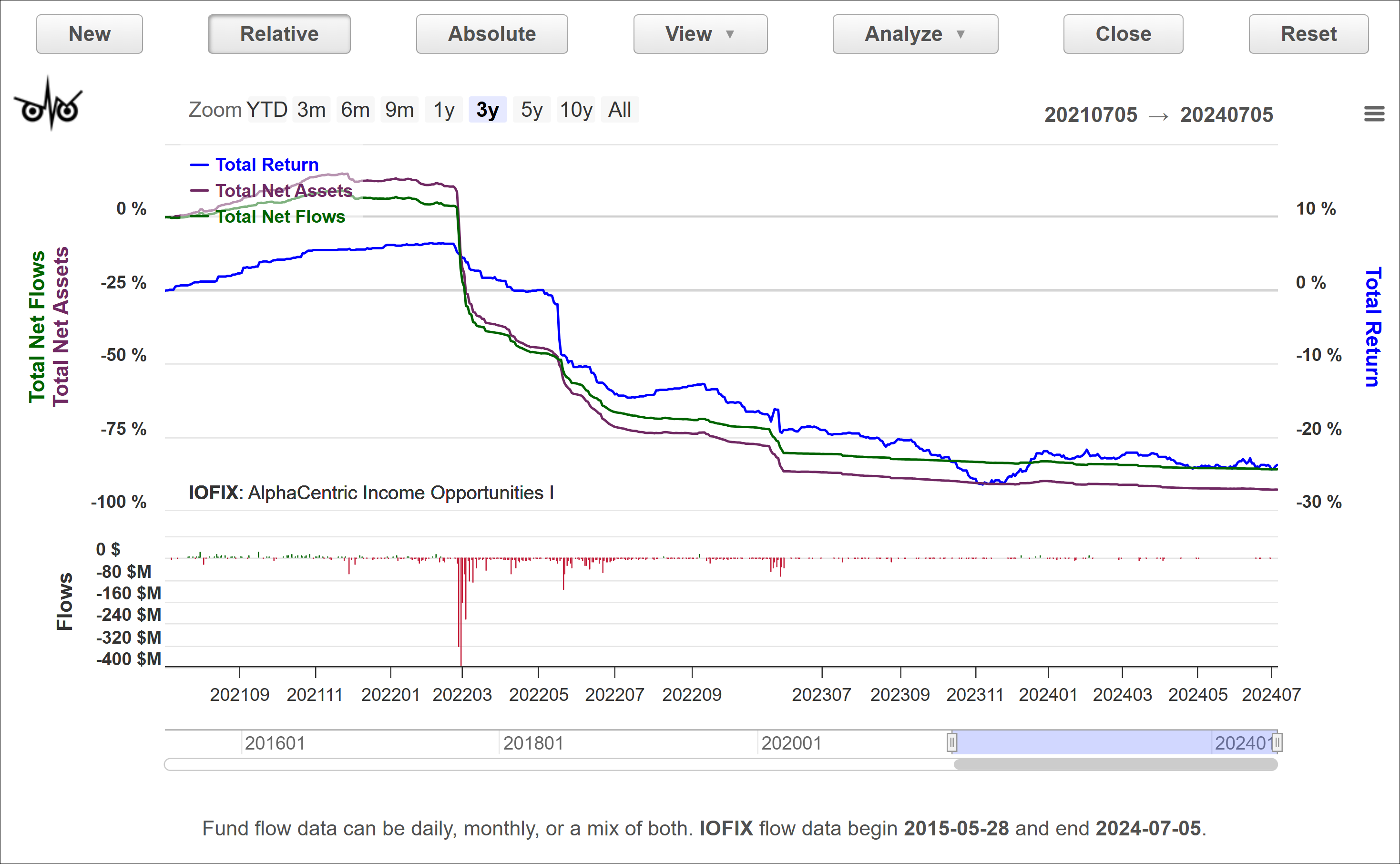
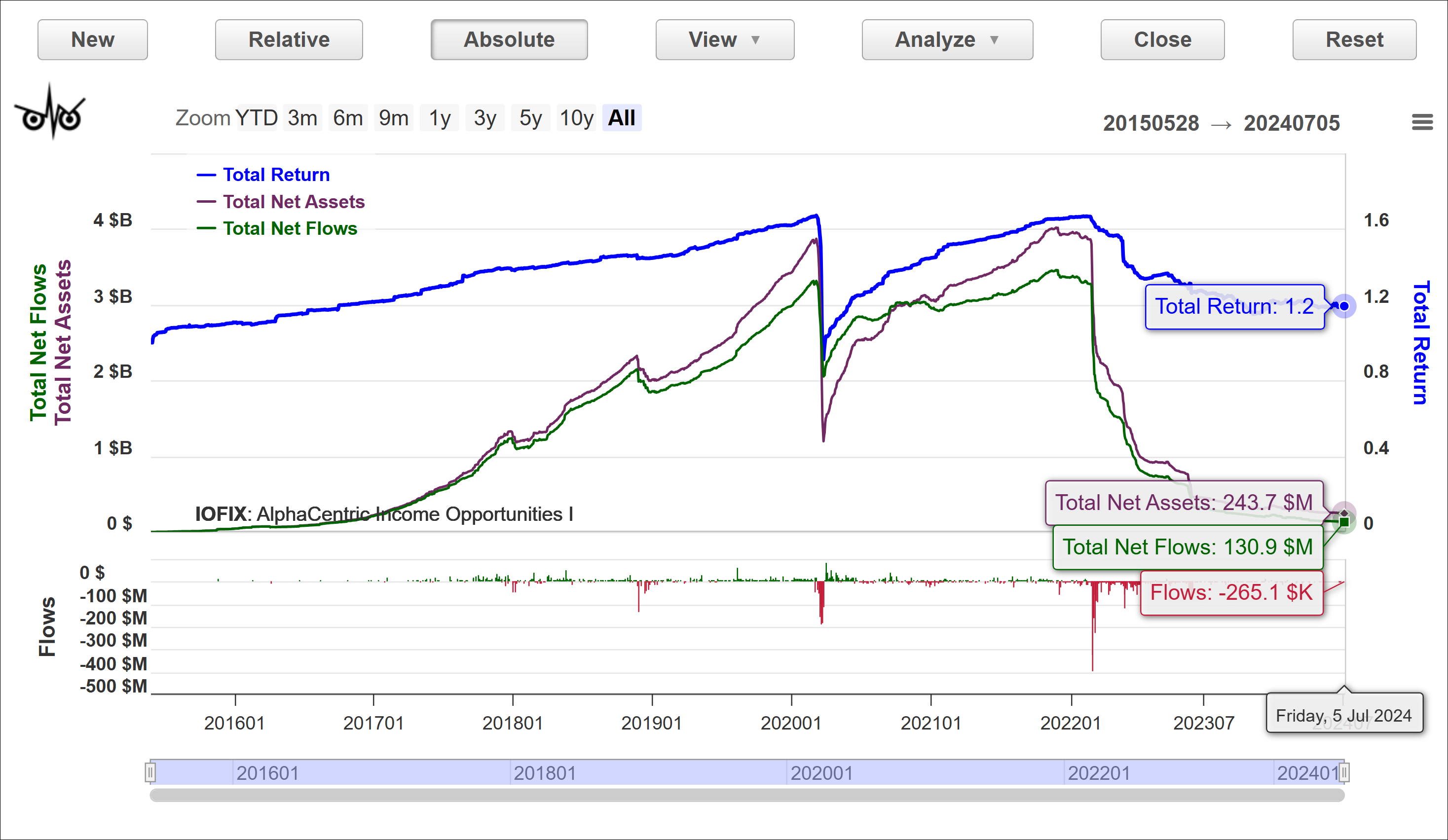
    IOFIX has not recovered and outflows continue.
    I also see that Tim Miner has departed Garrison Point. I was a big fan. Garret Smith, Brian Loo, and Jonathan Tran remain.
    Just 2 years ago, IOFIX enjoyed more the $4B in AUM. Now, under $250M.
    c
    IOFIX Flows and Return Data Last 3 Years
    image

    IOFIX Flows and Return Data Since Inception (Absolute Scale)
    image
  • Trump Sits Down With Businessweek
    First of all….sorry @hank…..I oftentimes get you and @Crash mixed up in my brain for some reason reason. It was Crash’s post that he since deleted. So sorry!!! @Crash, your post DID have some good investing stuff in it, you’re right.
    Second of all, I think many of us can be disappointed that the parties we have so long known no longer exist, as they have been taken over by individuals or families and dominated (Clinton’s and Obamas of Democratic Party, and Bush’s and now Trump’s of Republican Party). Most of us vote for the party that upholds the core handful of things that we believe in, with the other stuff that we DONT believe in being not enough to make us vote for “the other guy” (and hopefully, “girl” someday soon!). Last piece of politicking, I promise :)
    I don’t know how de-globalization, stopping the mass border crossings (a supply of cheap, “pay under the table,” labor) and “making things with that beautiful ‘Made in America’ stamp” aren’t inflationary. Combined with pressure put on the Fed to lower interest rates, where will that leave our economy?
    I watch way too much CNBC (it’s usually on as background noise), but Cramer was saying how the Russell 2K can’t handle billions and trillions rotating out of tech/growth because the market cap of the entire index is a mere percentage of a single Mag 7 stock. So they cannot be market leaders by themselves. LC value could be….maybe betting on the next trillion dollar market cap stock? LLY, BRK, JPM are close (above $500 billion).
    @BaluBalu, what do you mean “Energy Services” stocks? SLB and HAL (sorry for the ignorance), or pipelines/drilling stocks? Good point that increased supply will mean lower prices (good for consumer, arguably, but less good for energy stocks). Maybe energy transportation stocks, as the US would likely be exporting more energy (especially LNG). I have held in the past OKE (but sold about $20 lower price! *face palm*), ENB, WMB, KMI. Pipeline companies trade more correlated to oil than they probably should. But these are NOT K-1 issuing companies.
    I think defense stocks would do ok, even with the ending of war, as munition stocks would be replenished from the drawdowns from supplying Ukraine, and continued high military spending; maybe an increase in supplying Israel with military “stuff.”
    Utilities have been a mixed bag the last week or so, as the winners of the AI-linked energy supply, such as VST or CEG (and NEE, but that’s more green energy) have gone down as much or more than big tech. And I believe these are some of the more nuclear utility companies; you would think the new administration would be ok with nuclear power (maybe it’s “down with everything that’s considered alternative energy”).
    As far as fixed income, I’m not playing a drop in rates yet (as the market moves interest rates more than the Fed does anyways), other than potentially getting out of money markets. I continue to use preferreds (several that are floating rate, such as mREIT preferreds) and baby bonds, CLO ETFs (JAAA, JBBB, CLOZ…..thanks to multiple posters here for teaching me about them), and the low volatility mutual funds that @junkster and @FD1000 and others like (RSIVX, RCRFX/RCRIX, and a few others) that either don’t move or go up a penny every 5-10 days or so. I have been burned by income CEFs too many times to count; their yield is great, and if they traded like their NAV, then they would be amazing investments, but alas, their prices swing wildly. If I want to lose money, I would be better off swing trading the 3x tech ETPs hahaha. So I’m staying mostly away from bond CEFs and core/core-plus/multisector bond OEFs too.
    For my wife’s 401(a) she DCAs into once a month, her two biggest holdings are DODGX and HACAX (Harbor’s LCG). They’re about an equal allocation, and they take turns going up (or down) more than the other. I got her out of her small cap value holding there about 2 weeks before the meteoric rise over the last 7-10 days (“I’m an excellent market timer”), and I also have a workplace retirement account from my current employer that I cant add to, and is limited to OEFs only. In that account I am WAY overweight LC growth and tech (I am 47, though so I can be, hopefully?) and only hold a tracking amount of @stillers favorite AUERX as my only SC holding. I WILL talk up a fund that MFO has talked about in the past: FAMEX, a MC blend/value fund that is a long term winner, and is the number 2 holding in that account (a distant 2nd to PRWCX; can’t believe my good fortune that I got into that fund before it closed!).
    Apologies for the last paragraph: it went off topic for this thread.
    I will continue to favor big tech for longer term returns, and the high quality of the companies. Most even pay a dividend now (even if a pittance). Maybe an equal weight in both LC growth and LC value would be a good way to play the next several months, rather than holding the S&P 500 index (which is basically LCG)? Or a quality fund, like @davidrmoran and several others like (including me; I own GQEPX and some accounts I manage have QLTY).
    Apologies for the length of my post….sheesh. And apologies for the kerfluffle from my earlier post (AND FOR MISTAKEN IDENTITY!)!!
  • Fido first impressions (vs Schwab)

    With Schwab, if I purchase a new position I have to sell SWVXX the same day because SWVXX will settle next day.
    With Fidelity(my understanding) is that the MMF will auto trade and settle next day to cover the prior day purchase therefore MMF position earns interest for an additional day in a Fidelity MMF vs. a Schwab MMF wrt purchase of any instrument that settles T+1.
    Your understanding is correct as far as it goes, but it doesn't address when within the day that settlement occurs.
    Investors receive dividends if they own securities at the close of market on the record day. MMFs declare divs daily. You get the div for a day if you own the fund at the close of market. That's why T+0 MMFs pay divs from the day of trade - settlement is intra-day and you own the shares the day you buy them. And why they don't pay divs the day you sell - settlement is again intra-day and you don't own the shares at the end of the day.
    That's not the way the prospectuses of most Fidelity MMFs read. FSIXX is an exception, as seen in the prospectus excerpt above. This is also why it has a trading deadline of 2PM (Merrill requiring trades by 11:45AM to meet this deadline). Any later trades aren't processed until after market close (i.e. T+1) like most securities.
    This idea of intra-day trading and deadlines may not be familiar to many. Some people may remember that Fidelity Select funds used to price (and trade) hourly. Similar idea, though the closing day didn't matter much since these funds declared divs annually(?), not daily.
    You are correct that the MMF "auto trades" the next day, and settles that same next day. But what you're missing is when within the day it sells and settles. That happens before market open. Check your activity log or statement; it says "Morning Trade". You don't get the MMF div on the settlement day because you don't own the MMF shares at the close. Even though you "auto traded" the MMF on the settlement day.
    The trading timing for Fidelity MMFs is described, albeit not too clearly, in the brokerage agreement:
    If You Utilize a Fidelity Money Market Fund as Your Core Position
    If you utilize a Fidelity money market fund as your core position and there are debits in your account generated by account activity [e.g. bill payment] occurring prior to the market close each business day ... these debits will be settled at the market close using the following sources, in this order:
    • the Intra-day Free Credit Balances
    • redemption proceeds from the sale of your core position at the market close
    • redemption proceeds from the sale of any shares of a Fidelity money market mutual fund held in the account ...
    • [available margin]
    There will be an additional sweep early in the morning prior to the start of business on each business day, and certain unsettled debits in your account along with debits associated with certain actual or anticipated transactions that would otherwise generate a debit in your account during the business day will be settled using redemption proceeds from the sale of your core position early in the morning prior to the start of business.
    That early morning MMF sale prior to market open is to settle the debit generated by acquiring a new position the previous day.
    Bottom line - yes, the Fidelity MMF trades the day of settlement; no you don't get an extra day's div because the MMF sale is settled prior to close of business that day. Same result as with SWVXX, that earns its dividend on the trade date because it settles on the following day. SWVXX prospectus.
    MSF post several things that take more time or don't exist.
    I think that everything I posted in the previous post was either a prospectus excerpt or a description of an actual trade I made, could you (FD1000) state what it I posted that doesn't exist? Well, I did also post current 7 day yields, but I don't think that's what you're questioning :-)
  • AAII Sentiment Survey, 7/17/24
    AAII Sentiment Survey, 7/17/24
    BULLISH remained the top sentiment (52.7%, high) & bearish remained the bottom sentiment (23.4%, below average); neutral remained the middle sentiment (23.8%, low); Bull-Bear Spread was +29.3% (high). Investor concerns: Elections, budget, inflation, economy, the Fed, dollar, Russia-Ukraine (125+ weeks), Israel-Hamas (40+ weeks), geopolitical. For the Survey week (Th-Wed), stocks mixed (growth down, cyclicals up), bonds up, oil down, gold up, dollar down. NYSE %Above 50-dMA 76.32% (overbought). US market broadening or rotation has started. Republican ticket is set; Democratic ticket has clouds over it. #AAII #Sentiment #Markets
    https://ybbpersonalfinance.proboards.com/post/1558/thread
  • BOXX ETF
    1 yr total return: BOXX 5.34%; USFR 5.55%
  • Fido first impressions (vs Schwab)
    How is the above possible when you don't know what the sale proceeds will be(or even that the sale will actually go through) or do you do a conservative estimate and sweep up the remaining next day?
    Well, pretty easy. Suppose you own US LC, before closing, they were down 1.3%.
    If I sell $500K, I deduct 5% (for me it's 3%, I never made a mistake), and enter a buy order for $475K. The next day, I do the rest.
    BTW, most of my money is in IRA. Fidelity will not let you execute a buy order for the sell proceeds at all. You must call a rep, many times I argued with them, and they can enter a 90% buy, even if you sold a bond fund. I deal mostly with bond funds with min change, and why I buy at 99% on the Schwab site instead of wasting time and energy.
    90% is a Fidelity invention I haven't seen in any other broker. Sometimes they lie and say it is a SEC rule.
    I'm not paying RIA a penny :-)
  • Rising Auto & Home Insurance Costs
    @Observant1
    Was the Amica quote for a dividend-paying or non-dividend policy?
    We have dividend-paying policies with Amica - the cost is higher upfront but after our 20% dividend for auto/umbrella and 25% for homeowners, our bottom line is lower than any other company.
  • Fido first impressions (vs Schwab)
    @FD1000
    "Even if I sell a fund into cash, I buy into MM fund immediately = same day settlement"
    How is the above possible when you don't know what the sale proceeds will be(or even that the sale will actually go through) or do you do a conservative estimate and sweep up the remaining next day?
    Cash drag in Schwab isn't a thing for active traders like you but I'm not in the account daily so for me cash drag costs start adding up because I have multiple Treasuries spread out over multiple accounts with varying maturities so at times it could easily be a week of my matured Treasury earning squat or near squat at Schwab vs. automatically earning a solid rate at Fidelity.
    I've never been a day trader but many years back I was "active" (5-10 trades a month). Going by memory but I would not touch Schwab for any level of active trading. Both web and mobile apps are significantly less stable than Fidelity.
    All of my transfers have been electronic and for every single one of them I've had to follow up with Schwab reps multiple times to actually get it done and done right.
    The necessity of doing a 2nd MM transaction to either avoid margin or cash drag for every single buy/sell is a major turn off for me -- basically double the work for no additional benefit compared to Fidelity.
    Fidelity's major flaw is the wire transfer form when FFC is needed -- that thing is a radioactive disaster.
    Your point about Schwab allowing you to invest in I Class shares is interesting. No limits or account minimums at all? I can invest in most I Class shares at low to no minimums but that is due to my RIA.
    To each their own!
  • Fido first impressions (vs Schwab)
    Schwab relies very heavily on uninvested cash from customers -- don't know why there is confusion around this. Not offering auto sweeps into a MM fund like Fidelity and Vanguard is not due to Schwab being lazy, it is central to Schwab's strategy. Also Schwab MMF settles T+1 unlike Fidelity MMF which settles same day so another opportunity for Schwab to extract rent. Schwab strategy succeeds for the exact same reason that the large banks can get away with offering laughably low rates on savings account -- sloth behavior from customers.
    I find Schwab customer reps generally more friendly than Fidelity but Schwab sucks in efficiency compared to Fidelity. I'd happily move to Fidelity if my RIA supported them. I did 4 account transfers into Schwab and they found a way to screw up/significantly delay all 4. That takes a special talent. Today I called Schwab to check on the status of an IRA transfer for which I submitted the paperwork more than 2 weeks back. Radio silence from Schwab even after a Message Center follow up. Not even a simple "Yea we got it, give us X days". Funny thing is that Fidelity as the releasing institution sent me an automated mail (very unusual) acknowledging the request.
    As I explained before, T+1, isn't a problem. I hardly ever have cash, unless risk is very high. I always sell a fund and buy another, no MM. Even if I sell a fund into cash, I buy into MM fund immediately = same day settlement.
    "I did 4 account transfers into Schwab and they found a way to screw up"
    I transfer probably at least 20 times, never screw up. Several friends and relatives I sent to Schwab have done transfers; all had zero problems.
    I have done transfers online (no paperwork) for years now.
    Customer service at Fidelity is far better than Schwab. Fidelity reps used to be good, but in the last 3–5 years, the service has deteriorated.
    MSF post several things that take more time or don't exist.
    Well, I'm a trader for about 25 years. No single bond, stocks. No CD or treasuries. No sophisticated pro trade software. It's all mutual funds/ETF and rarely trading CEFs very short time.
    Schwab site is better and easier. If I need to trade and look at other things which is rare, I open another session, as I do with other sites. That's why I have a 24" screen. I also trade on my cell if I need to, but usually I don't.
    I like speedy update, Fidelity updates are behind. The most irritating is end of month distributions. I see them at Schwab already at 8-9 PM on the same day, it takes Fidelity another day, sometimes 2 days.
    For me, as a fund trader, Fidelity is the worst, and I have been in several shops, they will not wave the commissions on Inst shares, all the others did many of them.
  • Fido first impressions (vs Schwab)
    Also Schwab MMF settles T+1 unlike Fidelity MMF which settles same day so another opportunity for Schwab to extract rent.
    Well, sort of. Fidelity requires the purchase money to be available same day, which is the definition of "same day" settlement. But you don't start earning money in the new MMF account until the next day. And isn't that really what we care about here?
    Here's an excerpt of a post by a Fidelity moderator on a Reddit thread:

    Settlement for money market funds is generally same day. For anyone unfamiliar, the settlement date is the day on which payment for securities bought, or certificates for securities sold, must be in your account.
    ...
    When you purchase a Fidelity mutual fund, they begin earning dividends or interest on the first business day after the effective purchase or trade date, including money market funds. The core position is the exception to this, as the core begins accruing interest once funds are posted after a deposit
    https://www.reddit.com/r/fidelityinvestments/comments/159dtyj/settlement_time_for_money_market_fund_investments/
    Contrast that with "true" T+0 MMF settlement. I purchased a Fidelity MMF at Merrill on June 28th (last trading day of the month). Had it started earning money the first business day (July 1) after the trade date, then I would have earned no divs in June. Yet I was credited with earnings for the month. The activity log reads: "PAY DATE 06/28/2024".
    Here's an excerpt from the FZDXX prospectus - a higher yielding MMF available in a Fidelity retail account:
    Shares purchased by all other orders generally begin to earn dividends on the first business day following the day of purchase.
    Here's an excerpt from the FSIXX prospectus, another Fidelity MMF, one that is available to retail customers at Merrill:
    Shares purchased by a wire order prior to 12:00 noon Eastern time for Tax-Exempt Portfolio, prior to 2:00 p.m. Eastern time for Treasury Only Portfolio, or prior to 5:00 p.m. Eastern time for Government Portfolio, Money Market Portfolio, and Treasury Portfolio, with receipt of the wire in proper form before the close of the Federal Reserve Wire System on that day, generally begin to earn dividends on the day of purchase.
    BTW, Merrill sets an 11:45AM settlement time for FSIXX in order to get same day settlement. (If logged into Merrill, see here.) I guess it takes a little time to get the money wired to Fidelity.
    FSIXX is a treasury only (state tax-exempt) MMF currently (as of July 16) offering a higher 7 day yield (5.18%) than does FZDXX (5.15%).
  • BOXX ETF
    NYU law professor Daniel Hemel digs deep into the mechanics of the ETF BOXX and the fuzzy areas of tax laws (sections 1258 and 1092) that its tax deferral claims to exploits. He thinks that eventually there would be an IRS clarification or challenge that would negate much of the tax angle of BOXX. So, the play may really be whether the holders of BOXX will be grandfathered.
    All this fancy footwork just to create money-market or T-Bill returns? But investors love new black-boxes.
    https://www.taxnotes.com/featured-analysis/tax-trap-inside-boxx/2024/03/08/7j8x0
  • More Vanguard Brilliances
    Today I received Vanguard Letter's # 4 & 5 =
    telling me they have updated my Old email address = [email protected]
    to New email address = [email protected]
    YES FIVE LETTERS !!!!
    I HOPE VANG.
    NEW PRESIDENT WILL KICK SOME BUTT & AND FINIALLY PUT VANG BACK TO THIER FORMER COMPETANCE.
    Ralph Etris
  • Buy Sell Why: ad infinitum.

    I think I'll just sit and wait for a bit. The muni's should gather a nice price increase while kicking off a fairly respectable taxable equivalent yield.
    image
  • Buy Sell Why: ad infinitum.
    May buy VONG on pullback, certainly on a serious one. Or VONE. Am v v happy with +10% growth in positions taken in QLTY and JQUA at Fido (ML prohibits buying the former and does not allow reinvest w the latter!) months ago on pullback. Would that I had put in 5x.