
Howdy, Stranger!

It looks like you're new here. If you want to get involved, click one of these buttons!
Here's a statement of the obvious: The opinions expressed here are those of the participants, not those of the Mutual Fund Observer. We cannot vouch for the accuracy or appropriateness of any of it, though we do encourage civility and good humor.
  • Clarkston Select Fund is "hard" closed
    https://www.sec.gov/Archives/edgar/data/1558107/000139834419000860/fp0038702_497.htm
    497 1 fp0038702_497.htm
    ALPS Series Trust
    Clarkston Select Fund
    (the “Fund”)
    Supplement dated January 18, 2019
    to the Prospectus and Statement of Additional Information dated January 29, 2018, as supplemented
    Notice to Close the Clarkston Select Fund
    Effective January 28, 2019, the Fund is closed to investment by new and existing shareholders. However, the ability to redeem Fund shares remains unchanged.
    INVESTORS SHOULD RETAIN THIS SUPPLEMENT FOR FUTURE REFERENCE
  • Grandeur Peak reopens some of its funds with restrictions
    If you believe the GMO 7-year forecasts, along with many of the other pundits, emerging markets is the place to be for the next 5-10 years relative to other asset classes; so I would expect the Grandeur Peak funds to do well since they are heavy on emerging markets. Only time will tell, I'm not unloading mine just yet!
  • STATX - what am I missing?
    Even older funds may not gather many assets if they don't market themselves. See BRUFX - 35 years old, $500M, not available through any brokerage. (But it does offer an HSA - talk about a stealth product!)
  • The 6 Best Vanguard Index Funds for 2019 and Beyond
    “Investing icon Warren Buffett advises investors to stash 90% of their money in a Standard & Poor’s 500-stock index fund and keep the rest in short-term government bonds.”
    Anybody know what degree of truth this statement attributed to Buffet holds? I was aware that he shifted all or most of his retirement funds to something like that nearly a decade ago, in part, because he wanted to simplify things for his wife to manage after his death.
    If Buffet made such a statement directed at all investors (1) I’m not aware of it and (2) it would be preposterous advice because each individual’s situation is unique. If I had 90% of my retirement savings in the S&P 500 I’d be always on “pins & needles”, unable to sleep and, perhaps, standing out on a NYC ledge during one of those single-day thousand-point dips in the Dow.
    Back to Buffet - When people have amassed mega-millions it sometimes causes them to invest / view risk differently than most of us small-fry. Some avoid the risk of stocks completely and move into bonds, thinking they can survive the remainder of their lives on what they already have. Others, like Buffet, are content to go with the averages and remain heavily invested in equities.
  • STATX - what am I missing?
    I'm trying hard to convince myself this fund is legit.
    Thinking maybe they limit access to STATX because the market is so limited that they would lose the ability to make money if it grows too large. AUM max of $400M-$500M is probably ideal.
    I wonder if Vanguard does any DD before they add such funds to their offerings.
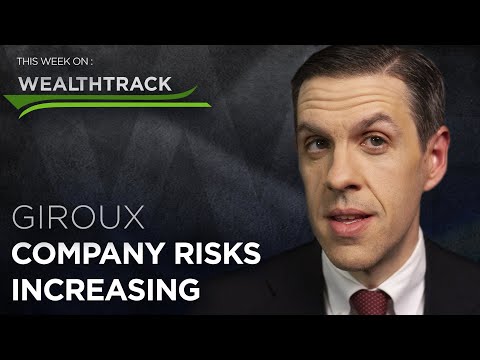
  • Consuelo Mack's WealthTrack Preview: Guest: David Giroux, Manager, TRP Appreciation Fund: (PRWCX)
    FYI: (Fund is closed to new investors.)
    Regards,
    Ted
    January 17, 2019
    Dear WEALTHTRACK Subscriber,
    How concerned are you about stock market risk? Have occasional eight hundred point drops in the Dow, corrections in various indices, presidential tweets and trade disputes had you reaching for your Pepto-Bismol or Valium?
    Market volatility has definitely picked up in the last year or so. Not an unusual occurrence. There have been many rocky periods, plus several euphoric highs and nail-biting lows during the long bull market that began in 2009. But those are not the risks that this week’s guest is focusing on. He is looking at much more fundamental, structural changes that he says are affecting the long-term future of specific companies, lots of them.
    He is David Giroux, Portfolio Manager and Chairman of the Investment Advisory Committee of T. Rowe Price Capital Appreciation Fund which is a Morningstar Gold Medalist and carries a Five-Star rating. Giroux was named Morningstar’s Allocation and Alternatives Fund Manager of the Year in 2017, the second time he was so honored and has been nominated for the award several other times.
    It is Giroux’s role as Head of Investment Strategy at T. Rowe Price that is the focus of much of today’s conversation because he is leading research projects across T. Rowe Price’s investment platform and asset classes. One of his major efforts is identifying secular risk in companies and avoiding companies that have it. He and his team estimate that over a third of S&P 500 companies are facing risks that will result in lower performance over the next ten years and that their numbers are increasing.
    As always, this week’s program is available to our PREMIUM subscribers right now. In our exclusive EXTRA feature with David Giroux you’ll learn about a book that he says has improved his and his team’s productivity significantly.
    Thank you for watching. Have a lovely weekend and make the week ahead a profitable and a productive one.
    Best regards,
    Consuelo
    Video Clip:

    M* Snapshot PRWCX:
    https://www.morningstar.com/funds/xnas/prwcx/quote.html
    Lipper Snapshot PRWCX:
    https://www.marketwatch.com/investing/fund/prwcx
    PRWCX Is Ranked #19 In The (50-70/% E) Fund Category By U.S. News & World Report:
    https://money.usnews.com/funds/mutual-funds/allocation-50-to-70-equity/t-rowe-price-capital-appreciation-fund/prwcx
  • Barry Ritholtz's Masters In Business: Guest: John Bogle: 3/14/16
    FYI: In our latest Masters in Business podcast, we speak with Jack Bogle, founder of the $3.5 trillion dollar Vanguard Group, creator of the index fund, and all around investing legend.
    Bogle tells the fascinating story of Vanguard’s origins. At the time, he was Chairman of the Wellington Funds, and due to a disastrous merger, was fired from that role. He found a niche within the asset management group running Wellington’s what he describes as unmanaged funds. This was the first equity index fund — Bogle later created the first bond index fund as well — and he named the new management company company for the HMS Vanguard, flying Rear Admiral Sir Horatio Nelson’s flag.
    Bogle discusses Wall Street’s initial response to index funds, explains why no one ever really decided to compete with Vanguard, and holds a master class on the proper way to invest.
    In our MiB interviews, we usually come prepared with 5 broad topic areas and over 50 questions I use to guide the conversation. Bogle, however, is a force of nature, and after gamely trying to say on script for about 12 minutes, I quickly gave up, satisfied to merely have an amazing conversation with one of the most legendary personalities in all of finance.
    Regards,
    Ted
    https://ritholtz.com/2016/03/mib-jack-bogle-vanguard-group-founder-2/
  • The 6 Best Vanguard Index Funds for 2019 and Beyond
    As an aside, a pretty well diversified low volatility (OMG), managed (OMG) fund, VMVFX beats all of the listed funds since its inception except one. The exception is barely being beat out by the SP500 fund. I realize one of the funds is a bond fund. So, what makes those funds so great for 2019?
  • The 6 Best Vanguard Index Funds for 2019 and Beyond
    https://www.kiplinger.com/slideshow/investing/T030-S001-6-best-vanguard-index-funds-for-2019-and-beyond/index.html
    Investing icon Warren Buffett advises investors to stash 90% of their money in a Standard & Poor’s 500-stock index fund and keep the rest in short-term government bonds. That’s a good start for investors who want to keep things simple, but it limits your investments to large U.S. companies. So today, we’ll show you how the best Vanguard index funds can add more portfolio diversification while still keeping your strategy simple.
  • STATX - what am I missing?
    @JoeD,
    The telephone number on the website seems to be to the actual office of the fund rather than the transfer agent's office.
    There was a post on M* (under "Bond Squad" with STATX) that resonates the same sentiment about the telephone number to Las Vegas and how the inquiry was handled.
    Here is the link to M* discussion on STATX:
    http://socialize.morningstar.com/NewSocialize/forums/p/385173/3953084.aspx
    M* listed VG as the only brokerage to trade STATX.
    I believe the prospectus mentioned something about paying dividends at least twice a month:
    https://www.sec.gov/Archives/edgar/data/1679960/000116204418000223/state485bpos201803.htm
    FUND DISTRIBUTIONS
    The Fund distributes substantially all of its net investment income to shareholders in the form of dividends. The Fund intends to declare and distribute income dividends every two weeks to shareholders of record. In addition, the Fund distributes any net capital gains it earns from the sale of portfolio securities to shareholders no less frequently than annually. Net short-term capital gains may be paid more frequently. Dividend payments are made through DTC participants and indirect participants to beneficial owners then of record with proceeds received from the Fund.
  • STATX - what am I missing?
    http://www.tbil.co/wp-content/uploads/2019/01/Mutual-Fund-Fund-Fact-Sheet-Final-01.11.19.pdf
    Link to STATX (State Funds Enhanced Ultra Short Duration Fund) Fact Sheet.
    Wish I understood a bit more about the leveraging effect via lending (reverse repos) and how much that contributes to the returns. They do offer a nifty little video at their site.
    Not sure why they pay out divys 2x per month. Treasuries don't pay interest, correct? You buy at a discount. But I guess they churn with those repos and collect fees.
    *Fund receives securities lending collateral which is limited to (i) 102% cash or (ii)
    102% - 115% US Government Securities.
    * Fund lends its 3 Month Treasury bills and receives a lending fee which is paid to the
    fund and distributed as a dividend to investors.
    Maybe this is a fund that only works if the AUM stay small and they can pick off those "pennies and nickels"?
  • STATX - what am I missing?
    Taking a closer look at this now than I did in the last thread, and I'm wondering how far off you are with that "Bernie" comment.
    The strategy has echoes of RPHYX's - buying "orphaned securities; exceedingly short-term (think 30-90 day maturity) securities for which there are few other buyers."
    [Than you Professor for Riverpark's fund profile: https://www.mutualfundobserver.com/2012/09/riverpark-short-term-high-yield-fund-rphyx-july-2011-updated-october-2012/]
    In the case of RPHYX, the remnants are short term junk bonds that the fund manager believes have little risk of default. In contrast, STATX is picking up short term Treasuries (with presumably even less risk of default).
    While both funds may be picking up coins from the sidewalk (bonds that aren't being bought by other investors), ISTM that RPHYX is picking up nickels and STATX is picking up pennies.
    So how does STATX generate an SEC yield a full percentage point higher than RPHIX's, even allowing for its 1/2 percent lower fees? Especially since it is investing in higher grade bonds, slightly shorter average maturity (1.0 vs. 1.1 years), and lower duration (0.01 vs. 0.55 years)?
    The only thing I see is the use of reverse repurchasing agreements, which as the prospectus states, has "a leveraging effect on the Fund’s NAV".
  • Morningstar Fair Market Value Chart -- Cheapest Since 2012
    Hi @Derf and good morning. Thanks for your question.
    I did put a little bit of cash to work recently opening first step positions in DWGAX, INUTX, PONAX and TEQIX since I have now reached my new asset allocation of 20% cash, 40% income and 40% equity. My focus this year is to grow my portfolio's income generation while maintaing my asset allocation along with achieving some growth of principal. Over the past five years my portfolio's income generation has ranged from a low of 3.0% to a high of 5.3% with an average of 4.4%. I'd like to get my income average a littler higher. Ten years ago its average was north of 5%. As most of us know yields have dropped during this time frame but are now (more recently) back on the rise. Even with the past, and more recent, market swoons my portfolio's total return has been better than nine percent annually over the past ten years; however, I also held a greater percentage in equities earlier than I presently do. At one time I was about 70% equity but I have now reduced this down to 40% equity (through time) due to an age based asset allocation realignment. Now being 70+ years in age I consider my present asset allocation, noted above, to be an all weather asset allocation, for me, as it holds ample cash, generates ample income, and should still grow my principal over time.
  • Morningstar Fair Market Value Chart -- Cheapest Since 2012
    Thought I'd share. Back in my days in elemetary school we had a daily show and tell. Now, retired we still have a daily show and tell among some of my old classmates. So, here is my "show and tell" for the board.
    In viewing Morningstar's Market Valuation Graph this morning (1/16/19) and converting its reading of 0.92 to Old_Skeet's market barometer scale I come up with a score of 162 for the graph indicating oversold. In compairson, Old_Skeet's barometer (which follows the S&P 500 Index) based upon its metrics has a reading of 156 which reflects that the Index is undervalued.
    Have a great day ...
    Old_Skeet
  • Grandeur Peak reopens some of its funds with restrictions
    I've held 3-4 of their funds since they opened the shop. It went swimmingly until it no longer did. When their funds were outpacing the pack the boys from Utah looked like geniuses, making company visits where few venture, and seeming to have a great team. The last two shareholder letters paint a very different picture; there's talk of mistakes, the need to move personnel around, a recognition that no matter how great a company might appear to fund management, the market is cruel. I still ponder what a "guardian portfolio manager" ought to be doing with respect to the rest of his team. I'm holding for now, but I previously dumped a significant percentage of my foreign (over)exposure.
    I think we all like honest and direct shareholder letters. The situation at GP reminds me of Bridgeway Funds, another small, independent company that had great numbers for several years. Bridegeway does good with its profits and seems to be a good place to work. John Montgomery writes fine analyses of his firm's fund performance. It really sounds good, but the performance of their small and micro-cap funds does not cut the mustard. Montgomery's first vehicle was BRUSX, a real winner for a long time. But in the last 10 years he's may behind his benchmark, losing an average of 3.58.% in the last 5 years, for example. Le marché est cruel.
  • Would you buy a mutual fund from Amazon?
    Large retailer moving into financial services/products space. Where have I heard this before?
    Oh yes, 1981, when the U.S.'s largest retailer (Amazon is currently only third), already owning an insurance company, acquired a financial services company. Most of its business came from selling mutual funds, MMFs, and CDs. At the time, it was looking forward to making even more money off a new fangled financial product called an eye-are-eh.
    So how'd that work out with Sears, Dean Witter, Allstate, and Discover?
    Of course there are many ways for a company to get into the mutual fund business besides this one and the couple mentioned in Investopedia. It could simply serve as the sales arm of an existing fund or family as Vanguard originally did when Bogle founded the company: provide administrative and distribution services for an existing company. Or it might function like Harbor, branding the funds and overseeing the management, but outsourcing the day-to-day management of all its funds to third party money managers.
  • Would you buy a mutual fund from Amazon?
    Caught the speculation on Bloomberg today. Nothing definite. But usually where there’s smoke there’s fire.
    BY DANIEL LIBERTO Updated Jul 25, 2018
    Excerpt:
    Amazon.com Inc. (AMZN) has all the right tools in place to take the asset management industry by storm, according to Sanford C. Bernstein & Co. In a research note, reported on by Bloomberg and Financial News, the investment manager said the Seattle-based company’s strong online presence and vast customer base, including 100 million-plus Amazon Prime subscribers, leaves it “well placed” to sell mutual funds to retail investors .....
    Bernstein predicted that any move by Amazon to start selling funds would prove popular with its customers. The analysts noted that a large portion of the company’s Prime subscribers fit the same profile as mutual fund buyers and added that many of them have already thrown their support behind the idea, via a recent survey by online marketplace LendEDU.

    https://www.investopedia.com/news/amazon-well-placed-disrupt-asset-management-industry-bernstein/
  • Learn About Class R Shares
    Is there anything in this short article that is correct?
    Put simply, the R-class of mutual funds are available only through employment-based retirement accounts ... In other words, investors access R-class mutual funds through their employers or work arrangement. ,,, To qualify for Class R shares, you must have access to a 401(k), 457 or employer-sponsored 403(b) plan.
    American Funds R-5 shares are available through individual (not employer sponsored) HSAs, e.g. The HSA Authority.
    https://www.oldnational.com/thehsaauthority/individuals-employees/investment-services
    mutual funds that charge loads are not allowed in employer-sponsored retirement plans
    "Apart from fees charged for administration of the plan itself, there are three basic types of fees that may be charged in connection with investment options in a 401(k) plan. ...
    Sales charges (also known as loads or commissions)."
    From DOL (2013). Emphasis in original.
    R-class shares were designed to allow securities firms to serve retirement planners without charging a load
    Ironically, the fund cited in the piece, RGAAX, is the R-1 share class of an American Funds fund. AF R-1 shares are load shares. They charge 12b-1 fees of 1.00%. As a matter of law, any fund charging a 12b-1 fee in excess of 0.25% must be called a load fund. (The article also gets the ticker wrong; it gives a MMF ticker ending in XX.)
    R shares still have fairly low expense ratios but tend to be costlier than index funds.
    R shares can be index funds just as easily as they can be actively managed funds. Often, that makes them cheaper than sibling share classes of the same fund. For example, OGFAX (JP Morgan Equity Index R6) is the cheapest share class of this fund; at 0.04%, it costs just 1/5 as much as the institutional share class HLEIX.