
Howdy, Stranger!

It looks like you're new here. If you want to get involved, click one of these buttons!
Here's a statement of the obvious: The opinions expressed here are those of the participants, not those of the Mutual Fund Observer. We cannot vouch for the accuracy or appropriateness of any of it, though we do encourage civility and good humor.
  • Ben Carlson: Dear Bernie Sanders, Banning Buybacks Won’t Help
    Two things:
    1. Buybacks decrease the amount of equity on a company's balance sheet and thus increase its leverage on a relative basis. The debt to equity level goes up, which can be dangerous if a company hits tough times as there may be debt covenants which require a certain debt to equity ratio: https://forbes.com/sites/greatspeculations/2018/05/20/buybacks-the-new-magic-beans/#43c29ae62dc2
    2. Dividends are immediately taxed, which from the perspective of the government, is a good thing for raising revenue. A share buyback lets investors hold onto the gains forever if they choose without being taxed. That is good for investors, but bad from a society perspective, considering the massive tax break corporations just got to hopefully--miraculously really as far as phony trickle down eco is concerned--create more and better paying jobs. So eliminating the buyback would encourage companies to pay more dividends and allow the government to raise revenue to reinvest in the economy, support social programs, pay for our military, etc.
  • Michael Batnick: The Most Bullish Signal In The World
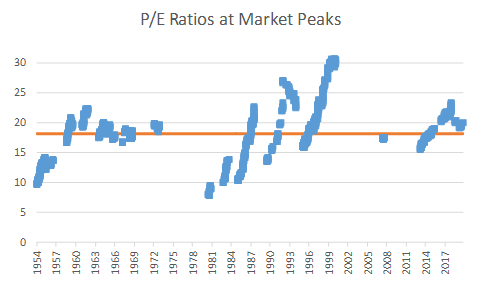
    Here is an interesting look at this topic that adds an average trailing earnings P/E ratio to the market peak chart. The article's author calculates that the current P/E ratio was about 10% above average at yesterday's market peak.
    image
    Here is the article's takeaway thought about current market conditions.
    To me, this analysis suggests that the current earnings multiple with the market at an all-time high is fair to slightly elevated. Given still low rates and monetary accommodation and political capital being spent to forestall an economic downturn, the economy may once again manage to extend its historic expansion. High equity multiples, low interest rates, and perhaps slower earnings growth all suggest lower forward returns on average. I would expect market participants to continue to reprice the stage of the business cycle, which will create episodic volatility.
    https://seekingalpha.com/article/4299923-p-e-ratios-market-peaks
  • Staying Home: International Diversification
    The foreign dividend payers are a good place to look for yield. My sleeve of global dividend paying equity mutual funds has a higher yield than my sleeve of domestic dividend paying equity mutual funds. With this, and most likely, I'll be putting some money to work in my global dividend paying equity funds come December after my equity mutual funds have made their yearend capital gains distributions
    My current investing goal is to not only to grow my principal; but, my portfolio's yield as well. With this, as mutual funds found in the growth area of my portfolio make thier yearend capital gain distributions I plan to buy (with these distributions) in the growth and income area of portfolio thus increasing my portfolio's yield while at the same time allowing for some continued capital appreciation. Over the past rolling twelve months I've increased my portfolio's income stream by 13% mostly due to it's reconfguration which I began late last fall. It will be interesting to see how 2018 yearend statement compares to 2019's. I'm thinking both income generation and valuation will be up over last years closing statement.
    I'm also thinking that my asset allocation will continue to bubble somewhere around 20% cash, 40% income and 40% equity. Within the 40% equity allocation I plan to grow my dividend payers and slightly reduce my capital appreciation (growth) funds by redirecting future capital gain distributions into the dividend payers over putting them back into my growth funds.
  • How Should You Invest In These Uncertain Times?
    @Simon and @msf
    I'm attempting to determine the value of purchasing the I-bonds vs STPZ , LTPZ or a TIP's fund, be it active managed or ETF.
    I-bonds, direct purchase have an annual dollar limit per individual, yes? I suppose an individual question would be whether the dollar limit would have a meaningful impact upon an overall portfolio.
    TIP type funds have no dollar limit for purchase.
    TIP funds will also follow in capital appreciation (price) in sentiment with yields when moving lower, as with most other bond types. TIP's are part of a safe haven investment along with other Treasury issues. And the investor may buy or sell when the trend changes.

    ADD:
    account type was not noted, so I don't know whether the I-bonds are in taxable or tax sheltered account, if this matters.
    Thanks for your time.
    Catch
    I can’t answer that Catch. But thank you for the opportunity to correct my earlier post above. I mistakenly assumed I-Bonds were the same as TIPS. Of course they aren’t (though I assume the inflation protection works similarly). So it was TIPS funds I was talking about - not I-Bonds.
    My guess is that I-Bonds are purchased in the same manner one would purchase regular savings bonds (but I may be corrected). Below is an interesting linked article re the suitability of I Bonds and TIPS as well as TIPS funds for tax sheltered accounts.
    My earlier point was to caution against rushing into funds that offer inflation protected bonds on the assumption you can only make money. You should do OK - but not assured for the reasons I noted earlier. BTW - TRP offers at least 2 TIPS funds, one of which is a shorter term version and less susceptible to interest rate movements.
    https://www.marketplace.org/2009/04/10/i-bonds-roth/
  • How Should You Invest In These Uncertain Times?
    At age 85+ with a cash sale of our home this year, I find it difficult to buy investments that pay a lot of taxable gains. So I have looked at tax managed funds and/ or municipal tax free funds. I would like to stay mostly in the tax rate of 12% . Most of our income is SS, RMD, and some qualified dividends and small amount of capital gains. Any ideas to look for would be so helpful. I thought about CD's, a ladder of bullet bond funds. I own a small variable annuity that could be added to. Thanks for your input.
  • How Should You Invest In These Uncertain Times?
    @Simon and @msf
    I'm attempting to determine the value of purchasing the I-bonds vs STPZ , LTPZ or a TIP's fund, be it active managed or ETF.
    I-bonds, direct purchase have an annual dollar limit per individual, yes? I suppose an individual question would be whether the dollar limit would have a meaningful impact upon an overall portfolio.
    TIP type funds have no dollar limit for purchase.
    TIP funds will also follow in capital appreciation (price) in sentiment with yields when moving lower, as with most other bond types. TIP's are part of a safe haven investment along with other Treasury issues. And the investor may buy or sell when the trend changes.

    ADD:
    account type was not noted, so I don't know whether the I-bonds are in taxable or tax sheltered account, if this matters.
    Thanks for your time.
    Catch
  • How Should You Invest In These Uncertain Times?
    I Bonds, paying 2.5% from next month. You are guaranteed to earn 0.5% above the rate of inflation if you buy before Oct 31.
    If you buy before Oct. 31, the bonds you receive will pay 1.90% through March of 2020. That's the way Series I savings bonds work. You get the current inflation adjustment (1.4%) for the first six months you own the savings bonds regardless of which month you purchase them in, then the you get the next inflation adjustment (2.0%) for six months, and so on.
    The 1.90% composite rate for I bonds bought from May 2019 through October 2019 applies for the first six months after the issue date.
    https://www.treasurydirect.gov/news/pressroom/currentibondratespr.htm
    The argument for buying now:
    The current I Bond fixed rate is 0.5%. That is the highest it has been since early 2009 when it was 0.70%. In this falling interest rate environment with low Treasury yields, I think it’s likely that the I Bond fixed rate will fall. For five of the last ten years, the fixed rate has been zero.
    If you buy I Bonds for the long-term, the fixed rate is the most important consideration, and it may be at a peak. We won’t know the next I Bond fixed rate until November 1st when the Treasury announces the changes.
    https://www.depositaccounts.com/blog/inflation-treasury-series-i-savings-bonds/
    Whether you buy now or buy in November, it's unlikely that the savings bonds will pay 2.5% next month. (I've no complaints with 1.9%, tax deferred, state tax exempt.)
  • BUY - SELL - HOLD October
    Hi @rono
    Thank you for your redo ink to shadowstats. There are those here who may not have know of the site previous, and the old timers who had forgotten.
    I'm absolutely positive inflation is running more than the gov't provided CPI increase (1.6%) for 2020 for SS, etc.
    As you've noted numerous times, invest in what you use as a consumer, too.....local utils, etc. A "pay yourself" investment plan, eh?
    Neighbor chat indicates that their Plan F supplemental health coverage premium will increase 9.6% in 2020. Insurance is insurance for a reason and they've had a need for this over the years and are pleased they had the extra coverage. I've expressed previous, that to help offset the rising costs of healthcare to invest in the sector. A good example is FSPHX, with an inception date of 1981. The lifetime annualized return is 15.4%. There are plenty of decent healthcare investments from the broadbased to the more narrow sectors, as with an etf of IHI (medical tech./devices).
    Take care,
    Catch
  • Small cap value outflows
    @Paul, Trying to buy at low tide can be a bit of a challenge. For me, I like to position cost average into my spiffs, buying the dips, especially after stocks have had a strong run. If you want to look at (and study) a fund that buys the dips and sells the rips then you might wish to learn more about CTFAX and study it's fact sheet learning how it plays the swing trade.
    CTFAX is one of nine positions found in my hybrid income sleeve as it generates it's distributions from both yield and capital gain distributions made from its swing trades. Due to stock market votalility I'm expecting a nice payout for 2019. So, if interested, buy it after it makes its December (yearend) distribution.
  • @hank REPO market, JP Morgan, Dimon explanation from Oct. 15
    @hank
    You noted: "Catch - It’s way outside my expertise. But this era of ultra-low rates seems bizarre, to say the least. And it’s prevailed much longer than most would have expected. I suppose the answer is to throw your money at the stock market and pull 20% a year, rather than settling for just 2-3% from cash or government bonds."
    I agree with the first two I have set in bold above; but the third depends on what one may see as a trend until I isn't. Then it may be run for cover, not unlike equities unwinding for whatever reason(s).
    The 2-3% yields from government bonds are here and now. But, the yield path continues a slow drift downward (bump up a few weeks ago, but lower again the past few days). This action for bonds continues to cause price action to the positive from the buy demand.
    So, U.S. bond buying continues for numerous reasons as to safety and/or a combination of safety away from the equity markets and the negative bond yields in other countries.
    As to the 20% from equity, yes; another area that is maintaining for the time.
    I offer these few performance blips for relatively safe bonds, with the exception of the corp. bonds; which I suspect will melt in value if the equity market starts to go negative for a longer time frame.

    Bond etfs, YTD returns down a bit from 2 weeks ago, which was a near time high price point:

    ---TIP =+7.6% (inflation bonds, mixed duration)
    --- IEF = +9.1% (7-10 yr notes)
    --- LQD = +15.7% (corp. bonds)
    --- LTPZ = +17.5% (long duration TIPs bonds)
    --- EDV = +23% (extended duration gov't)
    --- ZROZ = +25.4% (zero coupon bonds)

    The above gains are also reflected in many broad bond funds that may contain mixes of these bond types.
    IF yields froze in their tracks starting tomorrow, then yes; holding a bond (fund) for yield only would be a problem, as the price appreciation has likely stopped, too.
    Not unlike a nice equity fund known to pay a decent dividend; if all the companies within that fund became price range bound + or - .5%, then the only remaining value would be the dividend, let us example at 2%.
    Both holdings would become a wash against one another for profit potential, eh?
    Ok, the sleep clock arrives. Hoping I have not caused confusion; but money still may be made in bond holdings if yields continue to some unknown bottom pushing up the prices, where the money is being made (this statement applies to U.S.).
    Be well,
    Catch
  • Tax Free investing for a taxable account?
    The closest Vanguard match to TAIFX would be VTMFX. Unlike Wellesley it uses muni bonds for its fixed income sleeve. Also, while TAIFX and VTMFX have roughly 50/50 asset allocations, Wellesley's is closer to 40/60 (bond heavy).
    VTMFX manages its equity holdings directly, so it can control cap gains a bit better than TAIFX which holds equity funds that are not tax-sensitive. This is reflected in a somewhat better tax cost ratio over the past 1 and 3 years as calculated by M*.
    TAIFX tax cost ratios: http://performance.morningstar.com/fund/tax-analysis.action?t=TAIFX
    VTMFX tax cost ratios: http://performance.morningstar.com/fund/tax-analysis.action?t=VTMFX
  • Tax Free investing for a taxable account?
    There's one more tax-related benefit to munis to consider. If your income is fairly limited, tax-free income instead of taxable could keep the taxable income on the federal return low enough to put the 0% tax rate for long cap gains and qualified dividends into play. It'd depend on your exact situation how much (if any) impact beyond the avoided tax on the muni income a given level of muni investment/income would have.
  • BUY - SELL - HOLD October
    Sold off one of my money market mutual funds since there has been news, of late, about liquidity concerns in the repo market.
    Here’s a Bloomberg story about what some are calling the “repo mess.”
    https://www.bloomberg.com/news/articles/2019-09-22/repo-market-s-liquidity-crisis-has-been-a-decade-in-the-making
    After I fully comprehend @Catch22’s post re quantum computing *, along with why people are buying negative yielding bonds , I’ll try to get my head around repos. However, it seems to me that if repos came unglued it would throw many other global markets into turmoil - probably equities and, even more likely, funds that employ derivatives / leverage in pursuit of outsized gains. If you’ve been waiting for a sharp reversal in interest rates, this might be the cow that finally kicks the can over (to milk a metaphor to death).
    *Here’s a link to Catch’s quantum computing story: https://www.mutualfundobserver.com/discuss/discussion/53776/google-has-given-us-the-first-experimental-evidence-that-quantum-speed-up-is-achievable-real-world
  • M*: It's Open Enrollment Season. Have You Taken A Good Look At An HSA?
    The data have been updated to 2020, e.g.:
    For 2019, plans with annual deductibles of at least $1,350 for individuals and $2,700 for families are classified as high-deductible; for 2020, those numbers inch up to $1,400 and $2,800.
    Not only the data, but links as well, e.g. the KFF link in:
    Thirty percent of workers were covered by a HDHP in 2019, according to data from the Kaiser Family Foundation; in 2014 20% of workers were covered by an HDHP.
  • CD's
    FYI: Just exchanged Tri States Capital Bank Pittsburg 2.350% purchased on 6/17/19 maturing today, for Merchants Bank Carmel Indiana 1.850% mautring 2/28/20
    Regards,
    Ted
  • Medigap Plan F Will Soon End. Here’s How That Changes Retirees’ Costs.
    It's not zero cost, but you might take a look at United Healthcare Choice 1. For the extra $16/mo, it provides preventive dental (new this year), and unlike most MA plans, that includes a wide network of dentists. Also new this year is that you don't need to notify UHC in advance ("Passport" service) if you're traveling domestically - you get automatic access to its national network.
    https://www.aarpmedicareplans.com/alphadms/ovdms10g/groups/ov/@ov/@highrespdf/documents/highrespdf/4611547.pdf
    It has another plus: unlike other UHC plans, you're not paying for the AARP branding. (The UHC PPO plans, unlike the HMO plans, are not "endorsed" by AARP). UHC has its own "Renew Active" program rather than Silver Sneakers, which may be better or worse for you (or you may not care).
    Downstate the PPO network was very narrow. But in 2020 UHC nearly quadrupled the regional size of the network (making it comparable to its HMO network). People I know are now looking at this plan, hence my familiarity with it.
  • Medigap Plan F Will Soon End. Here’s How That Changes Retirees’ Costs.
    Sigh. All people born before 1955 (i.e. those who turn 65 before 2020) will be able to sign up for Plan F in any year, even if they're not current enrollees.
    The article says that the only difference between Plans F and G is that in the latter, "People must pay Medicare’s deductible before insurance coverage kicks in each year." There's also another difference. In 2019, only Plan F offered a high deductible option. Going forward, only Plan G will have that option.
    It says that Plan G will become more expensive as "the pool of people coming into the plan will start becoming less healthy than those who previously enrolled when financial advisors pointed them toward a bargain." Is it really suggesting that financial advisors have been committing malpractice by steering sick people away from the better bargain (Plan G)? The article said that Plan G was the better deal (independent of health) because the all in cost (premiums plus part B deductible) was less than Part F's.
    What will happen is not so much that Plan G premiums will rise, but that Plan F premiums will. That's for two reasons. One is that its pool of people will get older (thus more costly to cover). This year, anyone age 65 or above (i.e. virtually all potential enrollees) can buy Plan F. Next year, you'll have to be 66 or better to buy Plan F. Then 67, 68, and eventually all the potential participants will die out.
    Which leads to the second reason. The pool will grow smaller. The idea of insurance is that while you never know who will need care, you know with near certainty what the average cost will be. But as the pool shrinks, that certainty fades. Insurers have to prepare for an increasingly likely black swan event. That means rising premiums for Plan F.
    Medical underwriting: If you live in a state like New York or Massachusetts, you can buy any Medigap policy at any time, no questions asked. Or if you live in a state like California, once a year you have the option of "downgrading" your policy. So you could easily switch from Plan F to Plan G some time in the future once Plan F's premiums starting rising quickly. It pays to know what the rules are for your personal situation.
    https://www.medicareresources.org/states/
  • The Closing Bell: Stocks Waver On China Data
    FYI: U.S. stocks fell Friday on global growth worries, but major indexes were still poised to close the week with modest gains after a strong kickoff to corporate earnings season.
    The Dow Jones Industrial Average dropped 255 points, or 0.95%, in afternoon trading, dragged down by Boeing and Johnson & Johnson. The S&P fell 0.39%, while the Nasdaq Composite declined .83%.
    Are three indexes are within 4% of all-time highs reached this summer, showing the resilience of the U.S. stock market despite concerns about slowing growth at home and abroad.
    Friday’s declines came after fresh Chinese growth data sparked concerns about the world’s No. 2 economy and a slew of negative headlines pummeled some of the biggest U.S. companies.
    Among Friday’s movers, Johnson & Johnson slumped 4.7% after the company said it was recalling a single lot of baby powder after tests found small amounts of chrysotile asbestos. Boeing tumbled 3.5% after Reuters reported that the aircraft maker’s employees may have misled regulators over the safety of the 737 Max.
    Technology stocks were broadly lower, with Netflix down 6% after several analysts cut their price targets for the streaming-video company. Chipmaker Micron Technology tumbled 4.4%, while Microsoft fell 1.7%.
    But the S&P was still poised for a 0.5% increase for the week--its second consecutive week of gains--largely due to upbeat quarterly earnings reports, including from banks like JPMorgan Chase and Citigroup.
    Of the 73 companies in the S&P 500 that have reported earnings through Friday morning, more than four-fifths have topped analysts’ expectations, according to Refinitiv. That’s largely because expectations came down so much in recent months.
    Coca-Cola, United Airlines Holdings and health-insurance giant UnitedHealth Group are among the stocks that rallied this week on better-than-expected results.
    Overseas, Chinese stocks dropped sharply after data showed the Chinese the economy slowed further in the third quarter. The benchmark Shanghai Composite Index fell 1.3%, its biggest decline in a month.
    Fresh data showed that China’s economy grew 6% in the quarter as business activity continued to deteriorate. Each quarterly slowdown in Chinese growth has pulled the country’s economic performance to new lows not seen since the current measure of output was adopted in 1992.
    The benchmark Stoxx Europe 600 fell 0.3%. In the U.K., the FTSE 100 dropped 0.4% and the pound climbed 0.4% against the dollar.
    Investors are watching developments closely before U.K. lawmakers vote Saturday on a draft Brexit agreement struck with the European Union. Prime Minister Boris Johnson is trying to muster enough support for the deal in the U.K. Parliament.
    The yield on U.S. 10-year Treasurys fell to 1.741% from 1.757% on Thursday. Bond yields move in the opposite direction from prices.
    In commodities, U.S. crude futures fell 0.6% to $53.59 a barrel. Gold futures slipped 0.2%.
    Regards,
    Ted
    Bloomberg Evening Briefing:
    https://www.bloomberg.com/news/articles/2019-10-18/your-evening-briefing
    MarketWatch:
    https://www.marketwatch.com/story/stock-index-futures-struggle-for-direction-after-weak-china-growth-2019-10-18/print
    WSJ:
    https://www.wsj.com/articles/chinese-stocks-slide-after-economic-growth-cools-11571389552
    Bloomberg:
    https://www.bloomberg.com/news/articles/2019-10-17/asia-stocks-set-for-mixed-open-before-china-data-markets-wrap?srnd=premium
    IBD:
    https://www.investors.com/market-trend/stock-market-today/stock-market-bad-day-continues-these-two-stocks-took-down-the-dow/
    CNBC:
    https://www.cnbc.com/2019/10/18/stock-market-wall-street-in-focus-amid-corporate-earnings.html
    Reuters:
    https://uk.reuters.com/article/us-usa-stocks/wall-street-pressured-by-jj-global-growth-concerns-idUKKBN1WX1FV
    U.K:
    https://uk.reuters.com/article/uk-britain-stocks/ftse-feels-ihgs-pain-amid-caution-ahead-of-brexit-vote-idUKKBN1WX0QO
    Europe:
    https://www.reuters.com/article/us-europe-stocks/string-of-weak-earnings-leave-european-stocks-barely-up-on-the-week-idUSKBN1WX0PS
    Asia:
    https://www.cnbc.com/2019/10/18/asia-markets-october-18-china-gdp-brexit-oil-and-currencies.html
    Bonds:
    https://www.cnbc.com/2019/10/18/treasury-yields-tick-higher-as-investors-digest-china-data-brexit-developments.html
    Currencies:
    https://www.cnbc.com/2019/10/18/forex-markets-brexit-deal-chinas-economy-in-focus.html
    Oil
    https://www.cnbc.com/2019/10/18/gold-markets-brexit-deal-in-focus.html
    Gold:
    https://www.cnbc.com/2019/10/18/gold-markets-brexit-deal-in-focus.html
    Current Futures:
    https://finviz.com/futures.ashx
  • M*: Investing Close To Home Is Overrated
    Surely you're not suggesting that 3M does most of its mining and manufacturing in Minnesota, or that US Bank does most of its lending to midwest businesses. I might grant you midwesterners consume a lot of processed meats (Hormel). But enough of this Spam :-)
    Mairs and Power says that it invests in (local) companies it knows about. That's an argument for investing in global funds where the managers live abroad (close to the companies they invest in), not for investing in companies that do business close to home.
    Counter example to regional investing: FKCGX, formerly Franklin California Growth Fund. One would think that California would be a broad enough market that a fund could easily limit its investments to that state. (Franklin is based in San Mateo, Calif nearly midway between San Francisco and Silicon Valley, and a stone's throw from Oracle.)
    But it first dropped its 80% California requirement to 50%:
    It has been a policy of the Franklin California Growth Fund, under normal market conditions, to invest at least 80% of its net assets in equity securities of California companies. Effective September 1, 2002, Franklin California Growth Fund will change its name to "Franklin Flex Cap Growth Fund" and will eliminate the 80% investment policy. ... [replacement strategy] The Fund normally invests a majority of its assets in California companies
    Apparently that wasn't "flex"ible enough.
    Effective October 1, 2004, the section "Goal and Strategies" ... is replaced with the following: ...
    Under normal market conditions, the Fund invests primarily in equity securities of companies that the manager believes have the potential for capital appreciation. The Fund has the flexibility to invest in companies located, headquartered, or operating inside and outside the United States, across the entire market capitalization spectrum from small, emerging growth companies to well-established, large-cap companies.
    The successor fund was merged into FGRAX in August 2016.

    1999 NYTImes feature
    on FKCGX. Like Mairs and Power, emphasizing knowledge of companies near where the managers are:
    Call it the home-team advantage.
    "We're able to keep close tabs on our investments," said Conrad B. Herrmann, lead manager of the $1.58 billion Franklin California Growth fund, which focuses on California companies. "We read local newspapers in California and socialize and interact with people who might be employed in the companies in our universe."