
Howdy, Stranger!

It looks like you're new here. If you want to get involved, click one of these buttons!

Here's a statement of the obvious: The opinions expressed here are those of the participants, not those of the Mutual Fund Observer. We cannot vouch for the accuracy or appropriateness of any of it, though we do encourage civility and good humor.
  • A Fallen Star - Min Vol Funds - VMVFX
    I owned VMVFX until I didn't. It had exhibited surprisingly high volatility, especially during recent market draw downs (March 2020).
    Micheal Batnick Piece:
    are-min-vol-strategies-just-consumer-staples-in-disguise
  • Preparing Your Portfolio for Inflation
    Josh Brown Piece:
    On the economic and investment side, the quants at BofA are thinking that... over 60% of the bank’s analysts see rising prices in their respective coverage universe. One of BofA’s top strategists, Michael Hartnett, is talking about 2020 being the secular bottom for rates and inflation.
    and,
    ... a whole lot of fiscal stimulus and monetary stimulus, too. But here we are, at the big, fat middle part of an economic expansion with rising prices, capex growth, increasing demand for skilled labor and a massive, generational infrastructure bill on the way.
    whats-changed-for-now-and-whats-changed-forever
    Recent Michael Hartnett Pieces:
    The value of U.S. financial assets are now six times the size of gross domestic product. “Wealth gains obscene, but extreme asset bubbles natural end to nihilistic bull markets of past decade,” he said.
    And longer-term drivers of disinflation were poised to wane, too. Fiscal authorities were now more open to increased spending and central banks were now explicitly targeting higher inflation as a goal.
    Hartnett anticipated the coming decade could show similarities to the late 60s and early 70s when inflation and interest rates started to lift off as investors questioned the combination of easy fiscal and monetary policy.
    So what does this all mean?
    First of all, investors will have to get used to a world of lower investment returns, while dealing with an upturn in volatility, said Hartnett.
    And the ravages of inflation could turn negative returns in fixed-income into the norm. Instead, investors should look to take shelter in assets that tend to thrive during period of price pressures such as commodities.
    inflation-rebound-means-40-year-bull-market-in-bonds-is-over-says-bofa
    sell-the-vaccine-in-response-to-violent-inflationary-price-action-bank-of-america-strategist-says
  • Stimulus money, how does a family know the proper amount has been paid?
    I agree with @MrRuffles that if one hasn't gotten EIP1 or EIP2 by now, the checks likely aren't coming. The money can be claimed as a Recovery Rebate Credit on one's 2020 tax return.
    Timing on filing is another matter. Generally, file early if one is expecting a refund, and delay filing if one is going to have to pay. (Though one can't extend the payment due date by requesting a filing extension.)
    This simplifies things. It doesn't matter whether you're getting some credits (including the Recovery Rebate Credit). What matters is the bottom line. If, after accounting for all your tax credits you still owe money to the IRS, hold off paying quickly. You too can earn 0.01% on that money in your pocket for an extra month.
    2021 is a different story. Say that your 2019 AGI is $80K (individual), 2020 is $75K, and 2021 is projected to be $80K. Based on the 2019 AGI you would get nothing for EIP3.
    Let's assume the IRS has already processed you for EIP3. So it's too late to rush to file your 2020 return. Not to worry, the IRS will follow up with EIP4 later this year. It will be an incremental payment if you should get more based on your 2020 return than on your 2019 return (EIP3). But to get an EIP4 payment, you must have filed your 2020 return by Aug 15th (three months after the filing deadline this year of May 15th).
    Suppose instead you ask for an extension and don't file your 2020 return until after Aug 15th. Then you won't get any payment based on 2020 income. Not EIP3, not EIP4, and not a Recovery Rebate Credit on your 2021 tax return. That's based on your 2021 AGI. Given the hypothetical AGIs above, you won't see any money.
    So there could still be a reason to file your 2020 tax return in a reasonable amount of time, i.e. don't delay past Aug 15 if your largest possible payment is based on your 2020 AGI.
    (I expect that the vast majority of tax filers won't be in the situation of losing money because of such fine points.)
  • Stimulus money, how does a family know the proper amount has been paid?
    @catch22
    Based on my experience as a certified VITA tax preparer, I wouldn’t recommend waiting to file their returns - this will just delay the receipt of their stimulus money. (If they haven’t gotten the first or second payment it’s likely not coming without additional action.)
    If a taxpayer didn’t get the first or second stimulus payment, they should indicate as such on their tax return and it will be included on their return as a payment, either increasing any refund or decreasing any amount due.
    (I’m sure you already know this but filing by paper will significantly delay the processing of the return. If there is any way of e-filing I would recommend it.)
    The third stimulus payment is a separate matter and the receipt, or lack thereof, is not included on the 2020 tax return.
  • Baillie Gifford manager to retire
    It's not uncommon for investment management firms to have separate teams for different strategies. For example, here are RW Baird's equity teams:
    https://www.bairdassetmanagement.com/baird-equity-asset-management/team#GrowthTeam
    Those divide along growth/value/int'l lines. For a company like Baillie Gifford that focuses on growth, its dividing lines are finer. Growth: large cap, or small cap, or all cap; "rapid" growth: broad or concentrated. Five different int'l teams with sometimes subtly different styles.
    HAIGX pulls from the all cap growth team, while VWIGX and BGESX pull from the rapid growth (broad) team, and BTLSX is managed by the rapid growth (concentrated) team.
    Here's BG's blurb on its five international equity strategies and teams;
    https://www.bailliegifford.com/en/usa/professional-investor/literature-library/funds/mutual-funds/baillie-gifford-international-equity-strategies/
    While some of the difference between HAIGX and VWIGX comes from Schroeders, much of it is due to the different BG teams managing the funds. You can test this by looking at the overlap between VWIGX and BGESX. The major (>2%) holdings of VWIGX that aren't in BGESX are Tesla (5.51%) and Illumina (2.30%). VWIGX has 13 holdings above 2%. All data from M* instant x-ray.
    Likewise, you can look at the overlap between VWIGX and SCIEX (for the Schroeder team). The pure Schroeder fund doesn't hold Tesla or Illumina. So maybe these holdings in VWIGX came from the Schroeder team, thoujgh Schroeders is less growth oriented than BG. We may never know.
    I'm glad you brought up HAIGX, because it serves to highlight an obscure attribute. Like many fund families, Harbor funds hire an in-house management company (Harbor Capital Advisors, Inc.) to manage the funds, to select and oversee the subadviser third party management firms (here, Baille Gifford Overseas Ltd.), and in the case of multiple subadvisers, to decide who manages what percentage of the funds.
    2021 Prospectus, p. 41 (pdf p. 44)
    When a Vanguard fund is managed by Vanguard, it hires The Vanguard Group as the management company. Though unlike Harbor, when a Vanguard fund outsources the day-to-day management of the fund it typically outsources the full management job. For these funds, the third parties are not subadvisors, but the actual advisors. The oversight responsibility is retained by the fund's board, as is the responsibility of deciding which advisory firm gets to manage how much of the fund.
    2020 Prospectus, p. 16 (pdf p. 18)
    This also means that what happens to VWIGX when Anderson retires in a year is up to the Vanguard fund's board. It could, for example, live with the remaining less experienced (by 16 or more years) BG fund managers while allocating a greater fraction of the portfolio to Schroeders. In that case, one might say that Schroeders would be the successor to Anderson.
    For example, this is what Vanguard did when Barrow retired from Barrow, Hanley, Mewhinney & Strauss:
    Vanguard had been slowly redistributing Windsor II’s assets to other subadvisers in the years since BHMS founder Jim Barrow, who had managed the fund since its 1985 inception, announced he was stepping down at the end of 2015. At the time of Barrow’s retirement, BHMS managed about 60% of the overall portfolio. That number was nearly halved over the past four years, with the firm managing 37% of Windsor II’s assets at last report.
    https://www.adviserinvestments.com/adviser-fund-update/vanguard-manager-firing-fails-to-fix-funds-faults/
    A bit more on BG's international growth strategy and portfolio construction group:
    https://www.bailliegifford.com/en/usa/professional-investor/literature-library/institutional-only-literature/philosophy-and-process/international-growth-philosophy-and-process/
  • Can anyone please share if any of their Mut Fund holdings are in the green lately?
    I'm rather certain that over the long haul, you'd have reaped more profit from PRWCX than dividend-paying stocks. For years, the big Canadian banks have been my alternative fantasy portfolio. 90% of deposits in Canada belong to those big banks. There are only 5 or 6 of them. High dividends. Low P/E ratios. I would not go to BMO Bank of Montreal now, after recently learning here of their unethical shenanigans toward investors. But the others? Yes. My two favorites are CM and BNS. You're holding 15K in cash? Maybe you're very, very risk averse? If you just want the assurance of investing in solid companies that are not going to fold up and go bankrupt, and you crave the dividend income, then go for it. Just don't forget never to put all your eggs in one basket. Eh? CIBC: https://www.morningstar.com/stocks/xnys/cm/quote
    Scotiabank: https://www.morningstar.com/stocks/xnys/bns/quote
    But they are riding high, right now. EVERYTHING is riding high, or near all-time highs, even including the recent small (so far) drop-off. The Market's had a tremendous run-up since March of 2020. Wait for another pullback.
    :)
    Thank you, I'm on the same page with you about Canadian names, banks. For some reason, Canadian equities are more quality-oriented, and less P/E (less expensive).
    As far as risk-averse,...timing is (may not be the best personal investment quality) I invested in MSSMX (as in since the 2nd of January through mid-Feb, up 30%). Now in cash.
  • Finding the Right Benchmark for Your Portfolio
    Our benchmark remains FBALX. Yes, a bit "hot" for many in retirement, as an investment. Though not invested in the fund in 2008, it took a big hit, too; as with many other 70/30% funds. We have been able to get close to the 15 year return of 8.48, which has changed from about an average of 8.2% annualized as 2020 returns bumped this number. We attempt to get close to 7.5-8% annualized. 'Course, as expected, not unlike others; we've had the very good years get whacked by the poop years. Our largest portfolio benefit was to escape the 2000 and 2008 melts. Not fun to "make up" a portfolio loss from an actual sell. We have not yet decided whether FBALX will be a major percent holding when we stop meddling with our holdings. Our active would become a psuedo passive with FBALX management of the money.

    YTD, 1-Year, 3-Year, 5-Year, 10-Year, 15-Year, Since Inception (7 periods time frame)
    Returns 3.78% 59.15% 14.23% 13.68% 11.03% 8.48% 9.76%
    Category Ranking % 21 32 7 4 3 4 7
    # of funds category 695 697 664 639 571 411 300
  • Why in the World Would You Own Bond (Funds) When…
    SP500 Index for money needed in 3 years?! What happens if in 2-2.5 years the SP500 index drops 20-30% and then takes 3-5 years to recover? You're going to be selling at the worse time. It's been so long people are starting to forget what can happen... most crashes/bear markets don't end as fast as 2020 did. I don't know, maybe that's the new normal fast down and fast back up since everyone carries the stock market around on their phone now.
  • Can anyone please share if any of their Mut Fund holdings are in the green lately?
    I'm rather certain that over the long haul, you'd have reaped more profit from PRWCX than dividend-paying stocks. For years, the big Canadian banks have been my alternative fantasy portfolio. 90% of deposits in Canada belong to those big banks. There are only 5 or 6 of them. High dividends. Low P/E ratios. I would not go to BMO Bank of Montreal now, after recently learning here of their unethical shenanigans toward investors. But the others? Yes. My two favorites are CM and BNS. You're holding 15K in cash? Maybe you're very, very risk averse? If you just want the assurance of investing in solid companies that are not going to fold up and go bankrupt, and you crave the dividend income, then go for it. Just don't forget never to put all your eggs in one basket. Eh? CIBC: https://www.morningstar.com/stocks/xnys/cm/quote
    Scotiabank: https://www.morningstar.com/stocks/xnys/bns/quote
    But they are riding high, right now. EVERYTHING is riding high, or near all-time highs, even including the recent small (so far) drop-off. The Market's had a tremendous run-up since March of 2020. Wait for another pullback.
    :)
  • Can anyone please share if any of their Mut Fund holdings are in the green lately?

    People tend to feel losses more severely than gains. That may explain your perception, which is not to say that major portions of the market have not dropped lately. Still, there are parts of the market, like international (e.g. VXUS) that are up for the week.
    Sorry to truncate your post, but this is the right statement. Does anyone here invest in dividend-producing portfolios? I also have a small position in PRWCX, like $1k, the rest $15k in cash. Curious, how do funds like PRWCX compare to holding exclusively dividend-paying stocks?
  • Why in the World Would You Own Bond (Funds) When…
    At 200% long and 16% short fixed income (per M*), the shorting by CLMAX is basically noise. @bee was interested in funds that are purely or at least substantially short. 184% net long is the opposite. The juice in the fund comes more from leverage than a relatively small amount of shorting.
    If one's idea of shorting bonds is to eek out a little more return based on security selection (à la a 130/30 fund or a market neutral fund) rather than making interest rate bets, one might look into long/short credit funds.
    M* created this category of funds in 2016.
    Long-short credit funds seek to exploit mispricings in corporate debt, which may involve outright directional long and short bets, or relative value trades focusing on different securities on a company's capital structure or pair trades between the debt of two different but correlated companies, for example.
    One big difference between long-short credit funds and other nontraditional bond funds is that long-short credit managers tend to hedge out most of their interest-rate risk, putting their strategies' valuation proposition squarely on their credit selection skill.
    https://www.morningstar.com/articles/784363/long-short-credit-funds-have-potential-as-bond-diversifiers
    However, there aren't many such funds. "The Long-Short Credit category has dwindled in size since its launch in 2016, and [Morningstar's] returning the remaining strategies to their prior home in the Nontraditional Bond cateory" in April 2021.
    https://advisor.morningstar.com/Enterprise/VTC/April2021USCategoryLaunchFAQs.pdf
    In that memo, M* refutes the quoted statement about long-short credit funds having a big difference from nontraditional bond funds. "[I]n practice, both groups of funds have tended to minimize interest-rate risk and emphasize credit exposures."
    Makes one wonder if M* makes its decisions first and then comes up with rationalizations to justify them.
  • Can anyone please share if any of their Mut Fund holdings are in the green lately?
    My MMFs are up, short term, YTD, long term. I may die rich in a billion years.
    With "cash alternative" funds like RPHYX, up 0.10% for the week, 0.14% for the past month, and 0.46% YTD, and "old faithfuls" like PRWCX, up 0.17% for the week, 1.85% for the past month, and 3.22% YTD, I suspect lots of people here have funds that are in the green.
    According to M*'s screener, 1/4 of funds are up at least 3.77% over the past four weeks.
    People tend to feel losses more severely than gains. That may explain your perception, which is not to say that major portions of the market have not dropped lately. Still, there are parts of the market, like international (e.g. VXUS) that are up for the week.
    Personally, I don't look at individual funds' performance on a short term basis. I have a reasonably diversified portfolio, weatherproofed for down drafts, and usually just check overall performance.
  • Stimulus money, how does a family know the proper amount has been paid?
    From what I read, the second economic impact payment (EIP2) guidelines did not change the child age eligibility:
    A qualifying child is a child who meets the following conditions: ...
    The child was under age 17 on December 31, 2019
    https://www.irs.gov/coronavirus/second-eip-faqs#Eligibility
    This is the same as for the first payment (EIP1):
    https://www.irs.gov/newsroom/who-can-get-more-economic-impact-payment-money-for-children
    Technically taxpayers do receive notification as to how the total payment is calculated, but you won't like the answer.
    The EIP1 and EIP2 were advance payments against a 2020 income tax credit. The 2020 income tax instructions that taxpayers received includes the Recovery Rebate Credit Worksheet . This walks them through the calculations for the credit. Of course one must use 2019 AGI instead of 2020 AGI (line 11) to calculate the advance payments, and don't skip lines 5-10.
    From this worksheet, one should be able to read off the EIPs: line 15 of the worksheet should be the amount calculated for EIP1 and line 18 the amount calculated for EIP2.
    Since EIP3 is an advance of a 2021 tax credit, there will be a similar worksheet in the 2021 tax filing instructions (nine months from now). But it won't be as "easy" to read off the calculation. For 2021, EIP3 may be followed by EIP4 if the former was based on 2019 AGI, the latter on 2020 AGI and AGI dropped. Good luck! May the force be with you.
    Finally, AFAIK, the only official notifications one receives are Notice 1444-B (EIP2) and Notice 1444 (EIP1). These just tell you the amount of the payments, not how they were calculated.
  • Couple Municipal investments-Best Municipal Bond Funds to Buy and Hold and myths w muni bonds
    https://www.advisorperspectives.com/commentaries/2021/03/19/taxable-municipals-myths-and-misperceptions
    https://news.yahoo.com/9-best-municipal-bond-funds-211119796.html
    Taxable Municipals – Myths and Misperceptions
    by Tony Tanner of Ivy Investments, 3/19/21
    Taxable Municipal Bonds grabbed the attention of not only municipal bond market participants in 2020, but also of investors and financial professionals globally across the asset class landscape.
    9 Best Municipal Bond Funds to Buy and Hold
    Debbie Carlson
    State and local governments are in good shape.
    ***Like other asset classes, the municipal bond market rebounded after the initial sell-off last year because of the pandemic. Amy Magnotta, co-head of discretionary portfolios at Brinker Capital Investments, says state and local governments "are actually in pretty good shape, surprisingly, despite the pandemic," noting most state revenues were roughly flat in 2020 versus 2019. With President Joe Biden's stimulus money and infrastructure plan, and the reopening of many states' economies, the fiscal situation for many state and local governments might be good as they get cash injections. However, she says, with interest rates so low, investors need to be careful what funds they choose. Here are nine muni bond funds to buy.
    Vanguard Tax-Exempt Bond ETF (ticker: VTEB)
    Scroll to continue with contentAd
    How to Know 72 Hrs in Advance Which Stocks to Pick
    VantagePoint
    How to Know 72 Hrs in Advance Which Stocks to Pick
    Advanced A.I. “brain” consistently forecasts the stock market with up to 87.4% accuracy… 3 days in advance.
    READ MORE
    Todd Rosenbluth, director of ETF and mutual fund research at CFRA, says exchange-traded fund VTEB is a good place for muni bond investors to start when building this part of their portfolio. The fund tracks the S&P Municipal Bond Index, which is made of investment-grade issues and diversified across states. VTEB's annual cost is 0.06%, which amounts to $6 for every $10,000 invested, one of the lowest among its peers. The fund is free from both federal income tax from the alternative minimum tax. The yield is 2%. "It's a great core part of the portfolio," Rosenbluth says.
    Baird Short-Term Municipal Bond Fund (BTMIX)
    The municipal bond universe can be an inefficient asset class due to its large number of issuers, says Steven Saunders, director and portfolio advisor at Round Table Wealth Management, so his firm prefers to use actively managed funds where the managers can find relative value through security selection and yield-curve positioning. His pick is BTMIX, which "has demonstrated consistent value-add in these areas, and their short-duration strategy allows for defensive positioning in the event rates continue to rise." The fund has an annual cost of 0.3% and a yield of 1.5%.
    - ADVERTISEMENT -
    PIMCO National Municipal Intermediate Value Fund (GNMVX)
    Mark Mumford, director at Hollow Brook Wealth Management, says his firm looks for municipal bonds strategies that have a strong emphasis on credit quality and issuer diversification. GNMVX tries to limit swings in assets under management which can negatively affect a municipal bond strategy, he adds. The fund has a low annual fee of 0.39% and a yield of 1.67%, with an effective duration of 5.3 years. The fund seeks investment-grade bonds with higher yields using fundamental credit research. "Municipal markets can be inefficient, creating opportunities for experienced teams to find value in a low interest rate environment," Mumford says.
    Northern Intermediate Tax-Exempt Fund (NOITX)
    Magnotta says with rates low and a recent pickup in market volatility, she prefers active management and is focusing on investment-grade munis. She chooses NOITX, because she likes that it has an experienced team with a long tenure, holds high-quality issues and has a liquid portfolio. She notes the annual cost of 0.46% is below average. "This is a strategy that long term is a good balance in a portfolio," Magnotta says. This fund has more than $3 billion in assets under management, and the average credit quality in the fund is A-rated.***
    Vanguard Tax-Exempt Bond ETF (VTEB)
    -- Baird Short-Term Municipal Bond Fund (BTMIX)
    -- PIMCO National Municipal Intermediate Value Fund (GNMVX)
    -- Northern Intermediate Tax-Exempt Fund (NOITX)
    -- Nuveen Dynamic Municipal Opportunities Fund (NDMO)
    -- VanEck Vectors High Yield Municipal Index ETF (HYD)
    -- Nuveen High Yield Municipal Bond Fund (NHMRX)
    -- Nuveen All-American Municipal Bond Fund (FAARX)
    -- Northern Arizona Tax-Exempt Fund (NOAZX)
    Several good reasonable funds considered to be added here especially for capital Preservation and retirement accts/and inflation worries.
    We do have HYD but may add some to Mama retired portfolio
    Enjoy
    Happy Saturday
  • Baillie Gifford manager to retire
    https://www.sec.gov/Archives/edgar/data/1120543/000110465921038922/a21-10255_1497.htm
    497 1 a21-10255_1497.htm 497
    Filed pursuant to Rule 497(e)
    under the Securities Act of 1933, as amended
    Registration File No.: 333-200831
    BAILLIE GIFFORD FUNDS
    Baillie Gifford International Concentrated Growth Equities Fund
    Baillie Gifford International Growth Fund
    Supplement dated March 19, 2021 to the Prospectuses dated April 29, 2020 as supplemented or revised from time to time
    James Anderson is expected to retire from the Manager and cease to serve as Portfolio Manager for Baillie Gifford International Concentrated Growth Equities Fund and Baillie Gifford International Growth Fund effective on or about April 30, 2022. Therefore, effective immediately, the following sentence is added to the first row in the table in the section titled “Baillie Gifford International Concentrated Growth Equities Fund Team” and the first row in the table in the section titled “Baillie Gifford International Growth Fund Team” each under “Investment Teams” in the Prospectuses:
    Mr. Anderson is expected to retire from the Manager and cease to serve as Portfolio Manager for the Fund effective on or about April 30, 2022.
    PLEASE RETAIN THIS SUPPLEMENT FOR FUTURE REFERENCE
    1
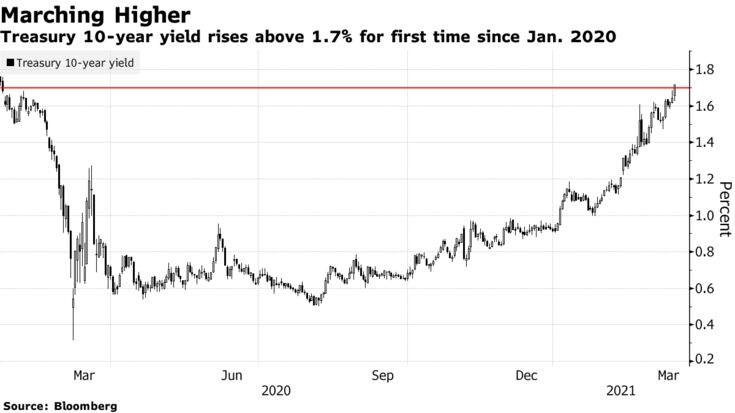
  • 10-Year Closing in on 1.5% (OP) - Blows Right Past - Near 5% (30 months later) - Whee!
    VIX climbed 10% today, but still close to its 52 week low.
    VIX Index
    The MOVE Index climbed 5%, but is making new 52 week highs:
    The Merrill Lynch Option Volatility Estimate (MOVE) Index is a yield curve weighted index of the normalized implied volatility on 1-month Treasury options which are weighted on the 2, 5, 10, and 30 year contracts. This Volatility Index shows the market's expectation of 30-day volatility. It is constructed using the implied volatility of a wide range of S&P 500 index options. This volatility is meant to be forward looking, is calculated from both calls and puts, and is a widely used measure of market risk, often referred to as the "investor fear gauge."
    Many of us are familiar with the VIX Index, commonly referred to as the “Fear Index”. The VIX Index is a measure of “fear” as that relates to equity markets and typically rises during periods of falling prices, sometimes sharply during more precipitous declines.
    Did you know that there is a similar index that measures fear within the bond market? That index was developed by Merrill Lynch and is referred to as the “MOVE” Index. The index rises as concerns grow that interest rates are on the march higher. The index will rise more sharply when there are fears in the market that rates may be headed significantly higher as was the case during the 2013 Taper Tantrum.
    https://raymondjames.com/davidolnick/david-chart-of-the-week/2016/11/18/the-move-index
    Financial Times charts the MOVE Index over the last 12 months or so here:
    MOVE Index
    *Notice the spike in the MOVE in March 2020*
  • Wall Street Banks, The Fed and Politics
    On March 31, an emergency pandemic regulatory relief measure that for the past year has allowed Wall Street banks to hold less loss-absorbing capital against certain assets is due to expire.
    Appearing to yield to the industry could put a second term in jeopardy for Powell, who was appointed Fed chief by former Republican President Donald Trump, because anti-Wall Street progressives control the Senate Banking Committee, which vets Fed nominees, and hold sway over White House financial nominees, analysts said.
    “Powell (is) in a politically precarious position,” said Isaac Boltansky, director of policy research at Washington-based Compass Point Research & Trading. “This decision will leave someone politically important unhappy with him.”
    u-s-feds-powell-faces-political-test-on-bank-capital-relief-question
  • PPM Small Cap Value Fund (I class) is closing to new investors
    https://www.sec.gov/Archives/edgar/data/1722478/000172247821000010/ppmf497e_031721.htm
    497 1 ppmf497e_031721.htm
    PPM FUNDS
    SUPPLEMENT DATED MARCH 18, 2021
    TO THE PROSPECTUS
    DATED APRIL 29, 2020,
    AS SUPPLEMENTED
    MAY 14, 2020, AUGUST 24, 2020,
    OCTOBER 6, 2020 AND NOVEMBER 30, 2020
    PPM Small Cap Value Fund
    (the “Fund”)
    PZSIX
    This supplement provides new and additional information pertaining to the Fund that affects information contained in the Fund’s Prospectus and should be read in conjunction with the Prospectus.
    The following changes are being made to the Prospectus:
    Effective as of the close of business March 18, 2021, the Fund is closed to investments by new investors and existing shareholders. The Fund’s closure to investments does not restrict any shareholders from redeeming shares of the Fund.