Howdy, Stranger!

It looks like you're new here. If you want to get involved, click one of these buttons!

Here's a statement of the obvious: The opinions expressed here are those of the participants, not those of the Mutual Fund Observer. We cannot vouch for the accuracy or appropriateness of any of it, though we do encourage civility and good humor.
  • Fidelity’s Pitch to America’s Teens - No-Fee Brokerage / WSJ
    “Fidelity Investments Inc. plans to open the door to a new generation of investors who will be able to trade stocks even before they learn how to drive or head to college. Fidelity said Tuesday it will issue debit cards and offer investing and savings accounts to 13- to 17-year-olds whose parents or guardians also invest with the firm. The accounts will let teens buy and sell U.S. stocks, Fidelity mutual funds and many exchange-traded funds. Similar to how it works for adults, the service won’t charge account fees or commissions for online trading.
    “The offering marks Fidelity’s latest move to position itself as a lifelong financial adviser to millions of Americans. Once known for the stock-picking mutual funds it sold through other brokers, the firm has spent the past few decades building direct connections to individual investors. Today, Fidelity runs one of the world’s biggest brokerages and the nation’s largest servicer of 401(k) plans and other retirement accounts offered by employers.
    “Fidelity and other major wealth managers slashed their stock-trading commissions to zero in recent years. Eliminating those costs had set the stage for the industry’s banner 2020, when many individual investors rediscovered the allure of trading stocks. Many brokerage and wealth-management firms reported a surge in enthusiasm and new accounts, especially among younger participants. Fidelity is among them. In the first three months of 2021, the company added 1.6 million accounts from investors 35 years old or younger—more than triple the number of new accounts from that demographic a year earlier, Fidelity said.”

    The Wall Street Journal - May 19, 2021
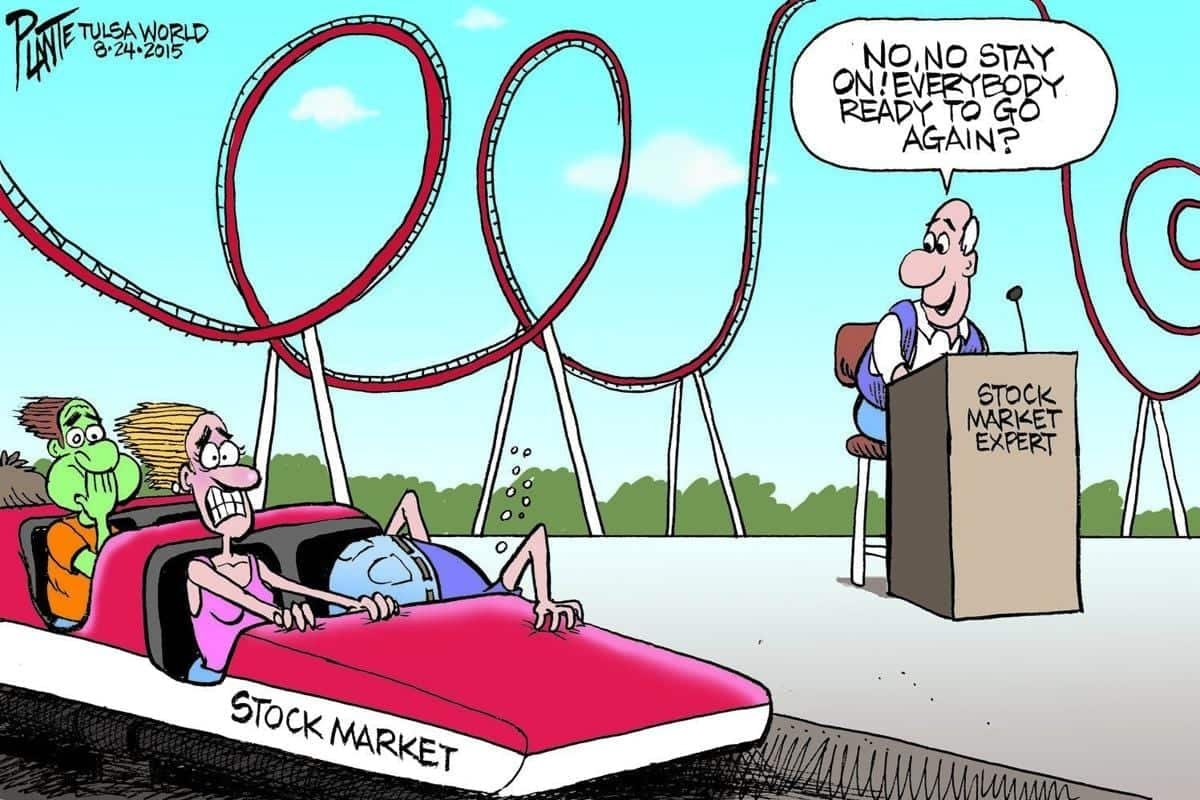
  • Just like last week ? !
    With a comprehensive personal investment strategy an investor can avoid the inevitable, repetitive and difficult questions like those asked in the OP. Or, at least have the answers at the ready.
    @Stillers: I agree with you that the total of 3 Discussion Topics you have posted for the community in the 16 months since you arrived are all vastly superior to any topic @Derf or I have offered up. That #3 - “Your tax dollars at work” sounds particularly compelling.
    As to your investment prowess, I’ve been wanting to thank you for the tip on DODFX back during the first half of December.
    “The conclusions that should be drawn are: DODFX is a mediocre FLV stock fund that has only kept pace with IC+ bond fund DODIX for the past ten years. DODFX is inherently a much higher risk fund than DODIX and the chance of it not meeting investors return expectations is significantly higher.” - Posted by @Stillers, December 2020.
    Admittedly, it’s only been 5 months. But here’s what’s happened since your post:
    - DODIX -5% (or more) / DODFX +14%.
    - DODFX has outpaced DODIX by approximately 20% over the 5 months.
    - DODFX is now in the top 20th percentile of its peer group based on recent performance (Lipper).
    - Meanwhile, DODIX peaked December 17 at $14.98 and has been falling ever since. Looks like you caught the high. Sure glad I listened and sold my depressed DODFX at that time, while putting the money into high flying DODIX.
  • Harbor Mid Cap Growth Fund changes
    https://www.sec.gov/Archives/edgar/data/793769/000119312521166201/d168244d497.htm

    111 South Wacker Drive, 34th Floor
    Chicago, IL 60606-4302
    harborfunds.com
    Supplement to Statement of Additional Information dated March 1, 2021
    May 19, 2021
    Harbor Mid Cap Growth Fund
    The Board of Trustees of Harbor Funds (the “Board”) has approved a change in Harbor Mid Cap Growth Fund’s (the “Fund”) name and principal investment strategy, together with certain related changes. Effective on or about September 1, 2021 (the “Effective Date”), the Fund will be renamed the Harbor Disruptive Innovation Fund and will no longer have a policy to invest, under normal market conditions, at least 80% of its net assets, plus borrowings for investment purposes, in securities of mid cap companies. As of the Effective Date, the Fund will seek to invest in what it believes to be disruptive and innovative companies of any market capitalization. The Fund’s benchmark index will change from Russell Midcap® Growth Index to the S&P 500 Index and the Russell 3000® Growth Index. There will be no change in the Fund’s investment objective.
    In connection with the changes noted above, Wellington Management Company LLP will no longer serve as the Fund’s suabadviser as of the Effective Date. Instead, the Fund will employ a multi-manager approach to seek to achieve its investment objective, whereby Harbor Capital Advisors, Inc. (the “Adviser”), the Fund’s investment adviser, will manage the Fund’s assets based upon model portfolios provided by multiple non-discretionary subadvisers. The Board has appointed 4BIO Partners LLP (pending approval of its registration as an investment adviser with the Securities and Exchange Commission), NZS Capital, LLC, Sands Capital Management, LLC, Tekne Capital Management, LLC and Westfield Capital Management Company, L.P. to serve as subadvisers to the Fund as of the Effective Date.
    The Adviser will, starting on the Effective Date, reposition the Fund’s portfolio in accordance with the new investment strategy for the Fund. In connection therewith, the Fund expects to experience portfolio turnover, which will result in higher than normal transaction costs to shareholders and may also result in the realization and/or distribution of higher capital gains than might generally be expected under normal circumstances.
    In connection with the changes described above, the rate of advisory fees payable by the Fund to the Adviser will be reduced as of the Effective Date from 0.75% to 0.70% annually as a percentage of the Fund’s average net assets. In addition, as of the Effective Date, the Adviser has contractually agreed to limit the Fund’s operating expenses, excluding interest expense (if any), to 0.50%, 0.58%, 0.83%, and 0.94% for the Retirement Class, Institutional Class, Administrative Class, and Investor Class, respectively, through August 31, 2022.
    An amended and restated Statement of Additional Information will be available for the Fund on the Effective Date.
    Harbor Global Leaders Fund
    Effective immediately the following information replaces the corresponding information on page 52 of the Statement of Additional Information.
    Harbor Global Leaders Fund. The Fund is subadvised by Sands Capital Management, LLC (“Sands Capital”). Sands Capital is an independent investment management firm, ultimately controlled by Frank M. Sands, Sands Capital’s CEO and CIO. Frank M. Sands controls Sands Capital by virtue of his position as, among other things, trustee, manager, or officer, respectively, of various intermediate holding entities and trusts through which voting or management rights with respect to Sands Capital are held and/or exercised.
    Investors Should Retain This Supplement For Future Reference
    S0521.SAI
  • Recommendations for new fund house?
    … Fidelity's holding period to avoid early redemption fees is 60 days, compared to Schwab's 90 days.
    Thanks @carew388,
    That’s an unexpected issue for me. I shuffle a fair amount of $$ around at TRP (and Invesco). Not selling entire fund - just adding or subtracting. During periods like March & April 2020 you want to be moving from less aggressive into more aggressive funds. Usually abide by a self imposed 30 day rule - in addition to TRP’s own 30-day block.
    *Question: Is that early redemption fee only applied to the most recent shares bought? First in / first out perhaps? Makes a heck of a difference!
    I did find this …..
    “Fidelity charges a short-term trading fee each time you sell or exchange shares of a FundsNetwork NTF fund held less than 60 days. This fee does not apply to Fidelity funds, money market funds, FundsNetwork Transaction Fee funds, FundsNetwork load funds … “
    That’s good news. But still trying to figure out whether first in / first out applies in the NTF cases.
    Ahhh … Fidelity sounds fine (as does Schwab). Fido has a lot of good funds of its own - and there’s no short term trading fee. Used to play around with their sector funds when younger.
    I’ve dealt with TRP for 25 years. Their online system is great 99% of the time. Pretty slick. But the method of switching over to electronic delivery is a bit gimped up. My talk with them today reminds me of the old line: A man said to the Universe … “Sir, I exist …”
  • Recommendations for new fund house?
    Having gone through this exercise a few years ago when vanguard unfairly dropped their decently integrated banking services, I was on the verge of moving to Fidelity and hit 2 roadblocks :
    1. their may be some funds that are restricted from transfer, probably the good ones. (e.g., admiral and primecap for vanguard). serious golden handcuffs.
    2. the moved funds may not count towards your asset limit to get the best benefits. in which case, you may have to move cash-like assets, or worse, realize tax gains just to get a similar holding.
    in the end, i had to open a conventional online bank account with needed services (capital1 , a nightmare in itself since it took almost 9 months to set up due to repeated administrative hassles)
    let us know if there is a silver bullet solution.
  • Recommendations for new fund house?
    Here’s a list of the 50 largest houses. Some are load-based. Any stand out as worthy of consideration? The number on the right references total number of distinct fund offerings.
    SOURCE
    Retail Net Assets # of distinct funds
    1 Fidelity Investments $984,173,589,258 315
    2 Vanguard Group $962,331,327,507 148
    3 American Funds $956,584,547,987 42
    4 Franklin Templeton Investments $377,385,331,414 122
    5 T. Rowe Price & Co. $345,725,591,811 110
    6 Columbia Management $167,493,529,444 140
    7 Dodge & Cox $126,826,526,974 5
    8 OppenheimerFunds $125,473,946,434 72
    9 John Hancock Funds $119,789,419,458 225
    10 Pacific Investment Management Co. $118,411,876,036 73
    11 Invesco Ltd. $95,323,126,745 92
    12 BlackRock Inc. $90,785,119,662 116
    13 Janus Capital Group $84,717,855,431 48
    14 American Century Investments $71,948,919,961 86
    15 MFS Investment Management $71,059,542,832 74
    16 Lord Abbett & Co. $66,647,971,069 42
    17 ING Retirement $58,294,891,374 150
    18 Wells Fargo Advantage Funds $48,938,991,118 101
    19 Putnam Investments $48,697,487,901 79
    20 AllianceBernstein Inc. $48,012,344,847 74
    21 Eaton Vance Corp. $45,749,419,375 91
    22 DWS Investments $43,664,723,778 67
    23 JPMorgan Funds $43,495,216,232 108
    24 USAA $41,901,152,367 41
    25 Legg Mason Inc. $40,997,886,898 87
    26 Hartford Mutual Funds $39,801,202,624 81
    27 Dreyfus Funds $35,223,057,365 105
    28 Ivy Funds $34,953,774,009 30
    29 First Eagle Funds $34,849,628,600 5
    30 Northern Funds $34,626,707,067 51
    31 Schwab Funds $34,218,636,841 47
    32 Principal Funds $33,220,356,251 63
    33 Prudential Investments $32,560,310,174 44
    34 Thornburg Investment Management $30,706,861,162 16
    35 Royce Funds $30,583,106,754 30
    36 Russell Investments $29,943,773,637 39
    37 Artisan Funds $28,990,199,955 12
    38 Federated Investors $27,512,268,214 66
    39 Goldman Sachs Asset Management $26,350,742,126 72
    40 Pioneer Investments $24,616,061,833 37
    41 Davis Funds $24,203,544,825 8
    42 Natixis Funds $22,552,861,400 28
    43 Oakmark Funds $22,312,816,162 7
    44 Waddell & Reed Inc. $21,894,219,733 22
    45 VALIC $20,406,552,997 45
    46 TIAA-CREF $20,067,405,527 50
    47 Nuveen Investments $19,271,984,888 106
    48 Delaware Investments $18,747,941,089 64
    49 Vantagepoint Funds $18,216,359,065 29
    50 MainStay Funds $18,123,576,513 43
    Source: Morningstar

  • When to take Social Security
    Thanks for your figures. Now I can be more specific to your particular "what if". Since I'm still making estimates, feel free to adjust the calculations as needed.
    For the sake of argument, let's assume that your SS benefits are 50% taxable. (It could be as high as 85%.) Let's also assume that you're working part time until age 70 so that we don't have too many different intervals to compute.
    Finally, let's assume a fed marginal tax rate of 22% and a state marginal rate of 6% for a combined 28% rate. We have to pick some figure to work with to make this concrete.
    I gather from your followup that you need an extra $20K/year (after tax) over and above your part time income for your expenses until you fully retire (assumed age 70). The fact that you'd be drawing from your IRA for this money suggests no money in taxable accounts - since that's what conventional wisdom says to deplete first.
    So if you defer benefits, you'll need to draw $27,778/year from the IRA. (72% of this gives $20K post tax).
    OTOH, if you take benefits at age 67, you'll get to "bank" $14,028/year, assuming you bank it in that same deductible T-IRA:
    $35K pre-tax SS benefits = $20K for expenses + $14,028 to IRA + $972 taxes
    [ net taxes = tax on SS benefits - tax savings on deductible IRA contribution
    $972 = (28% x 1/2 x $35K) - (28% x $14,028) = $4,900 - $3,928]
    So from age 67 to age 70, you're either reducing your IRA by $27,778/year or growing it by $14,028. That's a difference of $41,806/year for three years. In pretax dollars. In post-tax dollars (72%), that's $30.1K.
    I already explained how to account for the growth of this amount in an earlier post in this thread. So I'll just give the results here:
    Expected value of $30.1K (post-tax) difference/year over three years: $104K (portfolio visualizer), $93K in real (inflation adjusted) dollars.
    After age 70, if you've deferred SS, you'll be receiving 132%/108% x $35K, roughly $42.8K/year.
    Compared with the $35K you'd get by starting at age 67, that's a $7.8K/year difference pre-tax, real dollars. Post tax, the difference is $7.8K - (28% x $7.8K x 1/2) = $6.7K/year.
    The extra savings and growth ($93K real dollars to age 70) that you get by taking SS at age 67 can on average be expected to cover this $6.7K shortfall through age 87 (portfolio visualizer).
    That's a tad under what the new RMD table1 (single life) gives as the expected lifetime (88.2) for someone now age 67.
    The comment "by the way your dead at the end anyway" suggests that you're not giving much weight to the risk of loss once you're dead, since, well, you're dead anyway. OTOH, the risk of having less money while you're alive is going to matter. A risk averse person who values these two risks (dying before "breaking even", and living "too long") differently will tend to make the choice that reduces the more important risk.
    In addition, the estimate that by deferring benefits one will begin pulling ahead around age 87 is a result subject to wide variations. Maybe the market will not produce 7%/year (the figure I used as input), maybe it will swoon early in your drawdown period. Maybe you'll do much better, maybe you'll do much worse.
    In contrast, SS is a steady (inflation adjusted) income stream. All else being equal, the risk averse person will take the sure thing.
    A final note on the numbers. The calculations above incorporate the effect of taxes and account for investment growth. Your potential shortfall by taking benefits at age 67 and living to 100 still comes out to nearly triple magnitude you hypothesized: ""$10k, 20k, 30k maybe?" Or maybe $87K (13 x $6.7K, post tax, in real dollars).
  • Grandeur Peak closing two funds through financial intermediaries (with stipulations)
    https://www.sec.gov/Archives/edgar/data/915802/000139834421010939/fp0065552_497.htm
    497 1 fp0065552_497.htm
    FINANCIAL INVESTORS TRUST: GRANDEUR PEAK FUNDS
    GRANDEUR PEAK EMERGING MARKETS OPPORTUNITIES FUND
    GRANDEUR PEAK GLOBAL REACH FUND
    (Each, a “Fund,” and together, the “Funds”)
    SUPPLEMENT DATED MAY 17, 2021 TO THE SUMMARY PROSPECTUS AND
    PROSPECTUS OF THE FUNDS DATED AUGUST 31, 2020,
    AS SUPPLEMENTED FROM TIME TO TIME
    Effective as of the close of business on May 28, 2021, the Grandeur Peak Emerging Markets Opportunities Fund will no longer accept purchases, from new or existing investors, through financial intermediaries unless the purchase is part of:
    ● a retirement plan which held the Fund prior to this closure,
    ● an automatic reinvestment of a distribution made by the Fund, or
    ● a de minimis annual rebalancing approved by a member of the Grandeur Peak client team.
    Also, effective as of the close of business on May 28, 2021, the Grandeur Peak Global Reach Fund will close to new investors seeking to purchase shares of the Fund through third party intermediaries subject to certain exceptions for financial advisors with an established position in the Fund and participants in certain qualified retirement plans with an existing position in the Fund.
    The Funds remain open to purchases directly from Grandeur Peak Funds by existing investors and by new investors.
    The Funds retain the right to make exceptions to any Fund closure or limitation on purchases.
    INVESTORS SHOULD RETAIN THIS SUPPLEMENT FOR FUTURE REFERENCE
  • When to take Social Security
    "But why stress over that choice? Whats the + or - going to be, $10k, 20k, 30k maybe? A piddly amount in the scheme of things?"
    Here's a quick look at the magnitude of the risk, worst case. According to SSA, the average retiree monthly check (as of Dec 2020) is $1,544. That is likely less than what the average PIA (primary insurance amount - amount one would get at normal retirement age) is, because so many people take SS benefits early. For our back-of-the-envelope purposes, $1600 seems like a reasonable amount to use for the typical full retirement monthly benefit.
    Someone born in 1954 retiring in 2021 (age 67) would receive 108% of PIA if they started benefits at age 67, and 132% of PIA if they waited until age 70.
    https://www.ssa.gov/benefits/retirement/planner/1943-delay.html
    https://www.ssa.gov/benefits/retirement/planner/delayret.html
    So we can compare a benefit of $1728/mo for an extra 36 months to a benefit of $2112/mo starting at age 70. Worst case if delaying is 36 x $1728 = $62,208 (dying right before turning 70). If we use 100 years old as an upper bound on living, the "worst" case (living too long) of not delaying is:
    lost extra income over 30 years minus gained extra income over first three years =
    30 years x 12mo/year x ($2112 - $1728) - $62,208 = $138,240 - $62,208 = $76,032.
    That's about 2.5x as big a variation as suggested. But that's not the key point. The key point is that by deferring benefits risk of a lower cash flow in very old age is being reduced, and risk reduction has real value. At least for the risk averse.
    (FWIW, one of my grandparents lived to near 100, and while 1 in 4 aren't the best odds, it's enough to offer hope and for me to use age 100 for my own planning purposes.)
    In short, the piddly (or not so piddly) variation in possible legacies may pale in comparison to the value of the risk reduction achieved should one have the "bad luck" of living a long life.
  • CTFAX - COLUMBIA THERMOSTAT FUND ALLOCATION UPDATE
    @bee
    FCONX is an ultrashort bond fund....but interesting to compare it to VWINX. It looks like COTZX’s ramp up to higher equity %age in spring-summer of 2020 caused it to shoot past VWINX, after mostly underperforming prior to that (but having less equity than Wellesley?).
    I think a lot of people hoped FPACX, and other high cash funds, would behave like this, but the latter has not let go of much of its cash holdings due to inability to “find value in today’s market” or the like.
    I may have to consider this as a bond-ish holding appropriate during rising rates/threat of rising rates, similar to how I hold VWINX (I am early 40’s, so can afford to be a little more aggressive like that I suppose).
  • CTFAX - COLUMBIA THERMOSTAT FUND ALLOCATION UPDATE
    I charted COTZX against a more "static" conservative allocation fund (FCONX) as well as a VWINX. COTZX seems to have done a great job recently Identifying the March 2020 buying opportunity. I wonder if the fund can manage its high allocation to bonds with the same opportunity.
    PV Link
  • CTFAX - COLUMBIA THERMOSTAT FUND ALLOCATION UPDATE
    Yes-this was the allocation policy before the 2020 change which established the stock floor at 50%. It's good to see Columbia go back to its original allocation, which differentiated this fund from other allocation funds. I wish they could just stick with the 10% stock floor and stop changing it based on asset inflows, etc !
  • Bridgeway Small Cap Growth Fund reorganization
    https://www.sec.gov/Archives/edgar/data/916006/000119312521160629/d159594d497.htm
    497 1 d159594d497.htm BRIDGEWAY FUNDS INC
    BRIDGEWAY FUNDS, INC.
    Small-Cap Growth Fund
    Small-Cap Value Fund
    Supplement dated May 13, 2021
    to the Prospectus and Statement of Additional Information dated October 31, 2020
    At a meeting of the Board of Directors (the “Board”) of Bridgeway Funds, Inc. (“Bridgeway Funds”) held on May 13, 2021 (the “Meeting”), the Board unanimously approved a Plan of Reorganization (the “Plan”), providing for: (i) the conversion of the shares of the Small-Cap Growth Fund (the “SCG Fund”) into shares of the Small-Cap Value Fund (the “SCV Fund”) and (ii) the resulting transfer to the SCV Fund of all of the property, assets and goodwill of the SCG Fund (when completed, the “Conversion”). The Board determined that the Plan and Conversion would be in the best interests of the SCG Fund, the SCV Fund, and their respective shareholders. The effect of the Plan and Conversion will be that the SCG Fund shareholders would become shareholders of the SCV Fund.
    The Plan will require the approval of the shareholders of the SCG Fund. A special meeting of the shareholders of the SCG Fund is being called for that purpose. Shareholders of the SCG Fund will receive proxy solicitation materials providing them with information about the SCV Fund and Plan. If approved by shareholders of the SCG Fund, the Conversion is expected to take effect on or around the end of the third quarter of 2021. Share purchases of the SCG Fund will no longer be permitted approximately one week prior to the Conversion. Investors should check the Bridgeway Funds’ website (bridgewayfunds.com) for further information.
    PLEASE RETAIN THIS SUPPLEMENT FOR FUTURE REFERENCE
  • Is it time for a correction ?
    Not as bad as the afternoon in ‘87 when the Dow fell 27% during the short time I was driving home from work. Or as bad as the day in ‘08 when I happened upon an old HS buddy literally in tears because half his IRA had been wiped out in a few months by an investment in junk bonds he’d considered relatively safe.
    Shucks, this kind of noise is normal and healthy for markets. Never invest $$ you will need anytime soon. Nobody’s to blame - unless you mean the charlatans who promise quick gains and would have you believe getting rich investing is so easy “even a cave man could do it.”
    If you’ve been around the past half century or more, when it comes to investing, you’ve seen a thing or two.
  • Is it time for a correction ?
    Sooner or later ! Below taken from FMI large cap semi-annual report 3/31/2021
    Most stocks did reasonably well in the quarter; deeper-value names (many of suspect quality) and cyclical enterprises were standouts. Firms with a high probability of default,money-losing companies, and other highly-speculative stocks also continued to perform well.Recall that 2020 was a banner year for the most speculative stocks. Companies with over $1 billion market value as of year-end 2020, who also lost money in 2019 (409 money-losing companies),gained on average 123% last year. When the other side of this stock market cycle has been completed, we believe most of these stocks will better reflect fundamental reality
  • A Bitcoin / Cryptocurrency thread & Experiment
    Made my first forray into anything crypto-related, buying a bunch of BFARF at $5 at the opem before it closed up nicely. Just got approved to list on the NASDAQ the other day, so I expect it will pop given retail interest and make for some nice cap gains once the ticker changes. This is a total spec play on my part -- the company is a Canadian-based crypto miner that looks pretty decent vs its peers, so ... we'll see what happens.
    I don't own any cryptocurrency and think the proliferation of 'exchanges' is too crowded a field to figure out who's got an edge. But this 'mining' company at least I understand a bit and feel it's useful on the 'back end' of the crypto mania -- eg, crypto infrastructure -- and seems one of the better ones at that.
  • Buying this week's market dip?
    Hi @JD_co. I think there is plenty of room. I bought DBC a couple months ago so I'm up since that buy, but it's been trending up for about a year with the steepest up tick starting in Nov 2020. I believe it will be an up trend for a couple years to come. All commodities have been in a drought for a decade or more with low inflation, dropping interest rates and a strong $. Times they are a-changing. Just my 2-cents.
  • Selective Opportunity Fund to liquidate
    Update:
    https://www.sec.gov/Archives/edgar/data/1199046/000139834421010241/fp0065409_497.htm
    497 1 fp0065409_497.htm
    SELECTIVE OPPORTUNITY FUND
    Supplement to the Prospectus
    and
    Statement of Additional Information
    dated April 29, 2020
    Supplement dated May 11, 2021
    In Supplements dated February 26, 2021 and March 24, 2021, we notified you that the Board of Trustees has determined that it is in the best interest of shareholders to liquidate the Selective Opportunity Fund (the “Fund”), that as of February 26, 2021, the Fund is no longer accepting purchase orders for its shares, and that the Fund will close effective June 21, 2021 (the “Closing Date”). We are now notifying you that the Closing Date has been changed to May 21, 2021.
    Shareholders may redeem Fund shares at any time prior to the Closing Date. Procedures for redeeming your account, including reinvested distributions, are contained in the section “How to Redeem Shares” of the Fund’s Prospectus. Any shareholders that have not redeemed their shares of the Fund prior to the Closing Date will have their shares automatically redeemed as of that date, with proceeds being sent to the address of record. If your Fund shares were purchased through a broker-dealer and are held in a brokerage account, redemption proceeds may be forwarded by the Fund directly to the broker-dealer for deposit into your brokerage account.
    In the Supplement dated February 26, 2021 we notified you that the Fund will continue to pursue its investment objective through the Closing Date. In the Supplement dated March 24, 2021 we notified you that effective immediately, the Fund will no longer pursue its investment objective and may begin to liquidate the holdings in its portfolio. As of the date of this Supplement, all portfolio holdings have been liquidated and the proceeds of the liquidated holdings are invested in money market instruments or are held in cash.
    Any capital gains have been distributed to shareholders and reinvested in additional Fund shares, unless you requested payment in cash.
    IMPORTANT INFORMATION FOR RETIREMENT PLAN INVESTORS
    If you are a retirement plan investor, you should consult your tax adviser regarding the consequences of a redemption of Fund shares. If you receive a distribution from an Individual Retirement Account (IRA) or a Simplified Employee Pension (SEP) IRA, you must roll the proceeds into another IRA within 60 days of the date of the distribution in order to avoid having to include the distribution in your taxable income for the year. If you are the trustee of a qualified retirement plan or the custodian of a 403(b)(7) custodian account (tax-sheltered account) or a Keogh account, you may reinvest the proceeds in any way permitted by its governing instrument.
    * * * * * *
    This Supplement and the Prospectus provide the information a prospective investor should know about the Fund and should be retained for future reference. A Statement of Additional Information dated April 29, 2020 has been filed with the Securities and Exchange Commission and is incorporated herein by reference. You may obtain the Prospectus or Statement of Additional Information without charge by calling the Fund at (434) 515-1517 or visiting www.selectivewealthmanagement.com.