Howdy, Stranger!

It looks like you're new here. If you want to get involved, click one of these buttons!

Here's a statement of the obvious: The opinions expressed here are those of the participants, not those of the Mutual Fund Observer. We cannot vouch for the accuracy or appropriateness of any of it, though we do encourage civility and good humor.
  • Life Estate document, anyone familiar; creating, using, either as Grantee or Grantor ?
    Hi @msf
    Thank you for your time and effort with the reply.
    I'd already done research on this topic, and you've added further to the research.
    Aside from any other conditions/circumstances; it appears that a Life Estate establishes a cost basis for the remainderman upon the death of the Grantor. Obviously, being of benefit; if and when the remainderman chooses to sell.
    And if one chooses to use T.O.D.'s and/or P.O.D. 's for various other financial assets to help smooth some account(s) transactions upon death.
    I've added some additional information regarding Michigan in particular.
    Hopefully, others may have benefit with this topic.
    Regards,
    Catch
    This method also exists in Michigan:
    *** What is the Lady Bird law in Michigan?
    In Michigan, a Lady Bird Deed (also known as a Ladybird Deed or Enhanced Life Estate Deed) is a type of Quitclaim Deed that allows you, the creator, to transfer your property upon your death to a named beneficiary without having to go through the expensive and time consuming Probate process.
    --- A copy/paste regarding Michigan estate/inheritance:
    Does Michigan Have an Inheritance Tax or Estate Tax?
    Michigan does not have an inheritance tax. Its inheritance and estate taxes were created in 1899, but the state repealed them in 2019.
    Its estate tax technically remains on the books, but since 2005 there has been no mechanism for it to collect it. That’s because Michigan’s estate tax depended on a provision in the Internal Revenue Tax Code allowing a state estate tax credit against the federal estate tax. When congress eliminated that credit in 2005, it effectively killed Michigan’s estate tax.
    Note that estate and inheritance taxes are different things. Estate taxes, where they exist, are taken out of the deceased’s estate immediately after their passing. Inheritance taxes, conversely, are imposed upon the deceased’s heirs after they have received their inheritance.
    Michigan also does not have a gift tax. Remember, the federal gift tax is applied once you give any individual more than $16,000 in a single calendar year. Give any less than that, and there is no federal gift tax whatsoever.
    Other Necessary Tax Filings for Estates
    Inheritance taxes: Michigan does not have an inheritance tax, with one notable exception. It’s only applied to an estate’s beneficiaries if the decedent passed away on or before Sept. 30, 1993.
    Both federal and state income tax returns: The estate of the deceased must file individual state and income tax returns one final time, due by the tax deadline in the year immediately following their death.
    Federal estate tax: The decedent’s estate may be responsible for paying the federal estate tax if the estate is valued at more than $12.06 million ($24.12 million for married couples). If so, the estate will be taxed on the overage, not the entire value. Federal estate taxes are due nine months after the date of death.
  • 5% CD at Fido (Jonesboro State Bank)
    @Gary1952, great point. The brokered CD market is illiquid and the broker would try to sell it on best-effort basis.
    So, best to hold brokered CDs to maturity. If there is any doubt about that, stick with liquid T-Bills/Notes.
  • Fed to deliver another big rate hike as job market fails to cool
    Fed fund futures market-based projections are 75-50-25-pause bps-hikes at Nov, Dec, Feb-later FOMC with terminal rate of 4.50-4.75% (current 3.00-3.25%). Remember that the Fed controls the ST rate only. The US/global factors determine IT/LT rates.
    https://www.cmegroup.com/trading/interest-rates/countdown-to-fomc.html
  • Tech Analysis at Stockcharts
    Mark,
    Which ones do you use? I’m just curious, I have looked at these pages from time to time but really don’t see anything that is actionable. I mean, look at their #1 guy: https://stockcharts.com/public/1107832
    I do see where he says “look at chart 60”. (https://stockcharts.com/public/1107832/tenpp/5). But not the other 100?
  • “The Complete History of Bear Markets” (Article)
    PV does a nice job of Max DD and recovery:
    Here the S&P 500 since 1985...select "drawdown" tab to see this information.
    S&P 500 Since 1985
    Should look like this:
    image
  • “The Complete History of Bear Markets” (Article)
    “There have been 28 bear markets since 1928. The average decline was 35.62%, and the average length of time was 289 days.”
    Read full article here.
    I realize this article is an oversimplification. It appears to measure only the length in days of market declines and not the time needed for investors to recoup losses. Further, I don’t view what we are in today as “average” or “typical”. As bear markets go, I’m expecting worse than “average” - but would love to be proven wrong!
    * Figures are based on the S&P 500 index as noted at the top of article.
  • Buy Sell Why: ad infinitum.
    @Baseball_Fan -
    You said "We as humans are not generally wired to hold thru large downdrafts...I saw many corporate types happlily retire in 06' then come crawling back begging for their old jobs in 09'...they weren't real happy, nor real motivated to say the least...
    Why sit thru the downdraft? Who cares if you leave some schekels on the table getting back in"
    I believe most investors are generally wired to hold through large downdrafts in the market. Some would never admit that they might have possibly made a mistake in their investment choices while others will never accept the loss or sell at loss and will wait hopefully for the market to come back. Initially I did it myself but have readjusted my plays.
    Edit to add:
    How to Make Peace With Your Stock Market Losses
  • TBO Capital
    balyan55, thanks so much for the tip on IC3, filled out a complaint this morning. Bob_Up, I'm HOPING when this builds in the SEC docket, they'll do something aggressively. I was a bit...underwhelmed by the response from the SEC attorney. Super-nice guy, maybe he was just setting expectations low. Which I get. But we're thinking we may need to hire an attorney to look out for us.
    Another agency you should all think about filing with is the NY Attorney General's office. They have teeth. They're a more "law enforcement" arm than it seems to us the SEC may be. Maybe if they're all on notice they can coordinate this mess...
  • 2% swr
    Interesting thread/topic....
    So what do folks think...annuitize a portion of your nest egg to act as a "defacto" pension for those without one? If so, what type of annuity...inflation protected, length, simple etc?
    Isn't Pfau connected with some institute connected with annuities or something? Does that sway his thinking/perspective in any manner?
    Does the latest ~25% downdraft in the markets (still overvalued?) and increase in interest rates change any forecast pertaining to SWR?
    Tax conversation so releveant and somewhat confusing to me...
    Best Regards,
    Baseball Fan
  • Wealthtrack - Weekly Investment Show
    This was a good episode.
    At the start of 2022, approx. two-thirds of the PRWCX fixed income portfolio was in short-duration bank loans.
    This positioning really helped fund performance - especially on the fixed income side.
    Historically, Mr. Giroux has purchased Treasuries only three times in his career.
    There were no Treasuries in PRWCX at the start of the year but they (5 Yr Treasuries)
    now comprise ~10% of the portfolio.
    Mr. Giroux currently likes analog semiconductors - NXP, TXN.
    He also likes several big tech companies - AAPL, MSFT, GOOG.
  • Wealthtrack - Weekly Investment Show
    Oct 8 Episode
    It’s been a rough year for the markets and Capital Appreciation, although it’s down less than the market and its category. In this weekend’s episode, Giroux will give us his view of the state of the market, its risks, and potential rewards.


  • Life Estate document, anyone familiar; creating, using, either as Grantee or Grantor ?
    ISTM the difference between a life estate and a life estate deed is the difference between a piece of real estate and the real estate deed. One is the property, the other is the legal document describing the property.
    A little bit of terminology - grantor refers to the one signing the deed, "granting" and splitting the property between two owners - the owner of the life estate (aka life tenant) and the owner of the "post-death" property (aka remainderman or remainder beneficiary).
    https://www.deedclaim.com/life-estate/
    As noted in that piece, one can achieve much the same effect with a simple TOD deed, assuming your state supports that. Most people here understand TOD and many have attached that to their brokerage accounts. Life estates are more complicated. Which is not to say they don't have additional or different benefits, but rather that there may be simpler mechanisms available depending on what you are trying to achieve.
    Edit: There is a gift tax upon the present transfer of the future (remainder) interest in the property. Because this is a gift of a future interest, the $16K annual exclusion for gifts doesn't apply. In theory the gift tax could lead to double taxation. The IRS handles this as described below.
    The grantor (original owner) gifts a life estate to the life tenant and a future interest to the remainderman. That's a gift that gets counted against the $12M lifetime exclusion (adjusted annually, but scheduled to be cut in half in 2026). In addition, the whole value of the property is included in the life tenant's estate when calculating estate tax.
    In the usual case - the grantor retains a life estate - it would appear that the property value gets counted twice in the same estate tax calculation. That's because the grantor and life tenant are one and the same. So the property is taxed as a gift (to oneself), and also as property owned at death. It looks like the answer is that the IRS deals with this by cancelling the gift tax portion. But only if the grantor and life tenant are the same person. So there can be a gift tax, depending on who is getting the life estate.
    The transfer for gift tax purposes will be eliminated in calculating the adjusted taxable gifts when the estate tax is calculated, thus canceling any potential for double-taxation.
    http://archives.cpajournal.com/2001/0600/dept/d067001.htm
    See also IRC §2001(b) (adjusted taxable gifts).
    As to taxation, as you note, there is no gift tax upon signing of the deed, but there's still an estate tax:
    the transfer of a residence with a retained life estate permits the transferee [remainderman] of the residence to receive a full step-up in his or her cost basis in the premises upon the death of the transferor to its fair market value on the transferor’s date of death. This occurs because the residence is includible in the gross taxable estate of the transferor [grantor] upon his or her demise.
    http://www.nysscpa.org/most-popular-content/transfer-of-a-primary-residence-the-tax-and-long-term-care-consequences
    In the example above, the grantor and life tenant were one and the same, so it wasn't clear whether it was the grantor's estate that included the property for estate tax purposes or the life tenant's estate that did. Common sense suggests the latter - since the grantor gives away everything (though perhaps to him/herself). Massachusetts seems to confirm that:
    Whether or not the real estate is owned in Life Estate ownership form has no effect whatsoever on whether or not Estate taxes must be filed as the value of the property is included in the estate of the Life Tenant Owner.
    https://www.berkshireelderlaw.com/life-estate-ownership
    I suspect that the step-up would be somewhat different if the grantor used an alternate valuation date for estate tax purposes, but that's beyond the scope of your question.
    Other tax questions you didn't ask:
    What happens with the $250K gain exclusion for homeowners - who's home is it, who is selling it, does anyone get that exclusion? While the life tenant is alive, if the property is sold, it is the life tenant - assuming the life tenant is living there - that gets the exclusion.
    https://www.ellenbecker.com/resource-center/estate/estate-building-block-understanding-the-alternate-valuation-date
    What happens with state benefits for home owners? For example, in NYS, owners of owner-occupied homes get a modest property tax break ("STAR"). For this purpose " in the eyes of law, as long as the holder of the life estate is alive, the property is 'owned' by him or her." I suspect that's the typical treatment by various states and agencies.
    https://www.tax.ny.gov/pit/property/star/assessorguide.htm
    As always, I am not a lawyer or accountant. Heck, I'm barely a professional of any type. I'm just passing along a little information.
  • Barron’s Funds Quarterly (2022/Q3–October 10, 2022)
    Barron’s Funds Quarterly (2022/Q3–October 10, 2022)
    https://www.barrons.com/topics/mutual-funds-quarterly
    (Performance data quoted in this Supplement are for 2022/Q3 and YTD to 9/30/22)
    Pg L3: Good ACTIVE mutual funds that are OPEN, BROAD-based, in the TOP 20% of peers in various timeframes, have average ERs and have manager succession plans: LC-growth OLGAX, FDSVX; dividends PRDGX, IHGIX; SC-value BRSVX, AASMX; international MIEIX, DPWRX; fixed-income DODIX, SCCIX.
    Pg L10: Large-cap GROWTH funds have disappointed in 2022 (-4.1% in Q3; -32.1% YTD to 9/30/22) and there were outflows (but some related ETFs had inflows (VUG, SPYG, etc)); as expected, there were funds that did much better (BPTRX, etc) or worse (MSEQX, etc) than the averages. Large-cap VALUE also disappointed in Q3 (-5.9%) but was relatively better YTD (-16.6%). Several funds with large losses and outflows may have large YEAREND CG distributions (bad in taxable accounts; not relevant in tax-deferred/free accounts). MANAGED-FUTURES did well (after several disappointing years) and attracted inflows (QMHNX, PQTAX, etc). COMMODITY funds also saw inflows (DBC, FTGC, etc). Interestingly, despite the market selloff in both stocks and bonds, several INDEX funds had inflows, stocks (VOO, IVV, VTI, etc) and bonds (TLT; IEF, BND, LQD; SHY, VCSH, etc) (bulls will point to this as strength, bears as lack of capitulation yet). (by @LewisBraham)
    EXTRA from Part 2: Pg 22: Katrina DUDLEY, EUROPE TEMIX. Things couldn’t be worse for Europe but that is how opportunities develop. Costs have risen sharply due to supply-chain disruptions, energy crisis, Russia-Ukraine war. However, Europe wasn’t overvalued before all this, jobs are holding up so far, and any recession may be short and shallow. Be selective as countries are following different paths. Lower currencies (vs DOLLAR) are hurting the returns of the US investors. She LIKES telecom, energy, industrials, insurance, aircraft leasing, etc; she is AVOIDING travel, entertainment, etc. CHINA will remain a global growth engine despite pause or slowdown, so European companies with China exposure would be fine. RISKS include the ECB polies, energy crisis.
    Pg L37: In 2022/Q3 (SP500 -4.88%): Among general equity funds, the best were SC-growth -1.61%, MC-growth -1.65% (yes, it was BAD Q3, following terrible Q2) and the worst were equity-income -5.75%, multi-cap-value -5.64%, LC-value -5.60%, MC-value -5.45%; ALL general equity categories were negative. Among other equity funds, the best were short funds +6.54%, Lat Am +5.28%, and the worst was China -21.55%. Among fixed-income funds, domestic long-term FI -2.72%, world income -4.16% (not very refined in Lipper mutual fund categories listed in Barron’s).
    LINK
  • 5% CD at Fido (Jonesboro State Bank)
    Navy Federal FCU. "Our members are the mission." Bushwah. Restrictive now, with deposits by check, and the best available CD rate is still just 3.45%.
  • 5% CD at Fido (Jonesboro State Bank)
    Jonesboro State Bank CDs are all gone? Yields of both CD and treasury are going up.
    Still available - looks like 3,325 left.
  • Worst. Bond. Market. Ever.
    [also posted at Bogleheads.org, and maybe a few more to come, but I've gotten good value here at MFO and wanted to post it to give back.]
    Here at the end of the 3rd quarter, the statement has become true, period, with no qualifier other than “as regards investment grade bond markets in the US and Britain.”
    The statement can be evaluated over four time frames, in all cases treating the first nine months of 2022 as if these were 12 month returns. Tickers used to determine 2022 returns are in parentheses. All are nominal total returns and year-to-date as of 9/30/2022.
    1. Since December 1972 (total bond, BND)
    2. Since December 1925 (intermediate Treasuries, VGIT, and long Treasuries, VGLT)
    3. From January 1793 to January 1926 (long investment grade bonds, mostly governments, BLV)
    4. August 1753 to December 1918 (British Consols, EDV as the comparison)
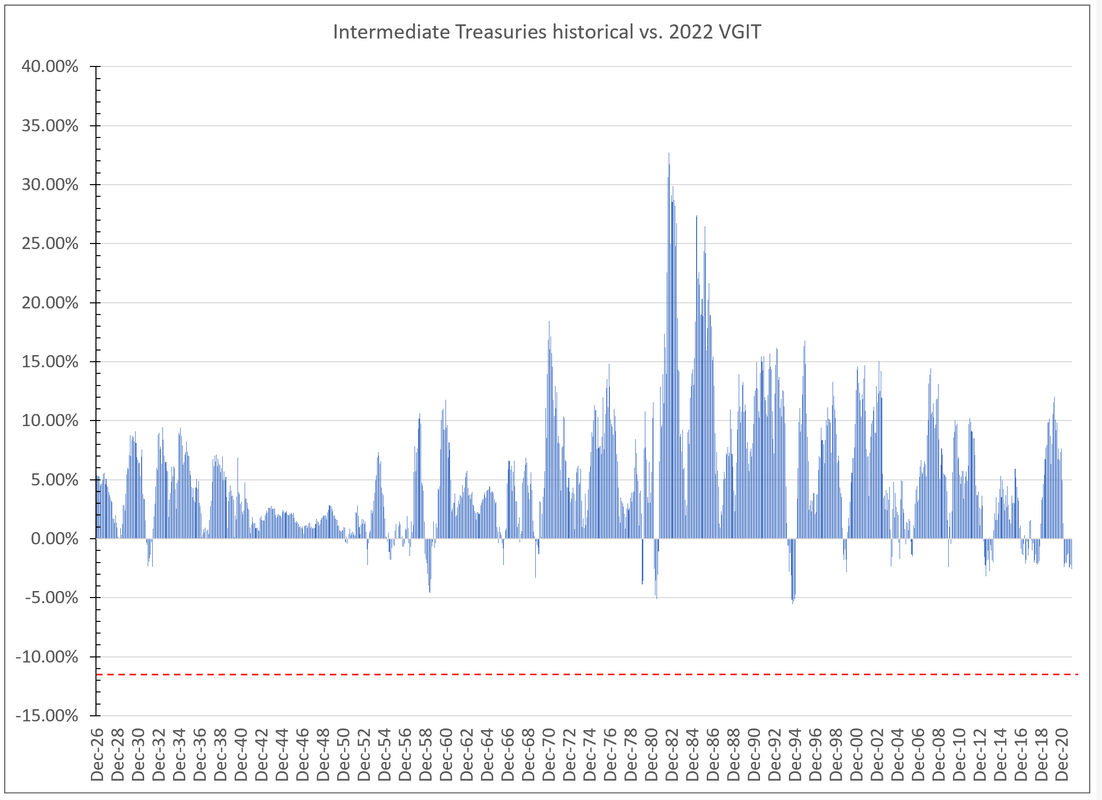
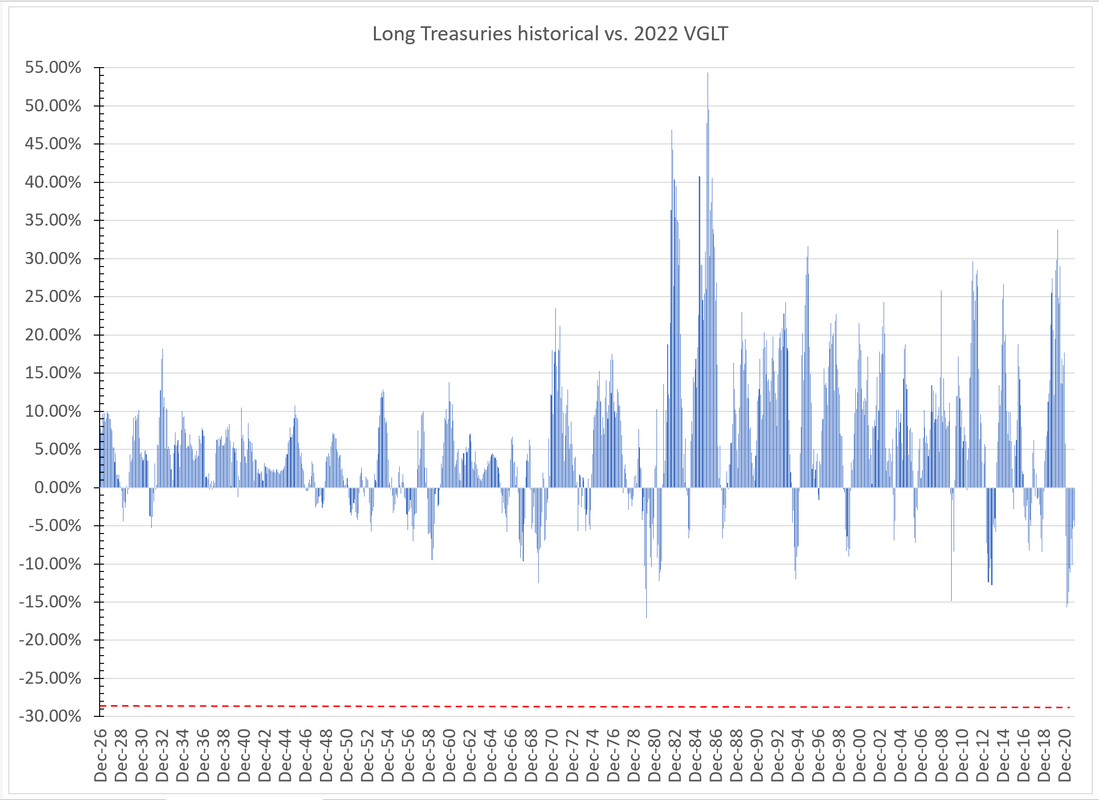
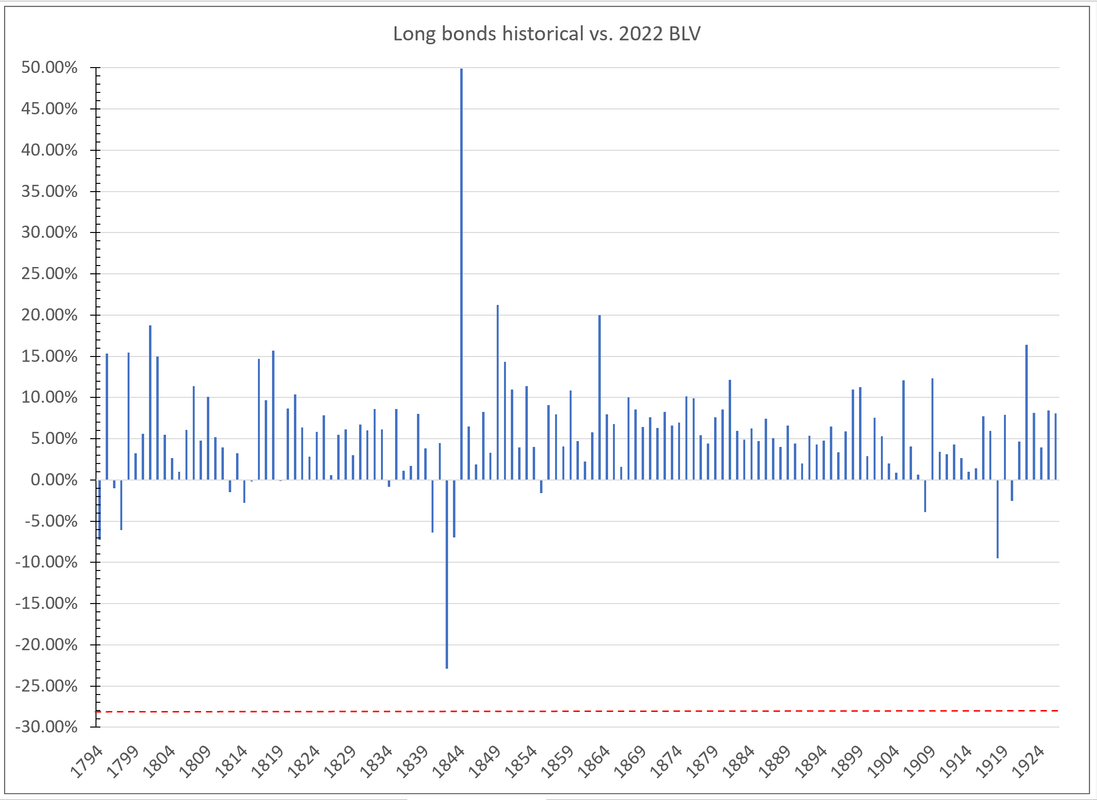
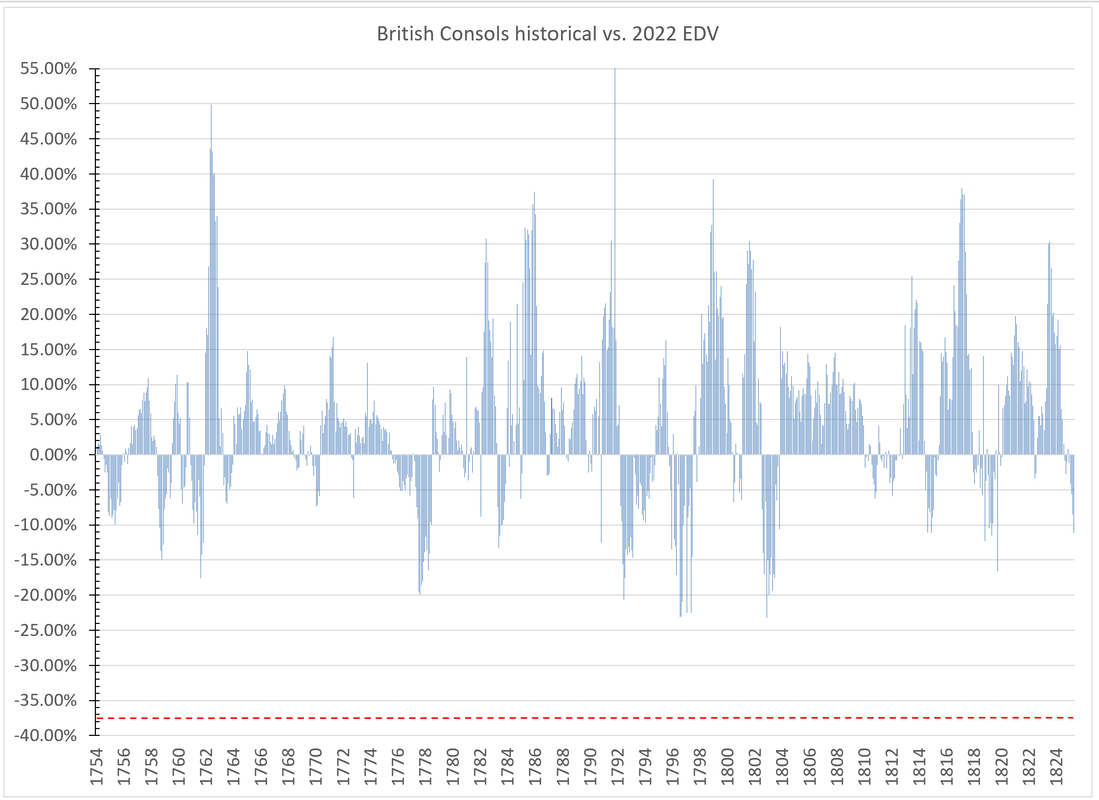
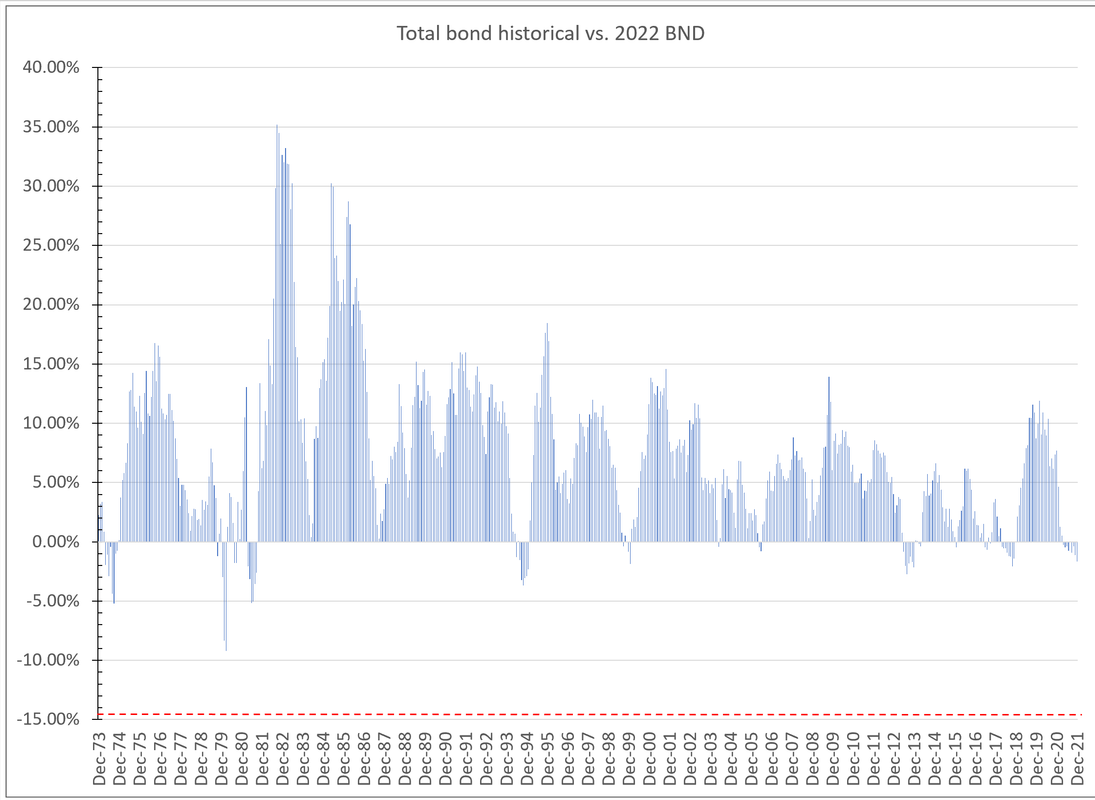
    Charts and brief discussion follow,. Red dashed line shows 2022 return, bars show historical returns over rolling twelve-month periods.

    [b]Total Bond[/b]
    image
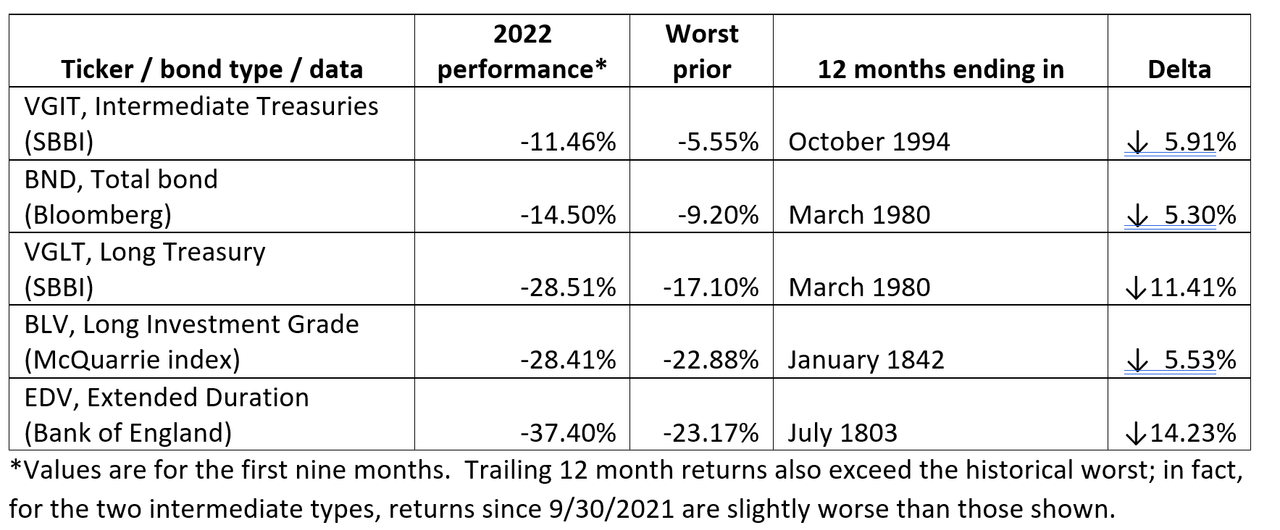
    This one is a staple of 3-fund portfolios and Vanguard Target Date funds. It’s probably the most shocking outcome within the Boglehead universe. As of 9/30, BND was down 14.50%. The worst previous 12 month return on the Bloomberg-Barclays Aggregate was the 12-month roll through March 1980 at minus 9.20%.
    I think it fair to say that few 3-funders had any conception that BND could decline by double-digits in the space of a year.
    But then again, a fifty-year record is not a lot to support a claim like “ever.”

    [b]Intermediate Treasuries[/b]
    image
    This is where investors go if they find BND holds too much risk for comfort, whether duration risk or credit risk. VCIT is down 11.46% in 2022. That’s head and shoulders below the worst previous 12-month return of minus 5.55% ending in October 1994. So much for “safe.”
    And 96 years maybe does qualify for “ever.”

    [b]Long Treasuries[/b]
    image
    VGLT really took it on the chin in 2022, down 28.51% thus far. It’s a reminder of why long bonds have a bad reputation in the eyes of some. Maximum duration, maximum price decline in an adverse environment. Turns out, the bad times in the 1960s and 1970s don’t really hold a candle to 2022. The worst previous 12-month return on the SBBI long bond was minus 17.10% for the period ending March 1980. That’s in nominal terms, as are all these comparisons. I’ll look at real returns at the end of the year, since most of the older inflation data (pre-1913) are only available on an annual basis.
    Again, 2022 produced the worst return on long Treasuries seen over any 12-month period in the past 96 years. By far.

    [b]Long bonds[/b]
    image
    This is a spliced series:
    1. My index of long corporates from 1925 back to 1897; https://papers.ssrn.com/sol3/papers.cfm?abstract_id=3805927
    2. My aggregate of corporate, municipal and Treasuries to 1842;
    3. Municipals to 1835; Treasuries and municipals to 1825; Treasuries to 1793.
    You have to go back over 150 years, to the 1840s, when states defaulted on their debts, to get a result that even comes close to the 2022 results for BLV (which pegs toward the midpoint of VGLT and VCLT). BLV saw a decline of 28.41% in 2022; the worst previous decline was the minus 22.88% decline for the period ending in January 1842. In April, 2022 was only a contender for worst ever in this bond category; it took bad returns in June and again in September to push 2022 returns below even those seen in 1842.
    I’d say 228 years is a good approximation of “ever.”

    [b]Really long bonds: British Consols[/b]
    image
    These were perpetuities, so the proper comparison would appear to be the Extended Duration Treasury fund. EDV got slaughtered in 2022, down 37.40%. That would be a mighty bear market even in stocks, much less safe government bonds.
    Nothing in the British Consol record comes close, not even the worst months of the Napoleonic Wars. The chart shows 12-month rolls from 1753 to 1823. An earlier examination December on December annual returns had shown all the worst returns to fall within in this stretch. Later years, in the heyday of the British empire, were mostly fine. WW I returns, nominal, in particular did not plumb the depths of Napoleonic returns.
    Consols down 20% plus? Happened more than once in the Napoleonic Wars (and before, in the American Revolution, and almost, in the Seven Years War). The worst case was minus 23.17% for the period ending July 1803. A Consol total return worse than minus 25%? Never happened. Return worse than 30%? Never approached, not even close.
    2022 EDV returns stand alone at the bottom of a chasm.
    And if 269 years isn’t a good proxy for “ever,” I don’t know what qualifies.
    [b]Summary[/b]
    image
    Unprecedented, across the board.
    [b]Why has 2022 been so bad?[/b]
    One word: duration, my boy, duration!
    Technically, modified duration, or the price sensitivity of a bond to a change in interest rates.
    Duration is a function of maturity (as everyone knows) and of coupon/yield (which most people forgot or never knew).
    1. Long bonds fall more when rates go up.
    2. Low coupon bonds fall more when rates go up.
    3. Low coupon, long bonds plunge when rates go up.
    [b]What that means in practice[/b]
    The last big bond bear market occurred at the dim horizon of memory for most investors active today, i.e., in the late 1970s. Rates on the 20-year Treasury rose from about 6% in 1972 to over 14% at one point in 1981.
    The 2022 bear market (so far) has seen a much smaller rise in rates, a little more than 200 bp since the beginning of the year. Why then has 2022 clocked in as historically awful?
    First, note the pacing: it took nine years for rates to rise 800 bp in that hazily remembered bear market, an average rise of less than 100 bp per year. 2022 saw more than twice that rise in just nine months.
    And the real kicker: in that long ago bear market, rates were already higher at the start than almost any observer expects to see in the current cycle. High rate equals more coupon income to defray price drops, and a more favorable total return, since duration is also less at high coupons.
    Back to 2022: an achingly low rate to start, less than 2.0%, and a rapid price drop, combine to produce a potent, toxic brew for bond total return.
    Next, the last time long Treasury rates were as low as in 2020-2021 falls outside the lived memory of most investors. It was just under 2.0% in early 1946. And it took 12 years of drip-drip declines before that yield rose as high as the current 4.0%.
    Now you have some sense of why 2022 has been so much worse for bonds than ever before.
  • Buy Sell Why: ad infinitum.
    Waiting a little while to buy anything more. Look at CM. $42.56 USD. Bargain basement. Smells delicious...... Small dividend arrived today from NHYDY.
    Salivating over RY. BMO. ABB. ENGIY.
    Carnage wherever you look. As I have said many times before: the Market always overreacts, both to the downside and the upside.
  • Nowhere near as bad as ‘07-‘09 - Yet
    Some incredible destruction of wealth taking place. TROW @$106 is off over 45% YTD as well as for 1 year. ISTM not long ago that one was thought a “safe” long term hold suitable for Grandma. (Grandma may need to get a job.)
    Fed’s plan appears to be - Make us all poorer so we can’t buy as much. Than everyone will be better off.
  • World’s largest crypto exchange hacked with possible losses of $500m
    Following is an unedited news article from The Guardian:
    Binance, the world’s largest cryptocurrency exchange, may have lost half a billion dollars after a hack of its network.
    The company temporarily suspended transactions and the transfer of funds after detecting an exploit between two blockchains, a method of digital theft that has been used recently in at least one other major hack.
    “The issue is contained now. Your funds are safe. We apologize for the inconvenience and will provide further updates accordingly,” Binance’s CEO, Changpeng Zhao, said in a tweet.
    Binance originally said that $100m to $110m in funds were taken. Since then, CNBC has reported the crypto company has lost $570m.
    In a blogpost on Friday, Binance said it was working on locking down any areas of vulnerability. “First, we want to apologize to the community for the exploit that occurred. We own this,” the company wrote. “Thanks to the assistance of all the security experts, projects, and validators, the vast majority of the funds remain under control.”
    Last year Binance said that it was time for global regulators to establish rules for crypto markets. The company acknowledged at the time that crypto platforms have an obligation to protect users and to implement processes to prevent financial crimes, along with the responsibility to work with regulators and policymakers to set standards to keep users safe.
    Binance is just the latest crypto company to experience a targeted hack. In August Nomad, a service that allows users to send crypto tokens between different blockchains, was struck, with media reports saying it was taken for nearly $200m. Harmony, another transfer service, lost about $100m in a hack in June.
    Associated Press contributed to this article
  • Fed to deliver another big rate hike as job market fails to cool
    Brace yourself that a 75 bps rate hike is coming next month. Labor cost (service cost) is unlikely to come with lower employment rate reported today.
    https://fidelity.com/news/article/top-news/202210070938RTRSNEWSCOMBINED_KBN2R21CN-OUSBS_1