
Howdy, Stranger!

It looks like you're new here. If you want to get involved, click one of these buttons!

Here's a statement of the obvious: The opinions expressed here are those of the participants, not those of the Mutual Fund Observer. We cannot vouch for the accuracy or appropriateness of any of it, though we do encourage civility and good humor.
  • AAII Sentiment Survey, 6/26/24
    AAII Sentiment Survey, 6/26/24
    BULLISH remained the top sentiment (44.5%, above average) & neutral became the bottom sentiment (27.2%, below average); bearish became the middle sentiment (28.3%, below average); Bull-Bear Spread was +16.2% (above average). Investor concerns: Elections, budget, inflation, economy, the Fed, dollar, Russia-Ukraine (122+ weeks), Israel-Hamas (37+ weeks), geopolitical. For the Survey week (Th-Wed), stocks mixed (growth down, cyclicals up), bonds down, oil up, gold down, dollar up. Data breaches (LockBit) & fintech app safety (Synapse, Yotta) were in the news. #AAII #Sentiment #Markets
    https://ybbpersonalfinance.proboards.com/post/1532/thread
  • Can someone explain PYLD’s apparent negative 90% cash position? What am I missing?
    You're looking at M*'s economic exposure view, not a the "classic" asset view.
    The Economic Exposure View displays the sensitivity of portfolio return to various asset classes. Economic Exposure will model the impact of these instruments based on their inherent leverage rather than solely based on their market values. Compared to the Classic Asset Allocation, this view provides additional clarity to investors around how funds use derivatives to adjust the portfolio’s risk profile in addition to more clearly depicting sources of risk and return.
    More clear to some, perhaps.
    M*'s "classic" view is a bit closer to what you described:

    Asset Class Net Short Long Cat. Index
    U.S. Equity 0.00 0.00 0.00 1.39 0.00
    Non-U.S. Equity 0.00 0.00 0.00 0.15 0.00
    Fixed Income 120.71 12.73 133.44 112.15 99.98
    Other -0.07 0.10 0.03 0.15 0.00
    Cash -21.69 77.90 56.21 13.39 0.00
    Not Classified 1.05 0.00 1.05 3.42 0.02
    Then there's M*'s market value view that shows net cash exposure of -3.86%. That is close to what you described. (Note that Blackrock describes its allocation table as percentages of market value.) Differences are likely due to Blackrock reporting as of June 25 and M* reporting as of June 13.
    P.S. When you cut-and-paste these tables, precede them with <PRE> and follow them with </PRE>. Asside from needing to add a few tabs to get the alignment right, this will display the tables cleanly. (I had to add a tab after "Other" and after "Cash".)
    Blackrock reports 14.23% B rated (as well as 21.79% BB rated); this is close to M*'s 13.96% B rated and 20.82% BB.
    https://www.blackrock.com/us/individual/products/331752/blackrock-flexible-income-etf
  • Can someone explain PYLD’s apparent negative 90% cash position? What am I missing?
    BINC looks a lot better on Blackrock’s website than at M*. Geeeeze.
    It has no cash (actually a few percent negative) compared to M*’s reported 43%!
    And very little sub investment grade paper - roughly 25% (but almost all BB). You couldn’t tell that from M *. Looks like a currently moderate duration of 3-5 years.
    Interestingly, Rieder has gone into international holdings with about 30% (+ - ) listed as non-US.
    I don’t worry much about historical performance with bond funds. Much more interested in what they hold. We’ve been through some very abnormal times.
    Derivatives are fine. (thanks @msf) They are used near exclusively by commodity funds (Who wants a boat-load of hogs?) But the ice below me feels a little thicker when they’re not being employed to large extent. I’ve spent hours exploring the world of bond funds, as might appear. I did come across mention that certain tactics don’t work as well for the manager in an ETF as they do with an OEF. But don’t remember the exact context.
    Thanks all. Very helpful.
  • Can someone explain PYLD’s apparent negative 90% cash position? What am I missing?
    This was a tough day for duration. The 10-Year spiked to 4.34% (10 basis points).
    A few bond funds I watch, with today’s move …
    JPIE -0.09%
    LSST -0.14%
    BINC -0.15%
    PYLD -0.16%
    GNMA -0.32%
    JPIB -0.40%
    BRTR -0.52%
    GBAB -0.88%
    It’s of little importance longer term. But if you’re trying to keep daily volatility lower or balance out a risk somewhere else (equities, junk bonds, commodities) than you might care about how your bond fund moves under varying circumstances.
  • Can someone explain PYLD’s apparent negative 90% cash position? What am I missing?
    Instead of PIMIX or PYLD(both are similar), look at RCTIX.
    One year chart(https://schrts.co/JRNGpRmT)
    3 year chart(https://schrts.co/RfSCENuJ)
    The above is not a recommendation or a guarantee; do your own due diligence.
    I sold PIMIX in 01/2018 after I invested over 50% of my money in it for years.
  • Federal Reserve Hacked by LockBit Ransomware
    Whenever breaches happen, the news comes out slowly.
    Unclear if this breach for Evolve Bank is from the Fed data. I also found a good open source - BNN.
    https://x.com/mikulaja/status/1805913148660084932
    https://www.bnnbloomberg.ca/evolve-bank-trust-confirms-its-data-was-stolen-in-cyber-attack-1.2089872
  • Can someone explain PYLD’s apparent negative 90% cash position? What am I missing?
    :) Thanks for the details & the honesty. Yogi.
    There’s no perfect bond fund. Short duration isn’t likely to get you the yield you want. Longer duration can feel like a roller coaster when rates move sharply. Many “core” bond funds dip heavily into BB and below. These can appear very safe & steady for long periods (as in the recent past) but can tank rapidly in a recession or during unexpected crisis. Both the highly rated JPIB and JPEI sometimes hold up to 50% in lower rated bonds, but are below that presently (30-35% as I recall).
    Yes - @yogibearbull - M* does tend to get things mixed up.
  • Fintech Apps - Yotta Funds Missing
    Beware of nonbank fintech apps promising good yields. These fintech intermediaries may only do recordkeeping for gross funds deposited with them but hold by them at the FDIC-insured banks. The customers aren't connected directly with those FDIC-insured banks (or, those banks aren't aware of the individual depositors), but they are confused by misleading references to FDIC insurance. So, when the money goes missing, the chase for money starts and customers, fintech, banks point fingers at each other.
    Well, this isn't hypothetical - Yotta-Synapse have managed to lose $109 million of customers' money.
    Ken Tumin/X https://x.com/KenTumin/status/1806063471668375680
    CNBC https://www.cnbc.com/2024/06/21/synapse-collapse-nearly-109m-in-yotta-customer-deposits-vanish.html
    https://synapsefi.com/solutions/neobanking
  • Can someone explain PYLD’s apparent negative 90% cash position? What am I missing?
    Thanks both. Larry, PIMIX is only 12.5% negative cash. I’d consider moving in but need an easier to trade etf for the time being.
    M* writes highly of PYLD (Bronze rated, however). I’ve held it for several months in the past. Steady eddy during that time. Even suggested it to a poster recently. It has a “average credit rating / surveyed” of A which is well above some other multi-sector funds, including the one I referenced earlier from J.P. Morgan. It has, however, a very high weighting to “Securitized Debt” obligations which are hard to analyze..
    Interestingly, if you believe M* (??) Rick Rieder’s year old etf BINC is sitting in 43% cash. Geez. That doesn’t sound like Rieder. I’ve always considered bond funds more difficult to understand than most equity funds. I think this discussion touches on some of the reasons. Maybe “Only the Shadow knows.”
    What I think is that PYLD is roughly short the same amount of bonds that it holds long, thinking their superior analysis will win out over time. Reasonable - but unlike anything I’ve seen in a bond fund.
  • Can someone explain PYLD’s apparent negative 90% cash position? What am I missing?
    While I have none of the skills or knowledge to tell you precisely why this is so I went looking around to satisfy my curiosity. I was thinking that it might have something to do with their derivative positions but I don't know.
    Anyway I found THIS
    Maybe it is, maybe it isn't.
  • Can someone explain PYLD’s apparent negative 90% cash position? What am I missing?
    Apologies for the less than perfect cut & paste from M*. But think illustrates the point I’m wondering about. The fund is PYLD - Pimco Multi-Sector Bond ETF. How is it that they’re 190% in fixed income and -90% in cash? The only thing I can think of is leverage. But doubling-down on their bond bets by borrowing so much seems out of character for a fund like this and knowing a bit about the Pimco managers (including Dan Ivascyn). Is there another explanation for this? Shorts? Would they really go short to that 90% extent? Feels like a powder keg. I do not currently own, but am considering it. Little experience with PIMCO. Good reputation. Compared to a fund like JPIE how would you rate the relative risk characteristics?
    Thanks in advance for your thoughts.
    Asset Class Net Short Long Cat. Index
    U.S. Equity 0.00 0.00 0.00 1.39 0.00
    Non-U.S. Equity 0.00 0.00 0.00 0.15 0.00
    Fixed Income 190.05 1.74 191.79 112.15 99.98
    Other 0.20 0.00 0.20 0.15 0.00
    Cash -90.25 92.77 2.52 13.39 0.00
    Not Classified 0.00 0.00 0.00 3.42 0.02
  • Buy Sell Why: ad infinitum.
    Bought a little CNS and a little GHC stock. The former is a first-time buy and looks pricy to be honest. But I have a high opinion of the outfit. GHC I’ve long watched / messed with. Sold it about $5-10 below the current $690 in December - but figure the cash was worth something over 6 months. Still holding NSRGY. It’s getting clocked today but still a buck or two above my average cost.
  • Thoughts on PSTL, O and PFE?
    Hi PopTart Nice to see you here again. The below chart is for 5 years, for PSTL, O and PFE. Stockcharts still provides Total annualized returns which includes all distributions; to the best of my knowledge. I find similar performance at M*, which I recall is ONLY NAV returns.
    I request that those familiar with these holdings, as several of you also use various charts, to let us know whether they agree with my statement; as I don't want to misguide anyone with data.
    SO, @yogibearbull, @Mark , @msf et al. Does anyone find improper results shown at the chart for the 5 year period. The chart includes the COVID period.
    5 year chart
    Now, the dangerous part. I recall you and your parents have accounts with Fido. Also, whether your parent's account(s) are taxable or not may have some bearing upon choices.
    One could use a real simple FBALX and something like Fido's FBND (total bond) with a 50/50 mix. FBALX may be presumed to be about a 70/30 mix and of course FBND being all bonds.
    FBALX has an indicated yield of about 1.8% and FBND at a 30 day yield of 5.2%, with 61% at AAA bonds.
    FBALX will be subject to draw down with any type of 'melt', but so will most other equity.
    Bonds at this point are a form of insurance, not unlike auto or home insurance (want it when you need it). There isn't a hell of a lot right now for making serious money in bonds, especially after taxes (this doesn't apply to traders). But, bonds will likely smile more in the future; as I think yields will come down again; which will provide price increases.
    REAL WORLD EXAMPLE of keeping simple can be okay.
    We've managed a 529 account since 2006. We set our own investments, being a Vanguard total return domestic equity and Vanguard total return domestic bond indexes at 50/50. The portfolio automatically resets to 50/50 each September. Each index holds several thousand issues. And of course, both holdings traveled through the 2008 and Covid melt periods without portfolio index changes.
    LONG TERM results: 15 year, combined, all distributions re-invested, annualized returns = 8.35%
    YTD, as of last Saturday = 6.74%
    Well, anyway just some jabber for this thread.
    WARNING: errors, spelling and omissions. I'm using a head cold product that may cause one to be a bit out of sorts :).
    Remain curious,
    Catch
  • Current CDs are Compelling
    I didn't mean to imply that JPMorgan was offering these rates. The only JPMorgan CD Fidelity shows is for one year. But that's at 5.40%, so the bank clearly knows this is the going rate and it could have held onto my money for three more months for less (5.35%).
    The interest was deposited into my brokerage account today (call date), so JPM got no free float. Maybe it couldn't put my money to use (lend it out) at a higher rate right now. Who knows? The bank is apparently happy and I'm getting a higher interest rate. Win-win.
  • Federal Reserve Hacked by LockBit Ransomware
    "BitCoin News" is a twitter account, not a source. According to them, "They have set a deadline of June 25th for the ransom payment." How would the Fed make a ransom payment, exactly? Anyway, today is June 26.
  • Current CDs are Compelling
    I'll see what happens with my JPMorgan CD, possibly called in two days. ...
    I picked it up at the end of last year to hold cash in my inherited Roth for this year's RMD. It locked in a good rate (5.35%) for at least six months (if called) and at most 9 months (maturity). I'm still expecting it not to be called, but if it is I can pick up a 3 or 4 month CD (non-callable) at 5.45%.
    To my surprise, it was called today. I picked up a 5 month CD (maturing at the beginning of Dec, just in time for my RMD) at 5.40%. Fidelity sells "fractional" CDs, so I was able to put the interest I received to work in a 3 month CD at 5.45%.
    Given these rates, I don't understand why JPMorgan called my CD, but I'm not complaining.
    Side note: Does Schwab offer fractional CDs (units of $100 instead of $1000)? I just opened a Schwab account and don't see this product offered.
  • Thoughts on PSTL, O and PFE?
    I don't really want more income being taxed at my marginal rate these days -- so I tend to stick with qualified dividends
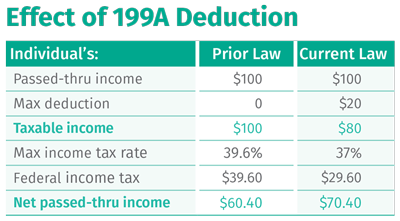
    Because of the 20% 199A deduction, REIT income is not taxed at one's marginal rate.
    image
    CCH, Section 199A Qualified Business Deduction
    IRS, Qualified Business Deduction
    The effective rate on REITs is somewhat more than that of qualified divs, even after the 20% discount. There's a still big difference between the tax rate for REITs and for qualified divs for people in the 12% bracket and for high earners. The sweet point, where the rate difference is not so significant, is in the 22%-24% brackets.
    12% bracket: 0% qualified div vs. 9.6% REIT (12% x 80%)
    22%-24% bracket: 15% vs. 17.6% - 19.2%
    32%+ bracket: 15% (or 20%) vs. 25.6%+
    I haven't included the 3.8% Medicare surtax on higher incomes. It wouldn't change the conclusions.
  • Let's gamble, says IBKR
    Gotta keep customers 'engaged' on their platform, right? What's next? In-meeting parlays on FOMC days? Do prospective customers get a promo code and covered up to their first $1000 of bets if they sign up during Jerome's press conference? The possibilities are endless!
    (nb: these are not to be confused with binary equity options that are traded at NADEX, mind you...)
    Per WSJ: https://www.wsj.com/finance/want-to-bet-on-the-cpi-or-jobs-report-a-prediction-market-is-coming-to-this-brokerage-8a174b52?mod=hp_lead_pos6
    The trading platform Interactive Brokers Group is launching contracts that allow customers to wager on future events related to the economy and climate.
    The contracts let users take yes-or-no positions on questions such as whether the consumer-price index will rise above a certain number or if the global temperature will reach a specific level.
    Interactive Brokers’ prediction market, ForecastEx, is set to begin operating July 8, the company said. ForecastEx recently received the necessary approvals from the Commodity Futures Trading Commission to operate. The contracts are a new type of derivative and aren’t securities.
    The contracts that will be available at launch include economic and climate indicators such as the Federal Reserve’s target interest rate, U.S. consumer sentiment, national debt, retail sales and atmospheric carbon dioxide. Interactive Brokers plans to expand to indicators around the world and other topics in the future.
    < - >
    Customers will be able to buy “yes” contracts or “no” contracts based on a stated outcome for an indicator. Contract prices range from 2 cents to 99 cents and fluctuate depending on what users are willing to pay for that outcome.
    When the event concludes—for example, the moment the CPI report is released—the correct contract is worth $1 and the incorrect contract is worth nothing.

    < - >
  • Boaz Weinstein Interview on Bloomberg 6/25/24
    I thought this was pretty interesting. Some unkind words for Blackrock.
    Weinstein’s ETF (CEFS) benefits from his activism on behalf of his shareholders. The fund has done very well, although M* has recently trashed it with a Negative Medalist rating, citing among other things excessive fees. I have no opinion here. Just trying to provide a bit of balance to Weinstein’s comments.
  • Buy Sell Why: ad infinitum.
    @BaluBalu
    I provided as much detail as I ever have/intend to provide online about our portfolio at this thread:
    https://www.mutualfundobserver.com/discuss/discussion/comment/177280/#Comment_177280
    Here's an update to our Market Portfolio (MP) after our last two rounds of exchanges last Friday and today:
    The MP is (now 11 OEFs with sale of NEAGX today):
    Stocks/Bonds/Cash: 74/6/20
    Domestic/Foreign: 90/10
    Technology Allocation: 32
    MAG 7 Allocation: 25
    LC/MC/SC: 77/20/3
    V/B/G: 16/33/51
    Suggest taking a look at my post on the linked thread and with a little massaging of the data there and here you should be able to ballpark the answer to your question.
    I kindly ask that any follow up comments or questions about our two ports be done via PM. Thx.
    Thank you very much. Sorry for the trouble. I was only looking for the 74/6/20 info but appreciate the additional detail you included.